
Younet
Rate this Tool
Average Score
Total Votes
Select your score (1-10):
Detail Information
What
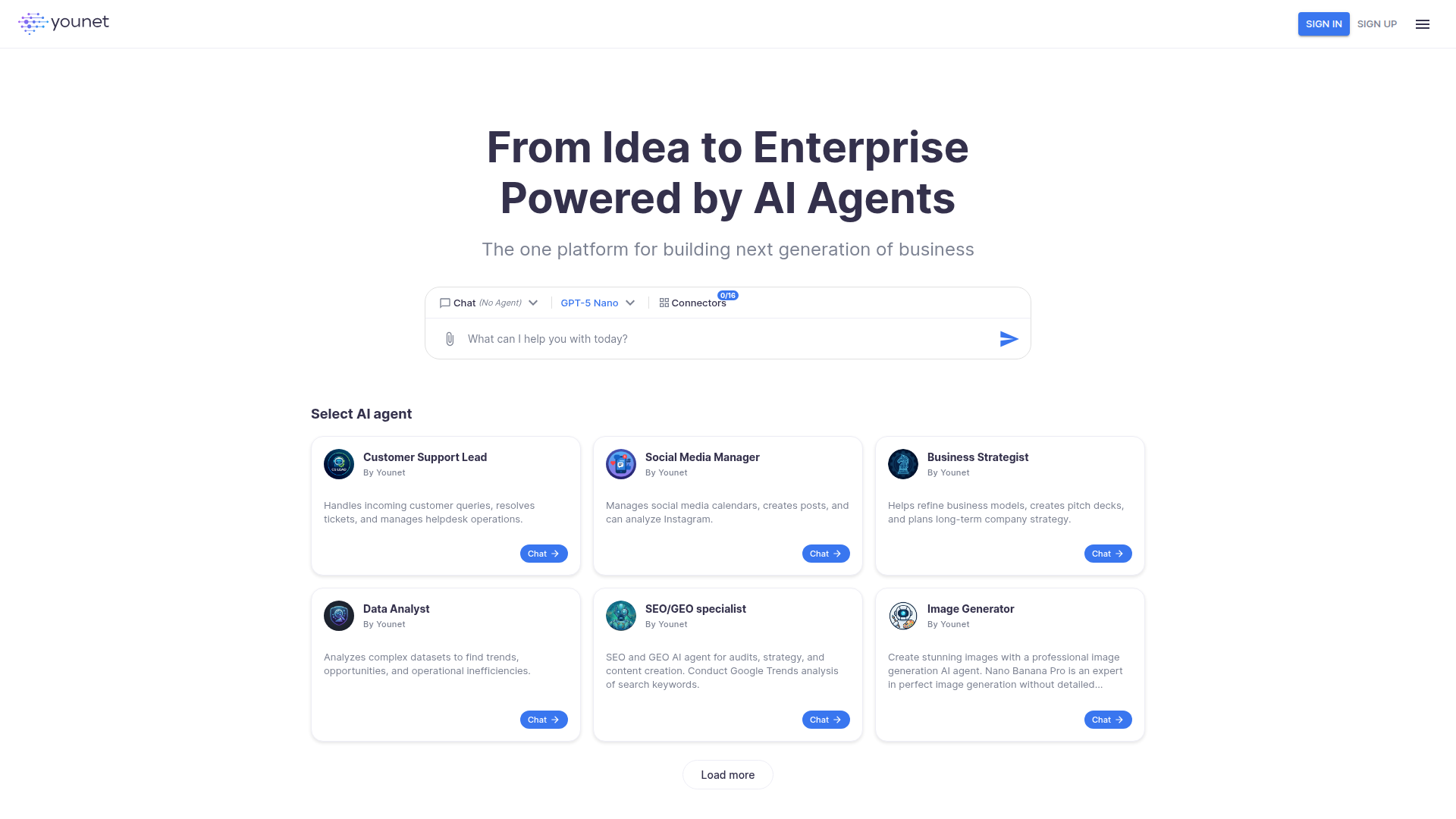
Younet is an AI agent platform positioned as a system for building business workflows around specialized agents. Based on the page content, it combines a chat interface, selectable agent roles, model selection, and connectors within a single product experience.
The product appears to serve businesses that want to move from idea-stage experimentation to broader operational use of AI agents. Its core workflow centers on choosing a prebuilt agent or creating a custom one, then using chat to perform role-specific tasks such as customer support, social media management, business strategy, data analysis, SEO/GEO work, and image generation.
Features
- Prebuilt business agents — The platform offers ready-made agents for functions like customer support, social media, strategy, analytics, SEO/GEO, and image generation, which can speed up initial deployment.
- Custom agent creation — Users can create their own agents, which is useful for tailoring workflows to company-specific processes or domain needs.
- Chat-based interaction — A central chat interface provides a simple operational layer for working with agents without requiring a complex UI for each use case.
- Task-specific agent descriptions — Each listed agent includes a defined responsibility set, helping teams match an agent to a business function more quickly.
- Model selection — The interface references a model choice such as GPT-5 Nano, suggesting users can run agents on a selected underlying AI model.
- Connector framework — The page shows a connectors component, indicating the platform is designed with external system connectivity in mind, though the available integrations are not specified on this page.
Helpful Tips
- Validate role depth before rollout — The landing page shows broad agent categories, so teams should confirm how much workflow automation, memory, and system access each agent actually has in practice.
- Start with a narrow business process — Products like this are usually easiest to evaluate by assigning one bounded workflow, such as helpdesk triage or SEO audit drafting, before expanding to multiple departments.
- Review connector requirements early — Since the page references connectors but does not name them, buyers should verify which systems are supported and whether setup requires technical resources.
- Assess governance for custom agents — If teams plan to create custom agents, they should check how prompts, permissions, outputs, and versioning are managed.
- Separate chat utility from operational automation — A chat interface can be valuable on its own, but organizations should distinguish between assisted task execution and fully integrated business process automation.
OpenClaw Skills
Younet could likely fit well into the OpenClaw ecosystem as an orchestration layer for role-based AI work. OpenClaw skills could be built to route requests to the right Younet agent, structure prompts for specific business outcomes, and normalize outputs into reusable formats such as support summaries, campaign briefs, strategy memos, or SEO recommendations. This is a likely workflow pattern rather than a confirmed native integration, since the page does not document API details or direct compatibility.
A practical OpenClaw use case would be a multi-agent business operations workflow: one skill classifies incoming requests, another selects a Younet agent such as Customer Support Lead or Data Analyst, and another post-processes the result into downstream actions like ticket notes, dashboard updates, or content plans. In industries with lean teams, that combination could shift work from manual coordination toward agent-supervised execution, especially in marketing, support, and internal planning functions.
Embed Code
Share this AI tool on your website or blog by copying and pasting the code below. The embedded widget will automatically update with the latest information.
<iframe src="https://www.aimyflow.com/ai/younet-ai/embed" width="100%" height="400" frameborder="0"></iframe>