
AI Voice Cloning Free - Best Voice Cloning Technology | Higgs Audio
Rate this Tool
Average Score
Total Votes
Select your score (1-10):
Detail Information
What
Higgs Audio offers a web-based AI voice cloning tool inside its AI Voice Generator product area. Based on the page content, it is aimed at creators, researchers, producers, and product teams that want to generate speech in a reference voice from a short audio sample and typed text.
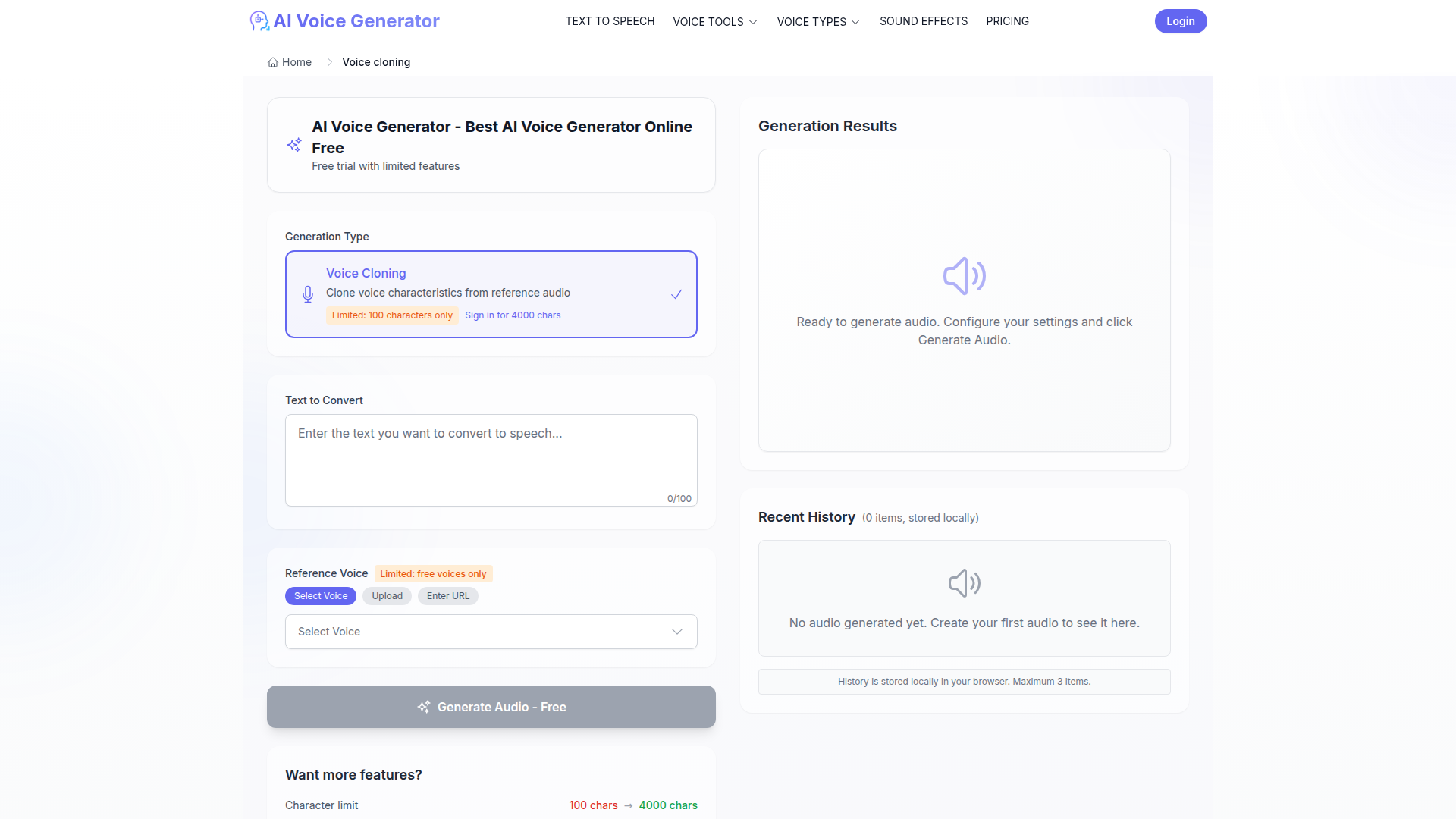
The core workflow is simple: enter text, provide a reference voice by selecting, uploading, or linking audio, then generate and download the output. The page positions the product as a fast, accessible voice cloning option with a free tier and expanded features for signed-in users, though some claims on quality and speed are presented as marketing statements rather than independently verified evidence.
Features
- Text-to-speech voice cloning workflow: Users enter text and generate spoken audio that reflects characteristics from a reference voice sample.
- Multiple reference voice input methods: The interface supports selecting a voice, uploading audio, or entering a URL, which can simplify different sourcing workflows.
- Free usage tier with gated expansion: The page shows a limited free mode with 100-character generation and a larger 4,000-character allowance after sign-in.
- History stored in browser: Free usage includes local history storage for up to three items, which helps with short-session experimentation without requiring cloud storage.
- Expanded feature set for signed-in users: The comparison table indicates broader voice options, unlimited cloud history, and more multi-speaker support after account access.
- Tutorial-style guided process: The page explains the cloning flow in four steps, which can reduce setup friction for first-time users.
Helpful Tips
- Validate real-world output quality with your own samples: The page makes strong claims about speed and studio-quality results, so teams should test accents, noisy recordings, and longer scripts before relying on it operationally.
- Check usage rights carefully: The page references commercial use in its FAQ area, but the provided content does not fully detail policy terms, consent requirements, or licensing boundaries.
- Assess free-tier limits against your workflow: A 100-character cap and local-only history are suitable for quick trials, but not for serious batch or editorial production.
- Review speaker and dialogue needs early: The page mentions multi-speaker limits in free mode, so teams producing conversations or character-driven content should confirm how dialogue handling works in practice.
- Treat “open source” claims conservatively until documented: The page states an open source framework, but it does not provide repository, model, or deployment details in the supplied content.
OpenClaw Skills
Within the OpenClaw ecosystem, this product could likely support voice-generation skills for script reading, prototype narration, synthetic dialogue creation, and branded audio experimentation. A likely workflow would pair an OpenClaw agent that drafts or transforms text with Higgs Audio for final speech rendering, creating a pipeline for podcast drafts, explainer audio, support prompts, or training simulations.
A more advanced likely use case is an OpenClaw agent that manages multi-step voice production: collecting approved scripts, checking character limits, selecting reference samples, generating variants, and routing outputs into content libraries or review queues. If connected this way, the combination could help media teams, learning designers, and product teams move from text-first workflows to voice-first publishing more efficiently, although the page does not confirm any native OpenClaw integration or API specifics.
Embed Code
Share this AI tool on your website or blog by copying and pasting the code below. The embedded widget will automatically update with the latest information.
<iframe src="https://www.aimyflow.com/ai/aivoicegen-net-voice-cloning/embed" width="100%" height="400" frameborder="0"></iframe>