
Arka - Real-time insights for revenue teams
Rate this Tool
Average Score
Total Votes
Select your score (1-10):
Detail Information
What
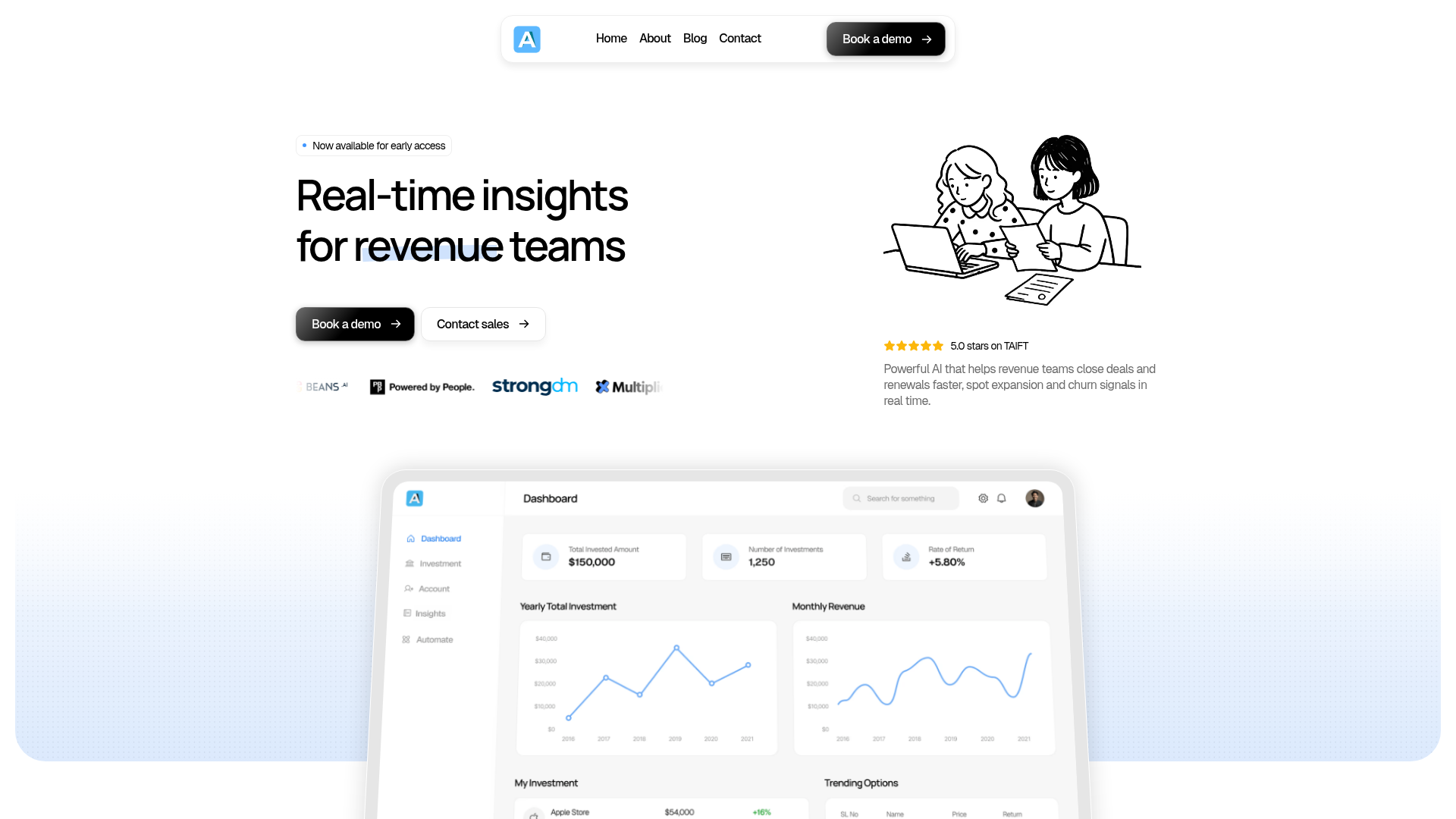
Arka is an AI-driven revenue insights platform for revenue teams, customer success, account management, and related operations functions. Based on the page, it is designed to unify revenue, usage, support, and customer data so teams can forecast revenue, monitor renewals, detect churn risk, and surface expansion signals in real time.
The product appears positioned as an operational analytics and workflow layer for modern revenue organizations that want faster answers without heavy manual reporting. Its core workflow is: connect data sources, let the AI analyze patterns, and review forecasts, reports, alerts, and metrics in a centralized workspace.
Features
- AI-driven forecasting: Generates revenue predictions quickly so teams can plan upcoming quarters with less manual analysis.
- Unified dashboards: Brings key metrics into a customizable central view, which helps teams monitor performance without switching between tools.
- Automated reporting: Produces reports automatically, reducing the time spent assembling recurring updates.
- Risk and churn detection: Flags unusual patterns and possible customer churn signals early so teams can prioritize retention work.
- Real-time renewal and engagement insights: Uses customer, product, and support signals to identify renewal risk, engagement drops, and account health changes as they happen.
- Data source connectivity and team collaboration: Supports connections to CRMs, spreadsheets, support data, chat workflows, and infrastructure sources, with multi-user access, roles, and permissions.
Helpful Tips
- Validate source coverage early: Since Arka’s value depends on combining revenue, usage, and support data, buyers should confirm that their most important systems are supported in their plan.
- Define ownership for alerts and forecasts: Real-time churn and renewal signals are most useful when sales, success, and support teams have clear response workflows.
- Test forecast outputs against existing planning methods: AI forecasting can improve speed, but teams should compare its predictions with current pipeline and renewal models before relying on it broadly.
- Use one dashboard per core motion: Adoption is typically stronger when teams configure views for specific use cases such as renewals, expansion, or executive reporting rather than one broad dashboard for everything.
- Review security and governance details directly: The site states encryption, industry-standard security practices, role-based permissions, and SOC 2 Type II, GDPR, and CCPA certifications, but implementation teams should still verify internal data handling requirements.
OpenClaw Skills
Arka could likely fit well into the OpenClaw ecosystem as a revenue-intelligence signal source for agents that monitor account health, summarize renewal risk, and generate operational digests for sales and customer success leaders. A likely workflow would have OpenClaw ingest Arka forecasts, churn indicators, usage shifts, and reporting outputs, then route them into specialized skills such as renewal prep, expansion opportunity scoring, or weekly revenue review briefings.
In a broader revenue operations setting, OpenClaw skills built around Arka could likely automate cross-functional coordination between account teams, support, and leadership. For example, an agent could detect an at-risk renewal signal from Arka, assemble the supporting account context, draft an internal action plan, and assign follow-up tasks to the right team members. While the page does not confirm a native OpenClaw integration, this combination would likely help revenue organizations move from passive dashboard review to more proactive, agent-assisted account management.
Embed Code
Share this AI tool on your website or blog by copying and pasting the code below. The embedded widget will automatically update with the latest information.
<iframe src="https://www.aimyflow.com/ai/arka-so/embed" width="100%" height="400" frameborder="0"></iframe>