
AI Clinical Documentation for Therapists | AutoNotes
Rate this Tool
Average Score
Total Votes
Select your score (1-10):
Detail Information
What
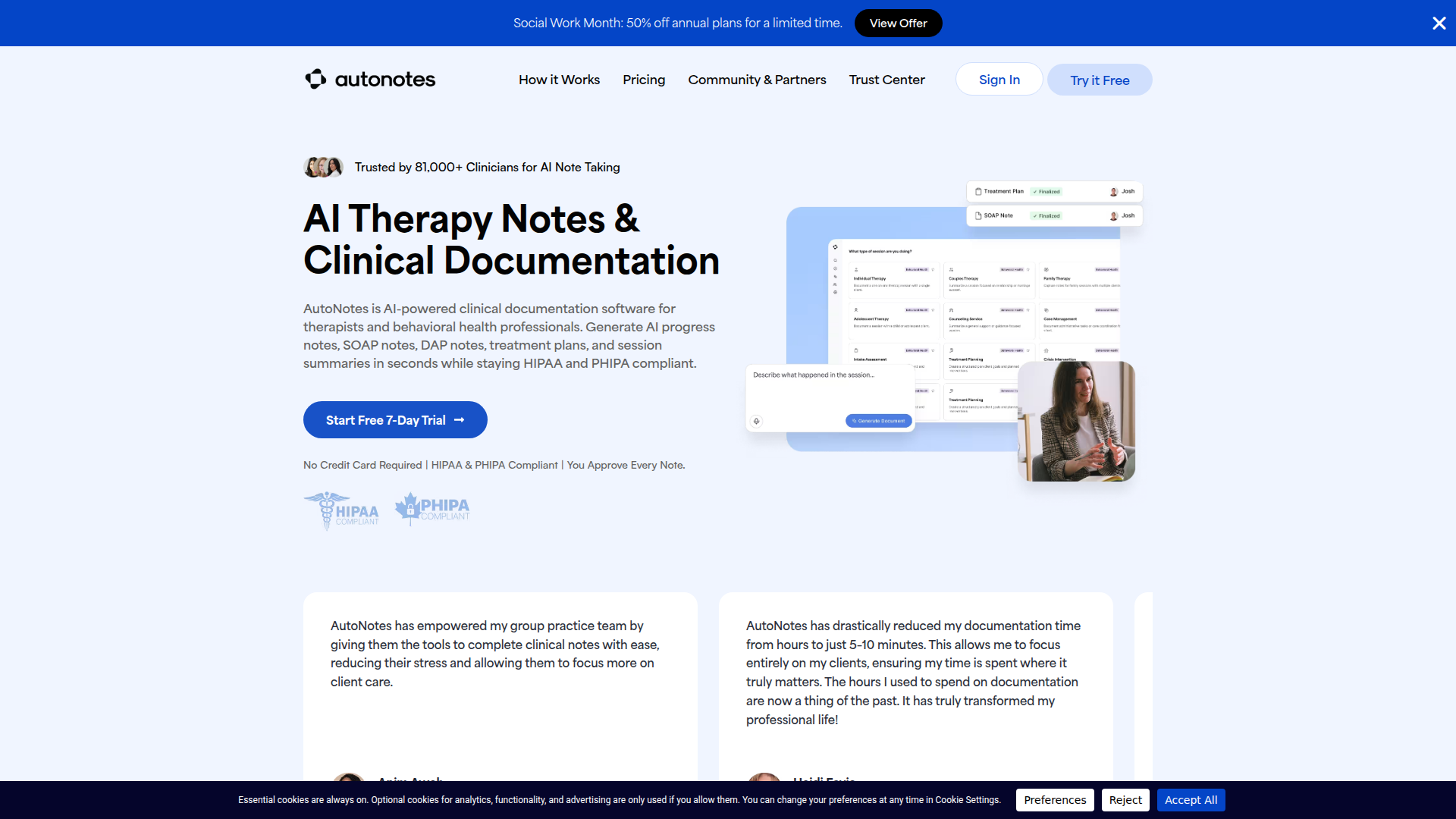
AutoNotes is AI-powered clinical documentation software for therapists and behavioral health professionals. It is designed to turn written summaries, voice dictation, uploaded audio, and recorded sessions into structured therapy documentation such as progress notes, SOAP notes, DAP notes, treatment plans, and session summaries.
The product appears positioned as a workflow tool for individual clinicians, group practices, and larger behavioral health organizations that want faster documentation with clinician oversight. Its core workflow centers on capturing session information in a natural format, generating editable clinical notes quickly, and maintaining continuity across notes and treatment plans while supporting HIPAA and PHIPA compliance.
Features
- AI-generated therapy documentation: Creates progress notes, SOAP, DAP, BIRP, EMDR, intake assessments, discharge summaries, and other clinical formats to reduce manual documentation work.
- Flexible input methods: Lets clinicians type reflections, dictate notes, upload summaries or audio, and in some plans record live sessions, making it easier to document in a preferred workflow.
- Treatment plan generation: Produces individualized treatment plans from progress notes, aligned to diagnosis, goals, and client needs for more consistent care planning.
- Note-to-note continuity: Carries forward treatment goals and prior progress so new notes reflect ongoing clinical context rather than isolated sessions.
- Customizable templates: Supports standard and custom note templates so practices can adapt documentation to modality, specialty, or internal standards.
- Data control and secure storage: Includes encrypted data handling, secure note storage, and options to delete recordings manually or automatically after note generation.
Helpful Tips
- Validate note quality against your documentation standards: Before broad rollout, compare generated notes with your clinical, supervisory, and payer requirements to confirm they fit your setting.
- Use template customization early: Custom templates are likely important for improving consistency across clinicians, especially for specialty workflows such as EMDR, couples, or group therapy.
- Set recording retention policies in advance: Since the platform supports recording storage and deletion controls, practices should define clear policies for handling recordings before adoption.
- Treat AI output as draft documentation: The site states that users approve every note, so clinician review should remain a required part of the workflow.
- Check plan fit by practice complexity: Solo clinicians may only need note generation and dictation, while multi-clinician organizations may benefit more from team management, workflow controls, and analytics.
OpenClaw Skills
AutoNotes could likely work well within the OpenClaw ecosystem as a documentation-centered agent workflow for behavioral health operations. Likely OpenClaw skills could include session-to-note orchestration, treatment-plan drafting review, documentation QA against internal standards, and follow-up task extraction from completed notes. If connected through approved workflows rather than a confirmed native integration, OpenClaw agents could help route draft notes, flag missing elements, and organize documentation queues for clinicians or supervisors.
For therapy practices, community mental health teams, and behavioral health groups, this combination could shift documentation from a standalone clerical task into a managed operational process. A likely use case would be OpenClaw agents monitoring note completion status, categorizing cases by documentation type, and preparing supervisor review packets while AutoNotes handles core note generation. In larger organizations, that could support more standardized documentation workflows without removing clinician control over the final record.
Embed Code
Share this AI tool on your website or blog by copying and pasting the code below. The embedded widget will automatically update with the latest information.
<iframe src="https://www.aimyflow.com/ai/autonotes-ai/embed" width="100%" height="400" frameborder="0"></iframe>