
Black Forest Labs - Frontier AI Lab
Rate this Tool
Average Score
Total Votes
Select your score (1-10):
Detail Information
What
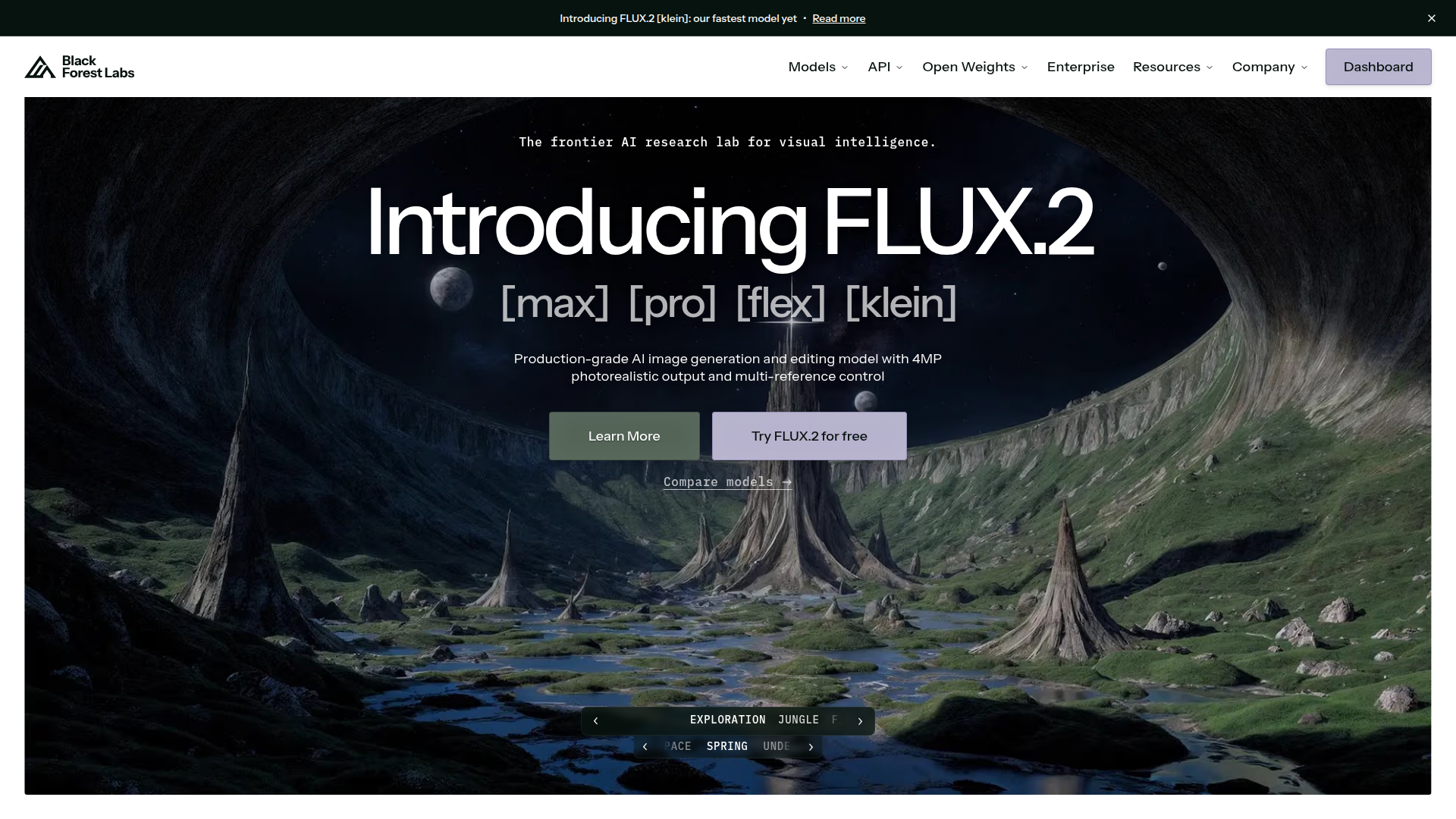
Black Forest Labs is an AI research lab focused on visual intelligence, with the FLUX.2 family as its core product line for image generation and editing. The site presents FLUX.2 as a production-oriented model suite that supports photorealistic image output, image transformation workflows, and multi-reference control, with access options across API, open weights, enterprise licensing, and a browser-based playground.
The product appears to serve developers, creative teams, and organizations that need flexible ways to generate, edit, customize, and deploy visual AI models. Its positioning is likely split between fast experimentation and production deployment: users can test prompts in a no-code environment, integrate models through an API, or run and fine-tune models on their own infrastructure when they need more control.
Features
- Production-grade image generation and editing — FLUX.2 is described as supporting both image creation and editing, making it suitable for workflows that start from text prompts or existing images.
- 4MP photorealistic output — The platform highlights high-resolution, photorealistic image generation, which is useful for professional creative and product-visual workflows.
- Multi-reference control — Prompt examples show the ability to combine multiple image references for style, object replacement, pose matching, and brand-pattern consistency.
- Fast inference with FLUX.2 [klein] — The [klein] model family is presented as the fastest option, with sub-second inference on capable hardware for rapid iteration.
- Flexible deployment options — Users can work through a web playground, integrate via API, or deploy open-weight models on their own infrastructure depending on their operational needs.
- Fine-tuning and customization potential — The open-weights offering emphasizes model customization and fine-tuning, which can matter for teams building domain-specific visual pipelines.
Helpful Tips
- Match the model tier to the workflow — Faster variants such as FLUX.2 [klein] are likely better for high-iteration use cases, while other FLUX.2 options may be more appropriate when image fidelity or control matters more than speed.
- Validate multi-reference performance on real brand assets — If consistent logos, product details, or style transfer are important, test with representative source images because the page shows examples but does not fully define operational limits.
- Use the playground before infrastructure planning — A browser-based testing environment can help teams refine prompt structure and editing patterns before committing to API integration or self-hosted deployment.
- Treat self-hosting as a customization path, not just a hosting choice — Open weights are most valuable when a team has a clear reason to control deployment, fine-tune models, or adapt outputs for a specific domain.
- Review licensing and policy terms early — The site lists multiple licensing and service terms, so buyers should confirm usage rights and deployment conditions before productizing outputs.
OpenClaw Skills
Within the OpenClaw ecosystem, this product could likely support agents focused on visual content generation, asset editing, and structured image production workflows. A likely use case would be an OpenClaw skill that takes a marketing brief, product catalog entry, or campaign concept and turns it into prompt-ready instructions for FLUX.2, then routes outputs through review, revision, and asset tagging steps. Another likely workflow would combine image-reference handling with approval logic for product mockups, ad variants, and branded creative refreshes.
For industries such as ecommerce, design operations, gaming, publishing, and marketing, the combination could shift work from manual creative request handling toward semi-automated visual production pipelines. If OpenClaw agents orchestrate prompt generation, reference selection, quality checks, and deployment triggers around FLUX.2, teams could standardize repeatable image tasks while keeping human review on high-stakes creative decisions. The site does not state a native OpenClaw integration, so this should be understood as a likely orchestration pattern rather than a confirmed built-in capability.
Embed Code
Share this AI tool on your website or blog by copying and pasting the code below. The embedded widget will automatically update with the latest information.
<iframe src="https://www.aimyflow.com/ai/blackforestlabs-ai/embed" width="100%" height="400" frameborder="0"></iframe>