
CAMEL-AI | Finding the Scaling Laws of Agents | CAMEL-AI
Rate this Tool
Average Score
Total Votes
Select your score (1-10):
Detail Information
What
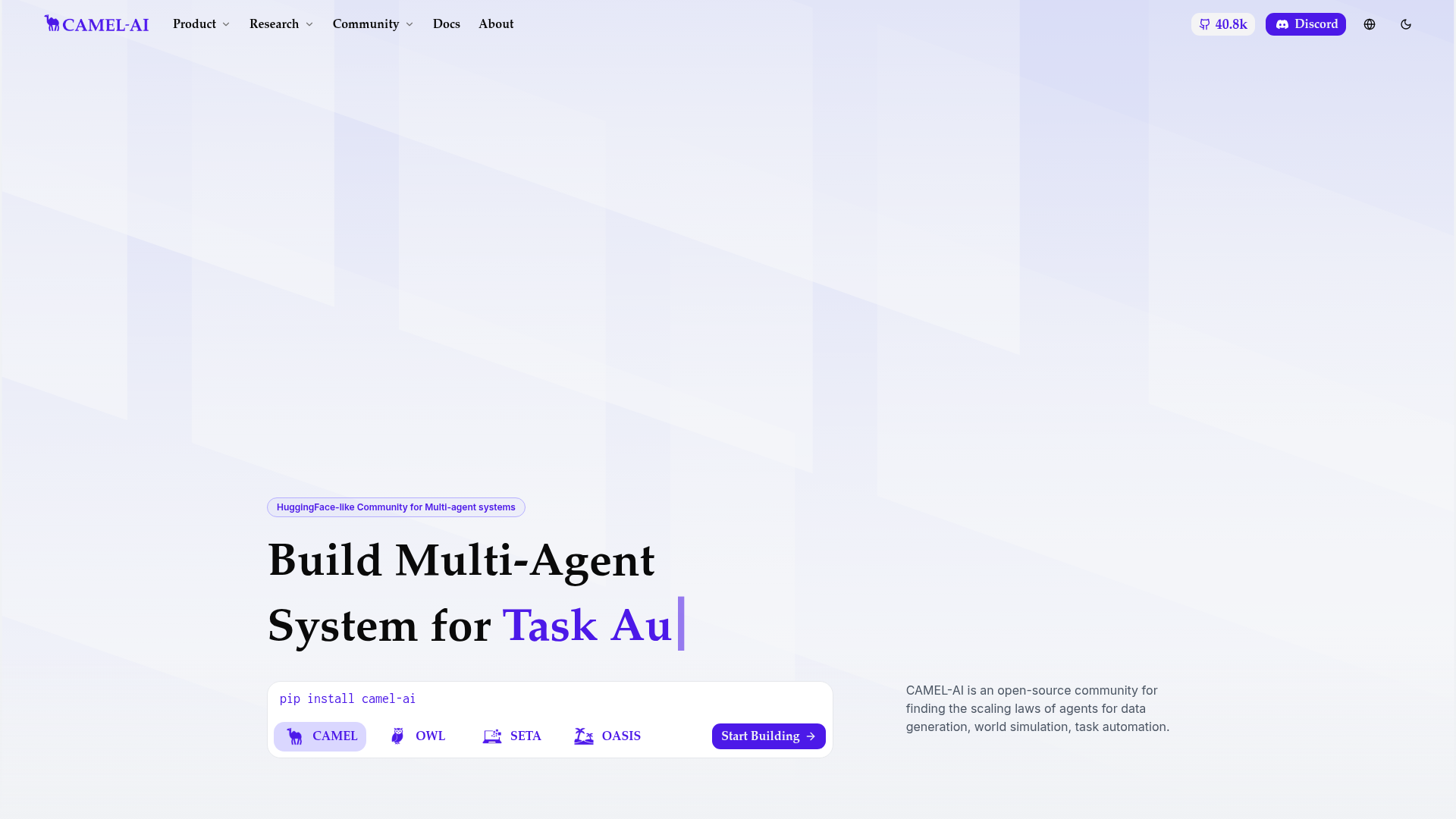
CAMEL-AI is an open-source community and framework focused on building multi-agent systems for data generation, world simulation, and task automation. It appears to serve AI researchers, agent framework developers, and teams experimenting with autonomous or semi-autonomous agent workforces.
The product is positioned as both a research ecosystem and a practical toolkit for creating stateful, scalable agent systems. Its core workflow centers on defining agents, tools, memory, environments, and task structures, then using those components to study agent behavior at scale or build long-horizon automation workflows.
Features
- Multi-agent workforce modeling — Supports role-based agent systems with hierarchies and long-horizon tasks, which helps teams simulate or automate complex work across multiple cooperating agents.
- Batteries-included agent toolkit — Provides components for messaging, planning, evaluation, and observability, reducing the amount of custom infrastructure needed to prototype and inspect agent workflows.
- Stateful architecture — Treats agent context as a state transition process, enabling richer memory handling and more persistent task execution over time.
- Code-as-prompt design — Uses code and comments as interpretable prompts, which can make agent logic easier for both humans and agents to read, modify, and extend.
- Research-to-training loop — Connects interaction logs to reinforcement learning and fine-tuning pipelines, supporting iterative improvement of agent behavior.
- Broad technical surface area — Includes agents, tools, memories, retrievers, interpreters, environments, verifiers, and human-in-the-loop components, making it suitable for both experimentation and application development.
Helpful Tips
- Match it to multi-step workflows — CAMEL-AI is most relevant when the problem involves coordination, delegation, simulation, or long-running task decomposition rather than simple single-turn chat.
- Validate production readiness per component — The site presents a large ecosystem, but buyers and builders should verify which modules are mature enough for their specific use case before standardizing on them.
- Use observability early — In multi-agent systems, failures often come from coordination and memory issues, so evaluation and tracing should be built in from the start.
- Clarify research versus operational goals — CAMEL-AI spans foundational research and practical tooling, so teams should decide whether they are optimizing for experimentation, synthetic data generation, or task automation.
- Plan governance for autonomous behavior — The platform explicitly studies agent capabilities and risks, which suggests that human oversight and policy constraints are important in real-world deployments.
OpenClaw Skills
CAMEL-AI could likely fit well within the OpenClaw ecosystem as an orchestration layer for complex agent skills. Likely use cases include OpenClaw agents that manage research workflows, software tasks, retrieval pipelines, structured planning, or role-based collaboration, with CAMEL-AI handling the underlying multi-agent coordination and stateful execution.
This combination could be especially useful in professions where work is naturally distributed across specialists, such as research, operations, software engineering, and analyst teams. A likely OpenClaw pattern would be to build reusable skills for task planning, evidence gathering, memory-aware execution, and human review, then chain them into workforce-style workflows that behave more like coordinated digital teams than isolated assistants.
Embed Code
Share this AI tool on your website or blog by copying and pasting the code below. The embedded widget will automatically update with the latest information.
<iframe src="https://www.aimyflow.com/ai/camel-ai-org/embed" width="100%" height="400" frameborder="0"></iframe>