
Clarion | Automate phone based workflows with conversational AI
Rate this Tool
Average Score
Total Votes
Select your score (1-10):
Detail Information
What
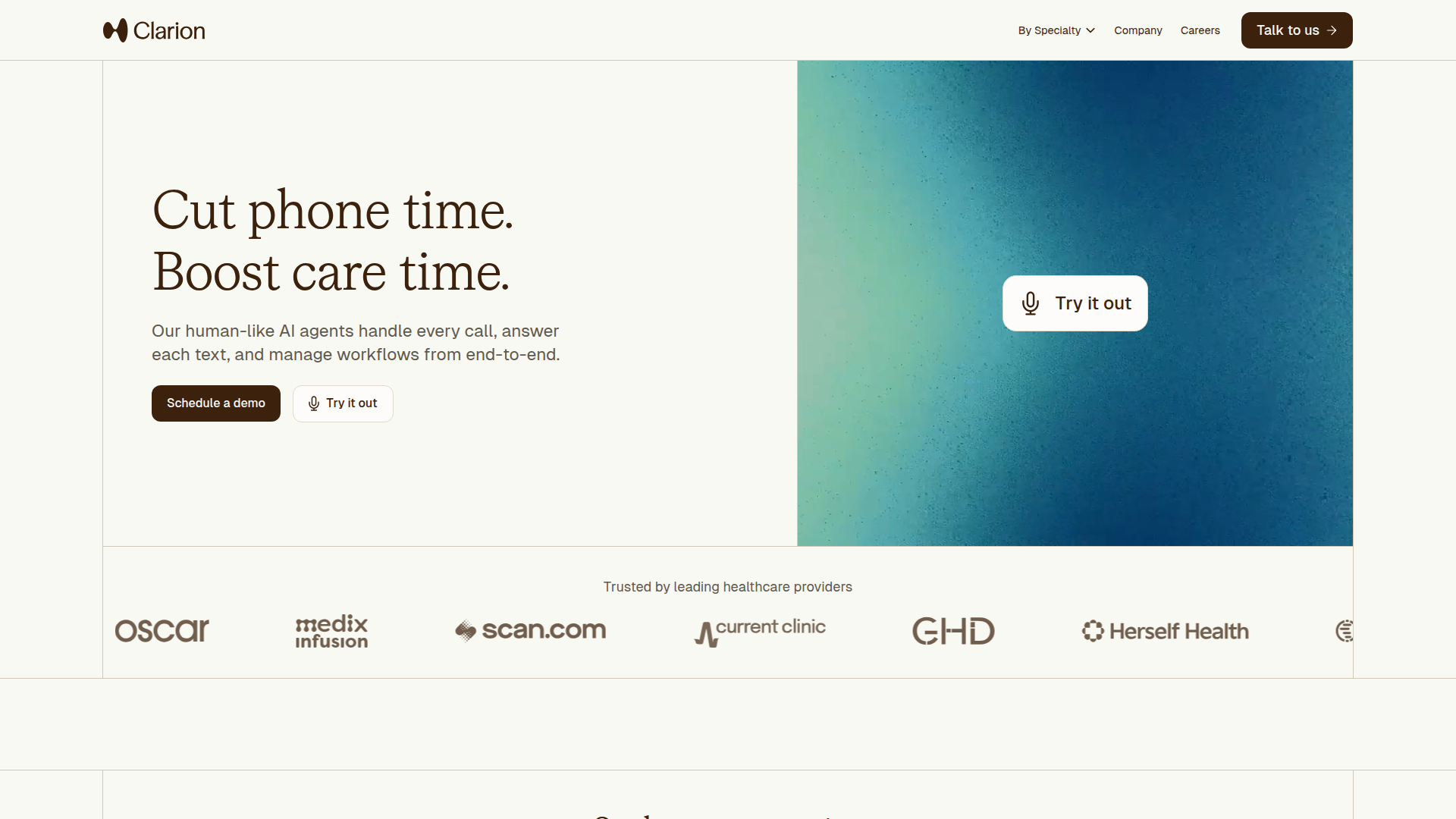
Clarion is a conversational AI platform for healthcare practices that automates phone-based and related patient communication workflows. It is designed for provider organizations such as cardiology, dermatology, gastroenterology, ophthalmology, orthopedics, primary care, value-based care, and women’s health practices.
The product appears positioned as an AI front-office operations layer that handles calls, texts, scheduling, referrals, billing and insurance conversations, and patient support across channels. Its core workflow is to capture inbound demand, resolve routine interactions end-to-end, and escalate complex issues to staff while integrating with existing systems such as EHR and IVR.
Features
- 24/7 call, text, and message handling — Clarion answers patient communications around the clock to reduce missed contacts during hold times or after hours.
- Automated schedule management — It can book, reschedule, and backfill cancellations so front-desk teams spend less time managing calendars manually.
- Referral follow-up and conversion support — The platform reaches out on new referrals, answers questions, and works to turn referrals into scheduled appointments faster.
- Billing and insurance conversations — Clarion handles coverage questions and payments through conversational interactions, reducing repetitive phone work for staff.
- Real-time monitoring dashboards — Live visibility into patient needs, interaction quality, and automation performance supports operational oversight and tuning.
- Seamless escalation to staff — When an issue is too complex to automate, the AI collects key information first and then hands off to the human team.
Helpful Tips
- For healthcare communication automation, verify which workflows are fully automated versus only assisted, especially for billing, insurance, and clinical support edge cases.
- Clarion emphasizes customization by specialty and practice protocols, so implementation success will likely depend on mapping scripts, escalation rules, and patient journey logic carefully.
- If your organization has existing EHR and IVR systems, confirm the depth of those connections and which actions can be executed directly versus triggered as follow-up tasks.
- Use live monitoring and audit capabilities to review interaction quality regularly; conversational systems in patient-facing contexts typically need ongoing iteration rather than one-time setup.
- The site references secure and compliant handling of patient data, but buyers should still validate security architecture, controls, and operational responsibilities during procurement.
OpenClaw Skills
Clarion could fit well within the OpenClaw ecosystem as a healthcare communication orchestration layer around which specialized skills and agents are built. Likely OpenClaw workflows could include referral triage agents, no-show recovery agents, patient intake summarization, escalation-routing skills, and analytics agents that review dashboard trends and recommend workflow changes. The page indicates voice, SMS, and web engagement, which creates useful surfaces for multi-step automation.
A likely OpenClaw use case would be connecting Clarion-driven patient interactions to broader operational agents that classify call reasons, flag staffing bottlenecks, draft follow-up tasks, or generate practice-level workflow insights for operations leaders. If implemented well, that combination could shift front-office teams from repetitive communication handling toward exception management, patient experience oversight, and process improvement rather than constant phone coverage.
Embed Code
Share this AI tool on your website or blog by copying and pasting the code below. The embedded widget will automatically update with the latest information.
<iframe src="https://www.aimyflow.com/ai/clarionhealth-com/embed" width="100%" height="400" frameborder="0"></iframe>