
AI Detector | Draft & Goal
Rate this Tool
Average Score
Total Votes
Select your score (1-10):
Detail Information
What
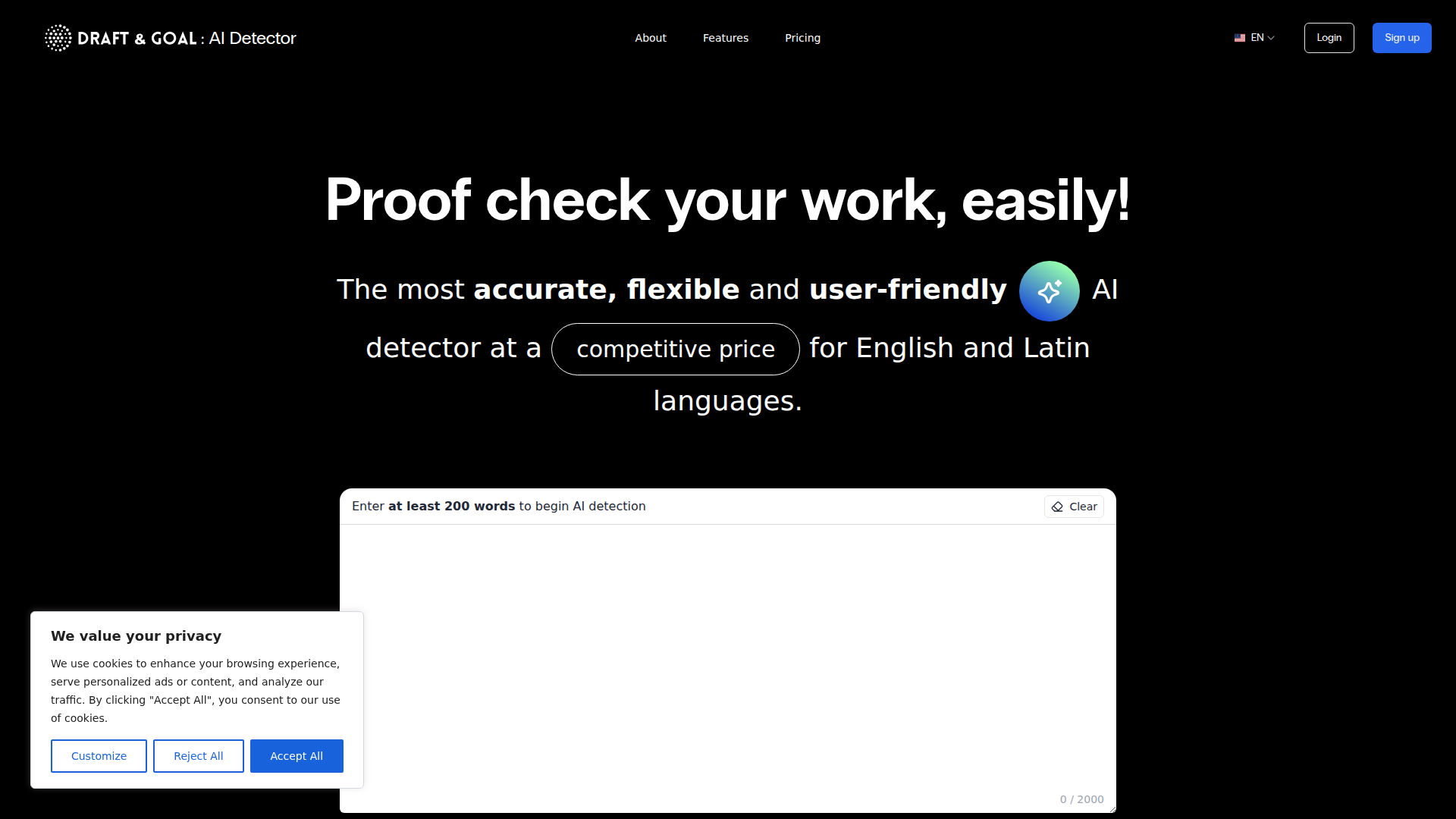
Draft & Goal AI Detector is a web-based text analysis tool for checking whether writing is likely human-written or AI-generated. The page positions it as an accuracy-focused detector for English and Latin languages, with broader language support also mentioned for Spanish, French, Italian, Portuguese, and Romanian.
It appears aimed at students, writers, and publication-oriented users who want to review text before submission or publication. The core workflow is simple: paste in at least 200 words, run a scan, and review a report that highlights where text appears AI-generated and why, with suggestions to reduce AI suspicion.
Features
- AI-generated text detection — Analyzes submitted text and classifies whether it is most likely human-written or AI-generated to support pre-submission review.
- Detailed detection reports — Shows where and why passages appear AI-generated, which helps users understand flagged sections instead of relying on a single score.
- Multi-language support — Supports detection across several languages named on the page, including English, Spanish, French, Italian, Portuguese, and Romanian.
- Model-agnostic analysis — The site says it is compatible with outputs from GPT-4o, Gemini, Claude, Copilot, LLaMA, and others, which is useful for mixed-model content review.
- In-house processing and storage — The page states detections are managed in-house with no external data sharing, and that scans are securely stored.
- Scan history for Pro users — Retains past documents and results for up to one year, which can help with audits, repeat reviews, or revision tracking.
Helpful Tips
- Treat AI detection as a risk signal rather than definitive proof, especially in academic or editorial workflows where false positives can have consequences.
- Test the tool on your own known human-written and AI-assisted samples before wider adoption to understand how its reports behave in your use case.
- Use the detailed report to guide revision workflows, but confirm any flagged sections through human review rather than editing solely to satisfy the detector.
- Check the language-specific performance carefully; the page lists multiple supported languages, but it does not provide methodology or per-language accuracy evidence.
- If long-term scan history matters, verify what is included in Pro access and how document retention aligns with your internal data handling requirements.
OpenClaw Skills
Within the OpenClaw ecosystem, this product could likely support agent workflows for content review, editorial QA, and academic submission screening. A skill could take drafted text, send it through a detection step, extract flagged segments, and generate a structured revision brief for a writer, editor, or reviewer. This is a likely workflow inference, not a confirmed native integration from the page.
OpenClaw agents could also be built around policy-based review pipelines, such as checking student submissions, marketing copy, or external contributor drafts before approval. Combined with reporting and scan history, an organization could likely create repeatable workflows for exception handling, human escalation, and version comparison, which may help education, publishing, and content operations teams standardize how they evaluate AI-assisted writing.
Embed Code
Share this AI tool on your website or blog by copying and pasting the code below. The embedded widget will automatically update with the latest information.
<iframe src="https://www.aimyflow.com/ai/detector-dng-ai/embed" width="100%" height="400" frameborder="0"></iframe>