
Duckie - AI Support Agents
Rate this Tool
Average Score
Total Votes
Select your score (1-10):
Detail Information
What
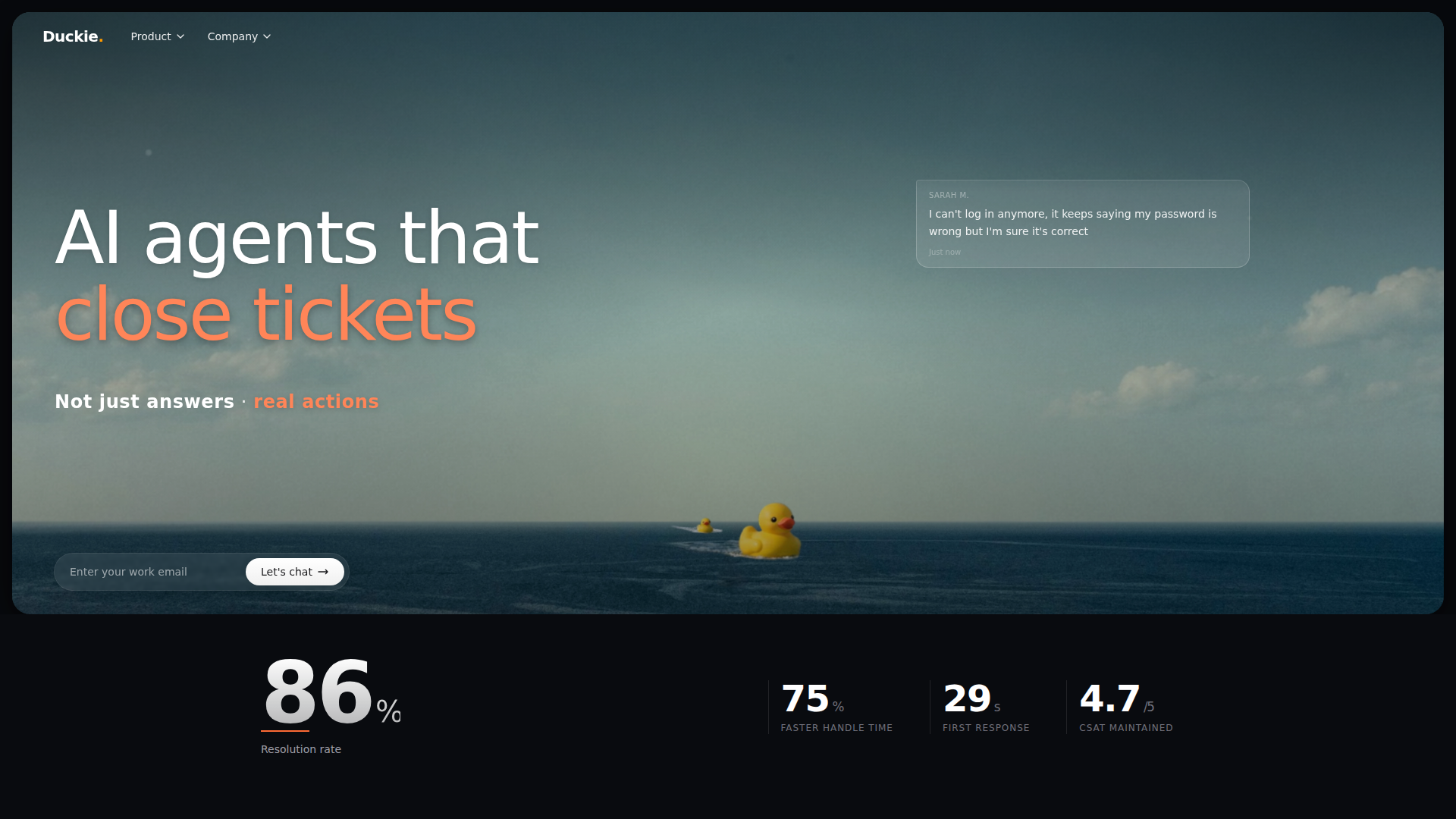
Duckie is an AI support agent platform designed to resolve customer service tickets by taking actions, not only generating responses. Based on the page, it is built for support teams that manage high ticket volume and want automation that can complete operational tasks such as refunds, password resets, invoice sending, order tracking, subscription changes, and account updates.
The workflow shown is: understand the request, verify eligibility and risk, retrieve relevant customer/order data, execute the action, send a response, and log the resolution. Duckie appears positioned as an enterprise-oriented support automation layer with fast deployment, governance controls, and human oversight for higher-stakes decisions.
Features
- Action-taking ticket automation: Duckie executes support operations (for example refunds, resets, and subscription updates), which reduces manual agent workload beyond standard chatbot deflection.
- Structured resolution runbook: The platform displays a step-by-step flow (understand, verify, research, resolve, log), helping teams standardize how common ticket types are handled.
- Rapid go-live process: The site presents a deployment timeline of roughly two weeks (connect, build, train, test, deploy), suggesting a guided implementation model for operations teams.
- Quality and control center: It includes guardrails, audit logs, human review paths, and instant rollback, which supports safer automation and traceability.
- Human-in-the-loop escalation: High-risk or policy-triggered actions can be routed for approval, enabling automation while keeping humans in control of sensitive decisions.
- Omnichannel and multilingual support: Duckie claims a unified inbox across 35+ integrations and real-time support in 40+ languages with context preserved across conversations.
Helpful Tips
- Start with narrow, high-volume workflows: Prioritize repeatable ticket types (refund eligibility, password resets, order status) before expanding to edge-case-heavy processes.
- Define approval thresholds early: Set clear limits for actions like refund amounts, cancellation handling, and fraud/risk triggers to avoid over-automation.
- Treat audit logs as operational data: Use action logs and reviewed-ticket patterns to refine runbooks, improve policy quality, and identify failure modes.
- Validate channel and system fit during pilot: The page lists several systems (for example Zendesk, Intercom, Slack, Notion, Jira), but teams should confirm required data sources and workflows in their own environment.
- Pressure-test multilingual quality: Even with 40+ language support claimed, test language-specific policy nuance and tone consistency before broad rollout.
OpenClaw Skills
Within an OpenClaw ecosystem, Duckie could likely serve as an execution engine for support operations while OpenClaw agents orchestrate policy logic, exception handling, and cross-team workflows. A practical skill pattern would be: classify incoming issue type, check customer/account context, enforce business rules, trigger Duckie action paths, and route out-of-policy cases to finance, risk, or CX leads.
A likely use case (inferred, not confirmed as a native integration) is building OpenClaw “Support Ops Supervisor” agents that monitor Duckie’s audit stream, detect drift in automation outcomes, and recommend runbook updates. For ecommerce, SaaS, and subscription businesses, this combination could shift support teams from mostly reactive ticket handling to operational governance, quality tuning, and proactive service design.
Embed Code
Share this AI tool on your website or blog by copying and pasting the code below. The embedded widget will automatically update with the latest information.
<iframe src="https://www.aimyflow.com/ai/duckie-ai/embed" width="100%" height="400" frameborder="0"></iframe>