
Empirical Health | Don't die of heart disease | Empirical Health
Rate this Tool
Average Score
Total Votes
Select your score (1-10):
Detail Information
What
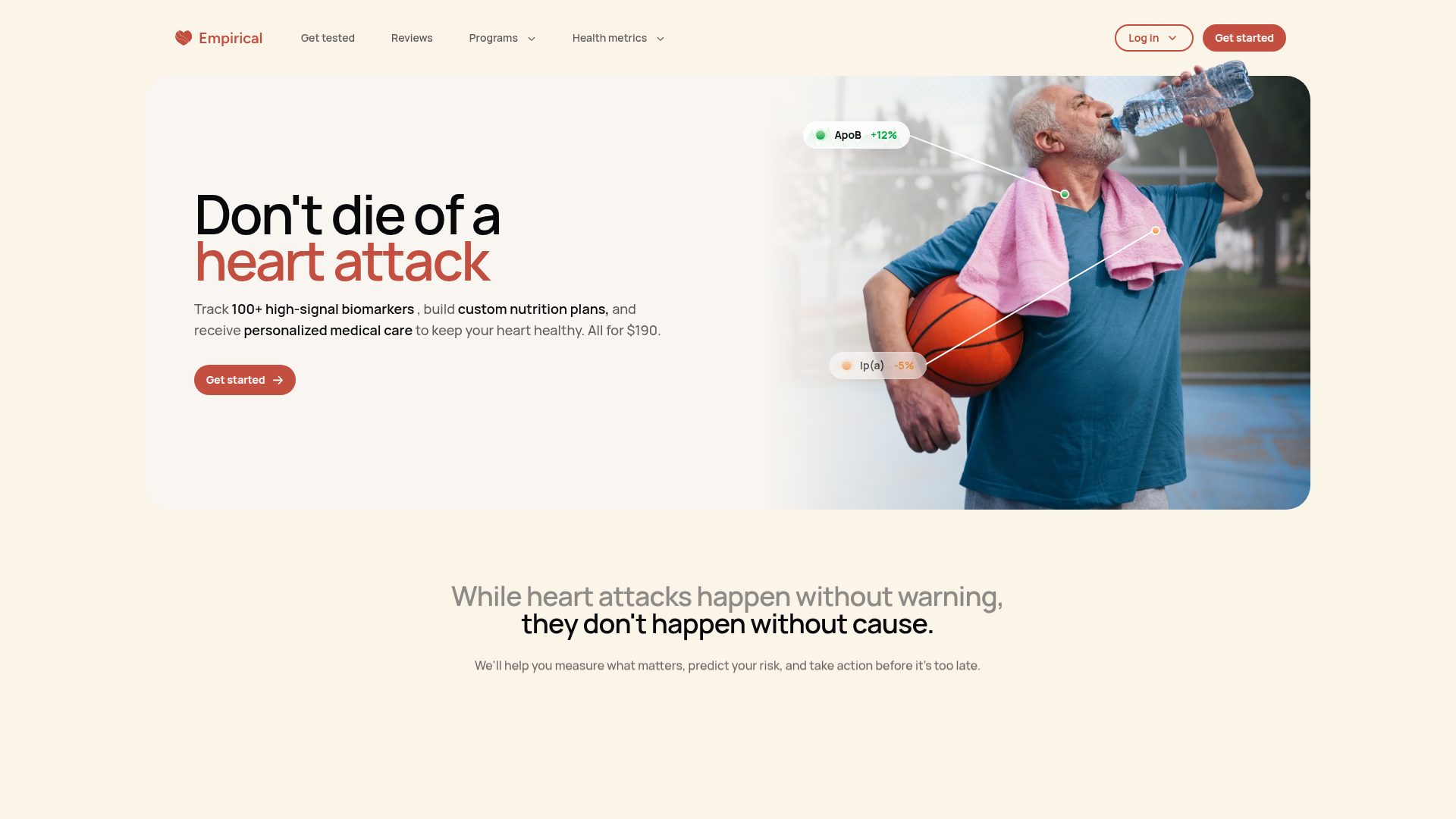
Empirical Health is a heart health program that combines lab testing, risk tracking, and doctor-guided care in a mobile and web-based experience. It is aimed at people who want to measure cardiovascular risk factors, understand how those markers relate to future heart disease risk, and receive a more tailored plan for prevention.
The core workflow is straightforward: users purchase a program, complete lab work at one of the listed testing sites, review 100+ biomarkers, and use the app to monitor heart-risk scores and related health metrics. Based on the page, Empirical appears positioned as a consumer-facing preventive health offering focused on cardiovascular screening, personalized planning, and ongoing tracking rather than emergency or acute care.
Features
- 100+ biomarker lab panel: A single lab visit covers cardiovascular, metabolic, liver, kidney, nutrient, blood, urine, and related markers to provide a broad baseline for heart health assessment.
- Large testing-site network: Access to 2,200 testing sites makes in-person sample collection more practical for distributed users.
- Heart risk prediction tools: The app shows 10-year and lifetime heart attack risk and appears to let users model how lifestyle changes may affect those outcomes.
- Doctor review and care planning: The page states that users can have a video visit with a board-certified doctor to review results and create treatment, nutrition, and exercise plans.
- In-app doctor messaging: Users can message their doctor about their treatment plan, which supports follow-up questions and ongoing adjustment.
- Nutrition and exercise tracking support: The product includes custom nutrition planning, food-photo tracking, and personalized exercise routine planning tied to individual needs and risk levels.
Helpful Tips
- Verify plan scope before purchase: The page mentions both a standard and an advanced plan, and it suggests doctor consultation may depend on plan level, so buyers should confirm exactly what is included.
- Assess whether the biomarker breadth matches your goals: This kind of product is most useful when users want longitudinal tracking and interpretation, not just a one-time lab snapshot.
- Use clinical guidance for actionability: A large panel is valuable only if results are translated into specific treatment, diet, and activity changes, so the physician review component likely matters.
- Check testing-site convenience and follow-up workflow: For adoption, practical details such as local lab access, app usability, and how often plans are updated can affect sustained use.
- Treat risk scores as decision support, not certainty: Predictive tools can help prioritize prevention, but they should be used alongside clinician judgment and personal medical history.
OpenClaw Skills
Empirical Health could likely work well with OpenClaw as a preventive-care intelligence layer around biomarker interpretation and follow-through. Likely workflow ideas include an agent that summarizes lab trends over time, a cardiovascular-risk explainer that converts biomarker changes into plain-English insights, and a care-plan coordinator that turns doctor recommendations into structured weekly tasks for nutrition, exercise, and re-testing. The page does not describe a native OpenClaw integration, so these should be treated as plausible ecosystem use cases rather than confirmed product features.
In a broader healthcare or health-coaching context, OpenClaw skills built around Empirical could help clinicians, care navigators, or self-directed patients maintain continuity between testing, interpretation, and behavior change. A likely use case is an agent that flags changes in ApoB, Lp(a), cholesterol ratios, or inflammation markers and then generates a monitoring brief, adherence reminders, and question lists for the next doctor visit. Combined thoughtfully, that kind of workflow could make preventive cardiology more operational and less episodic for consumers and clinical teams.
Embed Code
Share this AI tool on your website or blog by copying and pasting the code below. The embedded widget will automatically update with the latest information.
<iframe src="https://www.aimyflow.com/ai/empirical-health/embed" width="100%" height="400" frameborder="0"></iframe>