
Epsilon - AI Search Engine for Scientific Research
Rate this Tool
Average Score
Total Votes
Select your score (1-10):
Detail Information
What
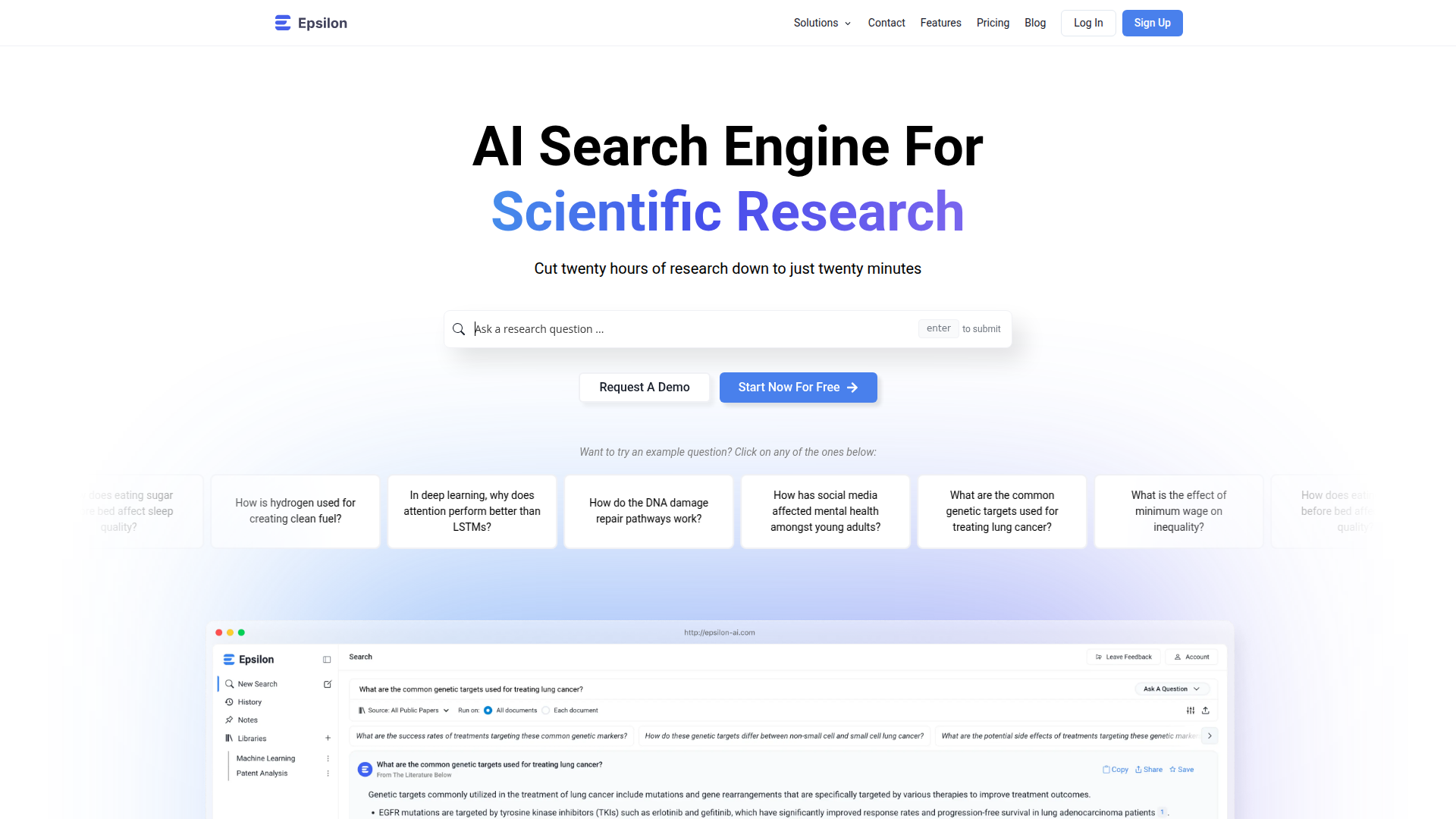
Epsilon is an AI search engine for scientific research that helps researchers find evidence, publications, patents, and summaries across a large academic corpus. It is designed for people doing literature reviews, citation gathering, proposal development, meta-analysis support, patentability-related research, and topic exploration.
The core workflow is question-based research: a user asks a research question, Epsilon searches a dataset of more than 200 million papers, identifies relevant documents, and generates a summarized answer with inline citations. It also supports publication and patent search, extraction of information across multiple papers, and organization of uploaded papers into searchable libraries, positioning it as a research productivity tool for academic and professional knowledge work.
Features
- Question answering with inline citations: Users can ask a research question and receive a synthesized answer that references underlying source passages, which helps with traceability and evidence review.
- Large-scale paper discovery: Epsilon searches a dataset from Semantic Scholar covering over 200 million academic papers, improving breadth for scientific topic exploration.
- Publication and patent search: The platform can surface both papers and patents, then group results into latest research, key texts, and most relevant articles to speed up source triage.
- Multi-paper information extraction: Users can enter a question or claim and have Epsilon scan top search results to pull relevant information from each document, which is useful for citation finding and structured evidence checks.
- Paper upload and library search: Uploaded papers can be summarized by introduction, results, and conclusion, then saved into libraries that users can search across later for synthesis work.
- Research organization support: Libraries and saved papers help teams or individuals organize trusted materials for ongoing projects, onboarding, and repeated topic analysis.
Helpful Tips
- Verify summary outputs against cited passages: Inline citations improve transparency, but researchers should still inspect the referenced text before relying on conclusions in formal work.
- Use it first for narrowing, then for close reading: Tools like this are most effective for reducing search and screening time before deeper evaluation of methodology and evidence quality.
- Test it on a defined research question: Adoption is easier when teams begin with a bounded use case such as citation gathering, early literature review, or claim validation.
- Check data handling requirements internally: The site states that search queries are sent to third-party providers such as OpenAI, so organizations should review whether that fits their research privacy expectations.
- Clarify patent workflow needs before buying: The page mentions patent search and an organization plan with patent analysis, but it does not fully describe depth of patent-specific review features, so buyers should confirm those details.
OpenClaw Skills
Within the OpenClaw ecosystem, Epsilon would likely fit as a research evidence layer for agents that support scientists, analysts, innovation teams, and IP professionals. A likely workflow would involve an OpenClaw agent sending structured research questions to Epsilon, collecting cited summaries, then routing outputs into downstream tasks such as literature brief creation, evidence tables, proposal drafting, or internal knowledge-base updates. The page does not describe a native OpenClaw integration, so this should be treated as a likely orchestration use case rather than a confirmed capability.
OpenClaw skills built around Epsilon could include a literature review agent, a citation validation agent, a patent landscape scout, or a grant-prep workflow that turns research questions into sourced briefings. In practice, that combination could help research organizations move from manual search-heavy work toward repeatable evidence workflows, especially in environments where teams need to compare papers, organize trusted libraries, and synthesize findings across domains more consistently.
Embed Code
Share this AI tool on your website or blog by copying and pasting the code below. The embedded widget will automatically update with the latest information.
<iframe src="https://www.aimyflow.com/ai/epsilon-ai-com/embed" width="100%" height="400" frameborder="0"></iframe>