
Automate Food Distribution with AI Agents | Burnt
Rate this Tool
Average Score
Total Votes
Select your score (1-10):
Detail Information
What
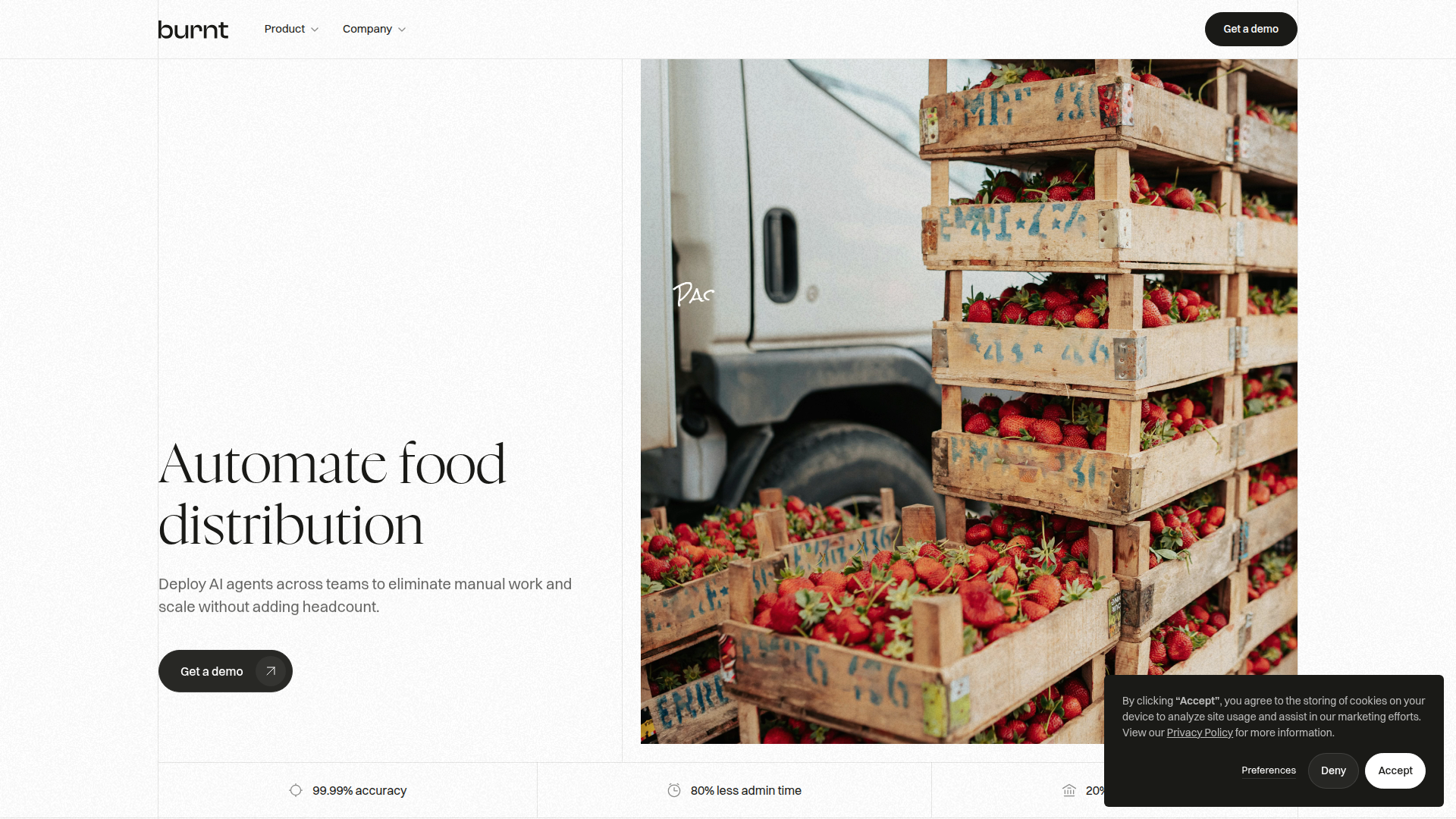
Burnt is an AI agent platform for food distributors. It is designed to automate manual work across sales and operations, procurement, and credit control, with the stated goal of helping distributors scale without adding headcount.
The product appears positioned as an industry-specific operational layer rather than a general-purpose AI tool. Its workflow centers on deploying purpose-built agents for key distribution functions, connecting them in one system, and giving teams real-time visibility across locations, warehouses, and regions.
Features
- Sales and operations automation: Burnt automates order intake and related sales workflows across channels to reduce manual processing and support more consistent execution.
- Procurement automation: The procurement agent helps automate purchasing decisions and supplier communications to keep inventory balanced while managing costs and relationships.
- Credit control workflows: Burnt handles collections calls and payment negotiations, which can reduce follow-up work while supporting cash-flow management.
- Coordinated multi-agent platform: The platform presents agents as working together across functions instead of operating as isolated tools, which is useful for end-to-end operational oversight.
- Real-time operational visibility: Users can monitor workflows across sales, procurement, and credit in one unified system for broader day-to-day visibility.
- Custom solutions and onboarding: Burnt offers custom capabilities, specialized integrations, continuous optimization, and on-site onboarding to adapt the system to each distributor’s workflows.
Helpful Tips
- Validate workflow depth by function: For food distributors, the practical value will depend on how well the product handles edge cases such as complex order formats, supplier exceptions, and collections scenarios.
- Start with one high-friction process: Burnt explicitly supports starting with a single agent, which is often the safest way to measure operational fit before wider rollout.
- Assess location and system complexity early: If your business spans multiple warehouses, regions, or legacy systems, confirm how the unified platform model works in your specific environment.
- Review custom-solution scope carefully: The site highlights tailored workflows and specialized integrations, so buyers should clarify which capabilities are standard versus built as custom work.
- Treat performance claims as vendor-stated: The page cites accuracy, admin-time reduction, and profit uplift figures, but it does not explain methodology, so these should be independently validated.
OpenClaw Skills
Burnt could fit well within the OpenClaw ecosystem as a domain-specific execution layer for food distribution operations. A likely use case would be OpenClaw skills that monitor inbound orders, procurement status, and collections activity from Burnt, then trigger downstream workflows such as exception summaries, escalation briefs, or daily operational digests for managers. The website does not state a native OpenClaw integration, so this should be viewed as a potential orchestration pattern rather than a confirmed product feature.
More advanced OpenClaw agents could be built around Burnt for distributor-specific work such as margin-risk monitoring, buyer-assistant workflows, collections prioritization, or cross-site inventory decision support. In practice, that combination could shift operations leaders from manually coordinating fragmented tasks toward supervising AI-managed workflows, especially in businesses with distributed facilities and high transaction volume.
Embed Code
Share this AI tool on your website or blog by copying and pasting the code below. The embedded widget will automatically update with the latest information.
<iframe src="https://www.aimyflow.com/ai/getburnt-ai/embed" width="100%" height="400" frameborder="0"></iframe>