
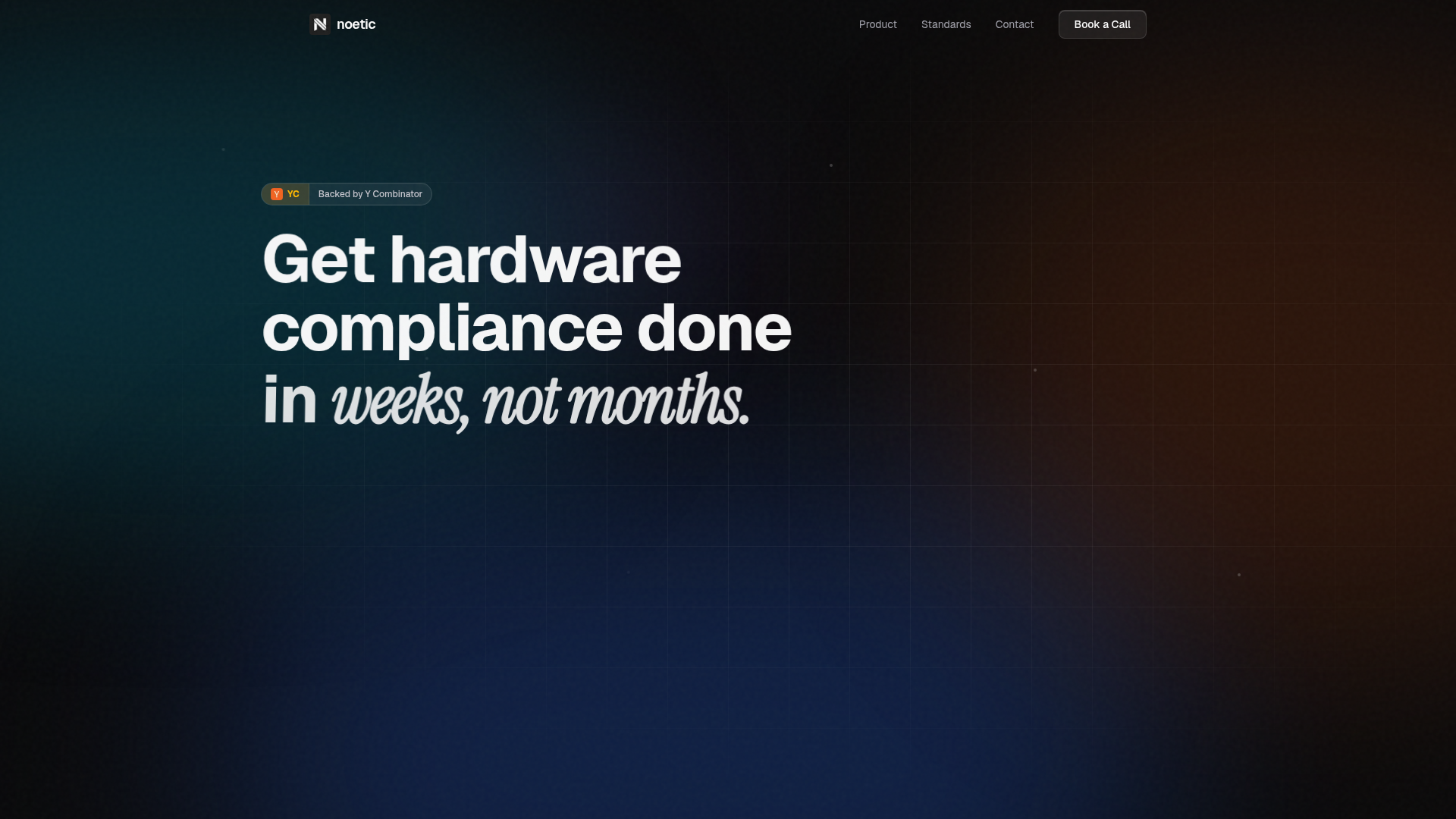
Noetic | Get Hardware Compliance Done in Weeks, Not Months
Rate this Tool
Average Score
Total Votes
Select your score (1-10):
Detail Information
What
Noetic is an AI-powered compliance platform for hardware teams. It is designed to help companies determine which safety and regulatory standards apply to a product, draft the documentation needed for review and testing, and identify testing labs suited to the product category and compliance scope.
The product appears positioned for hardware companies that need to move through compliance work faster, especially when internal teams would otherwise spend significant time interpreting standards, coordinating consultants, and assembling technical files manually. Its workflow centers on regulatory research, document preparation, lab matching, and ongoing status tracking in a single system.
Features
- Regulation research with citations — Noetic’s research agent analyzes a hardware product against many regulatory codes and identifies applicable standards with cited source material, which helps reduce guesswork.
- Automated technical documentation drafting — After requirements are mapped, the platform drafts documentation for testing labs, which can shorten preparation time for compliance submissions.
- Testing lab matching — Noetic connects teams with labs that specialize in the relevant product category and compliance requirements, helping streamline the path to testing.
- Centralized compliance tracking — The platform tracks requirements, documents, and status updates in one place, which helps teams manage changing records and avoid fragmented workflows.
- Coverage across major hardware standards — The site explicitly references standards and frameworks such as FCC, CE Marking, FDA 510(k), UL Certification, ISO 9001 / 9100, ISO 26262, FAA, and RIA, indicating broad applicability across hardware sectors.
- Focus on lab-ready outputs — The product is framed around moving from initial research to documentation that is ready for lab engagement in a shorter timeline.
Helpful Tips
- Validate scope early — For products with multiple functions or markets, confirm that the platform’s identified standards match your exact device class, use case, and target geographies before downstream testing begins.
- Use cited outputs as a review layer — Source citations are valuable, but regulated teams should still have engineering, quality, or legal stakeholders review critical interpretations before submission.
- Check fit for your industry depth — The site signals broad standards coverage, but if your product falls into a highly specialized category, request confirmation that Noetic supports the exact framework and documentation set you need.
- Map ownership across teams — Adoption will likely work best when regulatory, engineering, and program management teams agree on who reviews requirements, who edits documentation, and who manages lab coordination.
- Assess document maturity expectations — The platform drafts documentation, but buyers should clarify how much internal editing or expert validation is still needed for final lab submission.
OpenClaw Skills
Noetic could likely fit well into the OpenClaw ecosystem as a compliance intelligence and workflow layer for hardware operations. Likely skill ideas include an agent that ingests product specifications and automatically prepares a standards applicability brief, a documentation agent that organizes draft technical files for internal review, and a lab coordination workflow that routes status changes to engineering, quality, and program teams. The site does not state a native OpenClaw integration, so this should be treated as a likely workflow design rather than a confirmed product capability.
In practice, combining Noetic with OpenClaw could help hardware companies build repeatable compliance operations instead of handling each certification effort as a one-off project. For example, robotics, medical device, automotive electronics, or aerospace teams could use OpenClaw agents to monitor document readiness, escalate missing evidence, and trigger downstream actions once compliance milestones are reached. That combination could make compliance work more operational, auditable, and cross-functional for teams that need to launch regulated hardware faster.
Embed Code
Share this AI tool on your website or blog by copying and pasting the code below. The embedded widget will automatically update with the latest information.
<iframe src="https://www.aimyflow.com/ai/getnoetic-ai/embed" width="100%" height="400" frameborder="0"></iframe>