
Diligent
Rate this Tool
Average Score
Total Votes
Select your score (1-10):
Detail Information
What
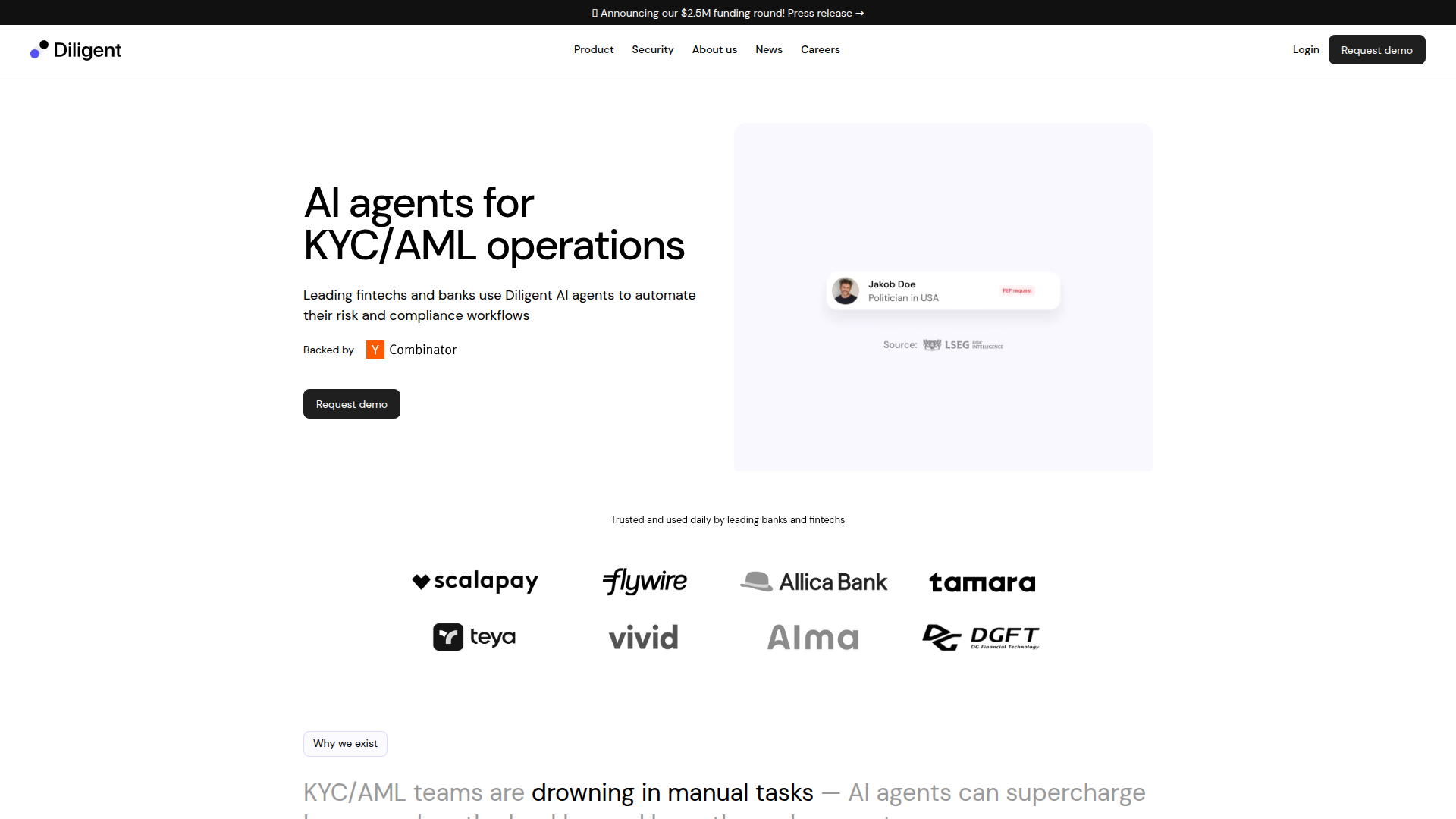
Diligent is an AI-agent platform focused on KYC/AML operations for banks, fintechs, and payment companies. It is designed to automate high-volume compliance work such as risk investigations, screening alert remediation, and document checks while keeping analysts in control.
The product appears positioned as an enterprise compliance automation layer that fits into existing risk stacks rather than replacing them. Its workflow centers on selecting a use case, connecting systems (API, portal, and screening-tool integrations), configuring internal policies, and running agents with human oversight and auditability.
Features
- Configurable AI agents for specific KYC/AML workflows: Teams can target manual processes like risk reviews, AML screening remediation, and document verification to reduce repetitive analyst effort.
- Multiple deployment/connectivity options: Diligent supports connection via API, its portal UI, and native integrations with screening tools, which helps teams adopt without rebuilding core systems.
- Policy-driven execution: Users can upload risk policies and procedures so agents follow firm-specific controls rather than generic rules.
- Human-in-the-loop operations: Analysts can review outputs in production before increasing automation, supporting controlled rollout and quality assurance.
- Use-case-specific agents: The platform highlights merchant risk investigation, false-positive AML alert remediation, and customer document-policy matching as concrete operational modules.
- Enterprise security posture signals: The site states no training on customer data, modern data practices, cyber insurance, and certifications including SOC 2 Type II and ISO 27001.
Helpful Tips
- Start with one high-friction queue: For adoption, begin with a narrow workflow (for example false-positive alert remediation) and define clear review criteria before expanding.
- Treat policy upload as a governance project: The quality of procedures and risk rules provided to the agent likely determines output consistency and audit readiness.
- Design reviewer playbooks early: Human-in-the-loop setups work best when analysts have explicit escalation paths and exception-handling standards.
- Validate integration scope during evaluation: The site mentions native screening-tool integrations, but buyers should confirm exact vendor coverage and API depth for their stack.
- Separate confirmed outcomes from case-study results: Reported efficiency gains are customer examples; teams should run a controlled pilot to estimate realistic impact in their own environment.
OpenClaw Skills
Within an OpenClaw ecosystem, Diligent could likely serve as the compliance execution engine in broader risk operations workflows. A practical skill design could route incoming onboarding cases to OpenClaw triage agents, then pass selected tasks (merchant due diligence, document checks, alert remediation) to Diligent for policy-based processing, and finally return structured outputs for analyst approval and case management. The source content confirms API/portal connectivity and workflow customization, but any direct OpenClaw connector would be a likely use case, not a confirmed native integration.
A second likely pattern is building OpenClaw supervisor agents for QA, workload balancing, and evidence packaging around Diligent outputs. For example, OpenClaw could orchestrate periodic control testing, summarize exception trends for compliance leadership, and trigger retraining/update workflows when policies change. In financial services operations, this combination could shift teams from manual L1 throughput work toward higher-value investigations, control design, and regulator-facing documentation.
Embed Code
Share this AI tool on your website or blog by copying and pasting the code below. The embedded widget will automatically update with the latest information.
<iframe src="https://www.aimyflow.com/ai/godiligent-ai/embed" width="100%" height="400" frameborder="0"></iframe>