
Home
Rate this Tool
Average Score
Total Votes
Select your score (1-10):
Detail Information
What
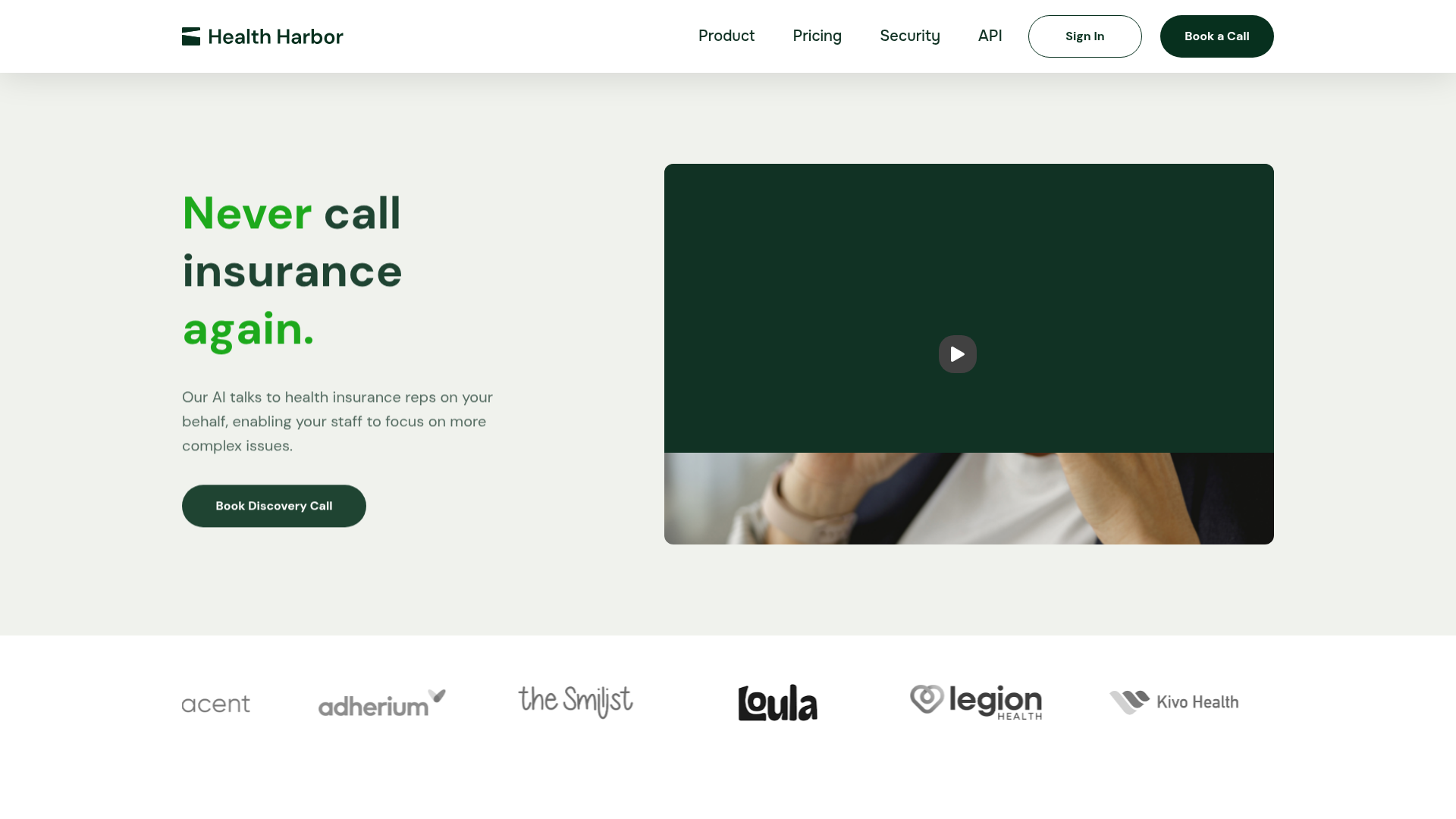
Health Harbor is an AI-based insurance calling platform for healthcare organizations that need to interact with health insurers for benefits verification, prior authorization, and claim status follow-up. It is designed for teams that currently spend time navigating phone trees, waiting on hold, and speaking with payer representatives to obtain information that may not be available on insurer portals.
The product appears positioned as an operational automation layer for revenue cycle, intake, and authorization workflows across medical, behavioral health, and pharmacy use cases. Customers can submit requests through a web portal or API, and the system places calls, captures and validates results, and returns outputs through the portal or webhook.
Features
- Benefits verification by phone — Checks plan activity, deductibles, maximums, and coverage for specific procedure codes and places of service when payer websites may not provide enough detail.
- Prior authorization support — Retrieves prior auth requirements, submits prior authorizations by phone, and follows up on status details such as submission date, approval date, duration, and approved visit counts.
- Claim status and denial follow-up — Contacts insurers to determine whether claims are not found, pending, paid, or denied, and investigates denial reasons so staff can focus on claim correction and recovery work.
- Two automation modes — Offers a fully automated AI Agent for end-to-end calls and an AI Copilot that handles IVR navigation and hold time before transferring the live call to staff.
- Result validation and audit data — Returns supporting data such as representative name, reference number, call end time, transcript, and call recording to help teams verify outcomes.
- API and portal-based workflow — Accepts requests through an API or web portal and returns results via webhook or portal, which supports both embedded and standalone operational use.
Helpful Tips
- Assess payer mix early — The site states API support for major insurers covering about half of US plans, so buyers should confirm payer coverage against their own volume before broad rollout.
- Match automation mode to workflow risk — Fully automated calling may fit repetitive status checks, while copilot-style transfers may be better for edge cases that require staff judgment.
- Use returned call evidence in QA workflows — Transcripts, recordings, and reference numbers can help teams review disputed outcomes and improve internal documentation.
- Plan around turnaround times — Typical results are returned in one day with a two-business-day SLA, so urgent operational processes should be mapped carefully to those timelines.
- Validate fit by use case, not just by specialty — The product supports multiple specialties, but teams should confirm that their most common benefit, auth, and claim scenarios are well covered.
OpenClaw Skills
Health Harbor could likely pair well with OpenClaw as a payer-operations skill layer for healthcare administrative teams. Based on the page, a likely OpenClaw workflow would collect patient, insurance, and procedure data from intake or scheduling systems, structure a benefits or authorization request, submit it to Health Harbor through its API, then route the returned result into work queues, patient estimates, or claim follow-up tasks. Because Health Harbor exposes transcripts, recordings, and verification data points, OpenClaw agents could also summarize payer responses and flag inconsistencies for human review.
In a broader industry workflow, OpenClaw could likely orchestrate multi-step revenue cycle automations around Health Harbor rather than replace it. For example, a scheduling agent could trigger pre-service verification, an authorization agent could watch for incomplete requirements and prepare staff handoff packets, and an AR agent could classify denial reasons from returned call data and assign next actions. If implemented well, this combination could reduce manual phone burden for intake, authorization, and billing teams while shifting staff effort toward exception handling and payment recovery rather than repetitive insurer calls.
Embed Code
Share this AI tool on your website or blog by copying and pasting the code below. The embedded widget will automatically update with the latest information.
<iframe src="https://www.aimyflow.com/ai/healthharbor-co/embed" width="100%" height="400" frameborder="0"></iframe>