
JURA Bio, Inc.
Rate this Tool
Average Score
Total Votes
Select your score (1-10):
Detail Information
What
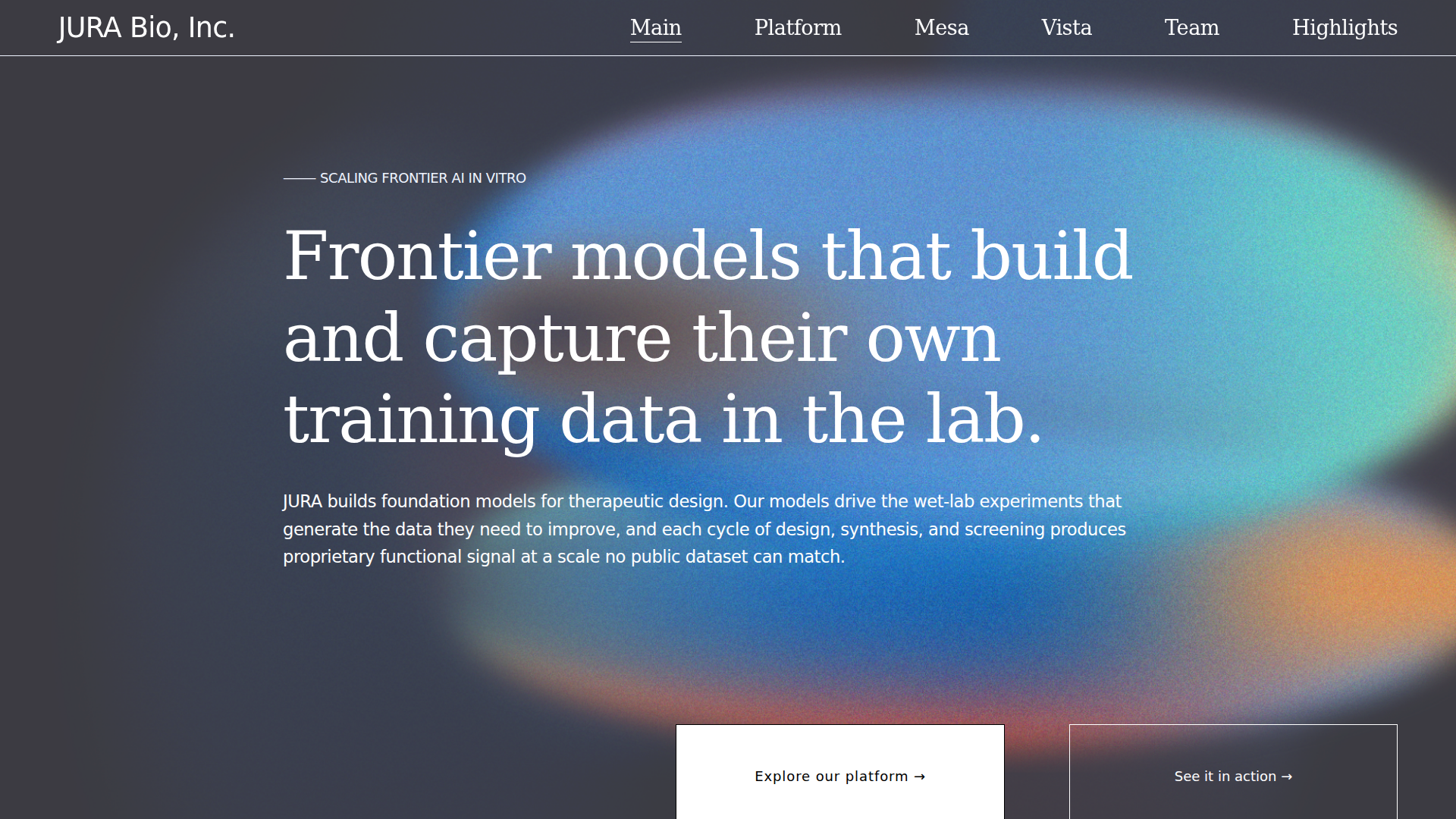
JURA Bio builds foundation models for therapeutic design and pairs them with wet-lab experimentation. Its core approach is a closed data loop: models guide design, synthesis, and screening in the lab, and the resulting functional data is used to improve the models over time.
The company appears to serve biotech and drug discovery organizations working on novel therapeutic modalities and difficult targets where public datasets are limited and generic AI tools are less effective. Based on the page, JURA is positioned as an AI-native therapeutic discovery platform that combines proprietary model development with candidate discovery and early development.
Features
- Sovereign AI models: Purpose-built foundation models are trained on proprietary functional data, which is intended to support discovery work where public data does not exist or is insufficient.
- Lab-driven training loop: The models help direct wet-lab experiments, and each design-synthesis-screening cycle generates new data to refine model performance.
- Support for hard targets and novel modalities: The platform is presented as useful for therapeutic areas that are difficult to address with off-the-shelf AI approaches.
- Candidate discovery and development: JURA states that it discovers and develops therapeutic candidates with confirmed function rather than stopping at in silico design alone.
- Coverage across multiple therapeutic formats: The company names antibodies, TCR mimics, peptides, T-cell engagers, enzymes, and emerging modalities as areas of application.
- Partnership-oriented model application: Publicly listed collaborations suggest the platform can be applied to biologics development, regulatory element design, and immune-cell-related therapeutic programs.
Helpful Tips
- For products like this, assess how much of the claimed advantage comes from proprietary experimental data generation versus model architecture, since the source emphasizes the data loop more than technical model details.
- In diligence or adoption planning, ask where the platform sits in the workflow: target selection, sequence design, screening optimization, candidate prioritization, or broader preclinical development.
- Evaluate modality fit carefully; the page lists several therapeutic classes, but it does not describe whether capabilities are equally mature across all of them.
- Review collaboration structure and IP expectations early, especially for platforms built around proprietary data creation and model improvement over repeated experimental cycles.
- Treat claims around confirmed function as promising but early-stage unless accompanied by program-specific validation data, which is not provided on this page.
OpenClaw Skills
Within the OpenClaw ecosystem, JURA Bio would likely fit best as a scientific design-and-decision engine inside multi-agent R&D workflows. Likely use cases include agents that translate program goals into experiment briefs, summarize design cycles, compare candidate classes across modalities, track screening outcomes, and prepare partner-ready research updates. The source page does not mention a native OpenClaw integration, so this should be read as a workflow inference rather than a confirmed product feature.
A combined OpenClaw setup could be especially useful for biotech research teams, alliance managers, and translational strategy groups. For example, one agent could organize target hypotheses, another could structure wet-lab result interpretation, and another could maintain a living knowledge base of modality-specific design decisions and partnership learnings. In practice, that kind of layer could help turn a platform like JURA from a specialized discovery engine into part of a broader operating system for AI-native therapeutic R&D.
Embed Code
Share this AI tool on your website or blog by copying and pasting the code below. The embedded widget will automatically update with the latest information.
<iframe src="https://www.aimyflow.com/ai/jura-bio/embed" width="100%" height="400" frameborder="0"></iframe>