
Letterbook — AI-Native Customer Support
Rate this Tool
Average Score
Total Votes
Select your score (1-10):
Detail Information
What
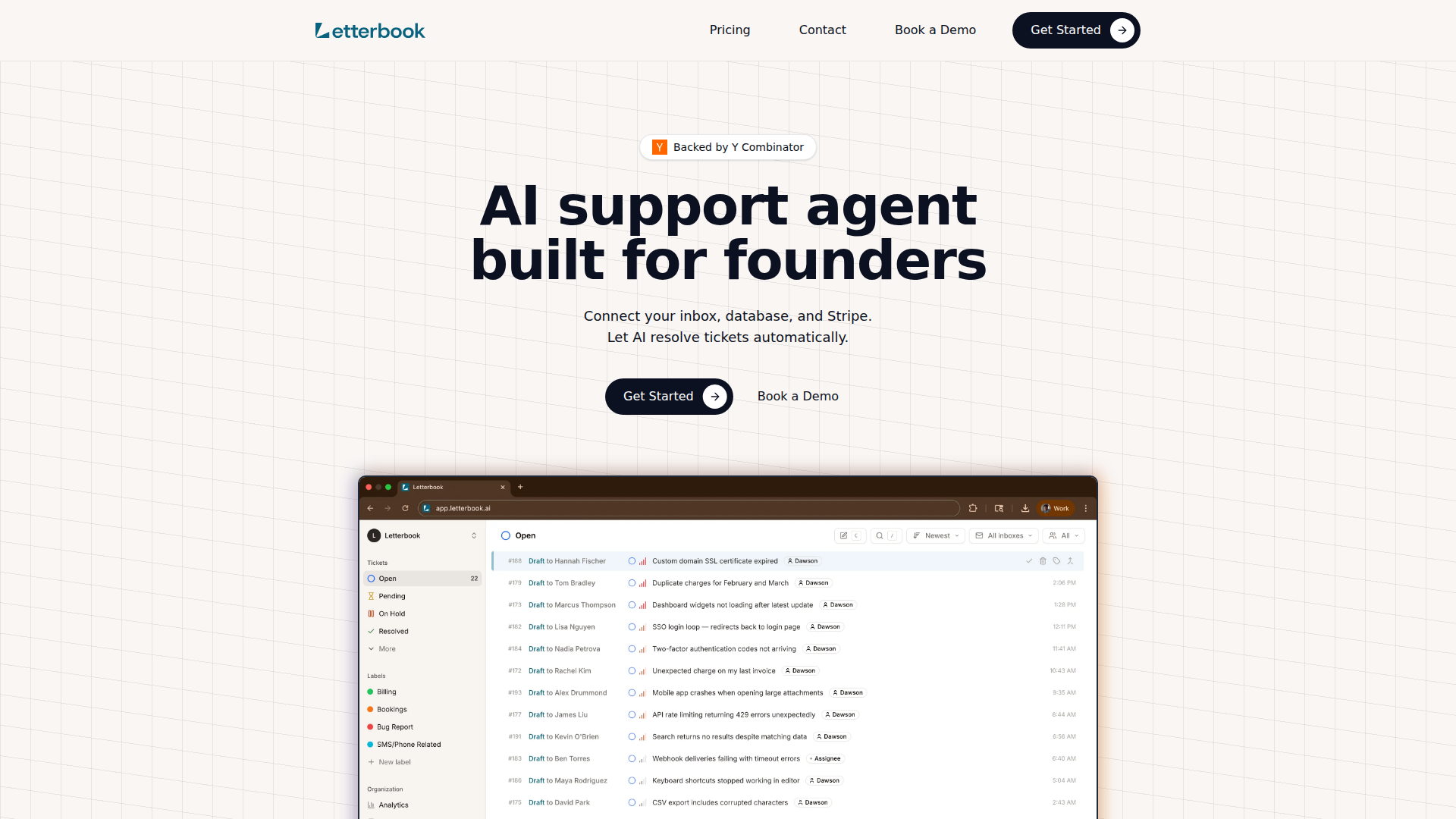
Letterbook is an AI-native customer support platform designed to help founders and fast-growing teams automate support work. Based on the page, its core workflow is to connect support operations to an inbox, a database, and Stripe so the AI can look up customer and account details, draft responses, and help resolve tickets.
The product appears positioned as an alternative to traditional helpdesk setups such as Zendesk, with an emphasis on fast setup, lower management overhead, and continuous improvement through ticket feedback. It is aimed at teams that want a modern support stack without building a large manual support operation early on.
Features
- Inbox, database, and Stripe connectivity — Letterbook gives its AI read access to customer, order, subscription, and account data so replies can be grounded in operational context.
- Scenario-based support playbooks — Teams can define instructions for common request types such as refunds, login issues, password changes, and bug reports to standardize handling.
- AI-generated draft replies — Each ticket receives a draft response informed by the defined scenarios and connected data, which can speed up agent review and resolution.
- Feedback-driven improvement — Teams can review tickets and give feedback so the system improves how it responds over time.
- Contact center interface — The product includes a support workspace positioned around speed, with shortcuts, AI assistance, and a modern UI.
- Knowledge base and analytics — Letterbook includes a knowledge base that updates as tickets are solved, plus reporting on resolution time, automation rate, and customer satisfaction.
Helpful Tips
- Validate data access carefully — Because the product relies on reading database and Stripe information, teams should define clear data scopes and review what the AI can reference in replies.
- Start with high-volume scenarios — Refunds, login issues, billing questions, and password requests are practical first workflows because they are repetitive and easier to standardize.
- Treat scenario design as operational policy — The quality of automation will likely depend on how clearly teams document rules, edge cases, and escalation paths in their instructions.
- Use human review early in rollout — Since the page emphasizes draft replies and feedback, a staged launch with approval workflows is a prudent way to improve accuracy before expanding automation.
- Compare against current support complexity — The strongest fit is likely for lean teams that want fast deployment; larger organizations with complex multi-channel or compliance-heavy requirements may need to confirm depth beyond what the page states.
OpenClaw Skills
Letterbook could likely work well inside an OpenClaw ecosystem as the execution layer for customer support workflows. Likely OpenClaw skills could include ticket triage agents, refund-policy interpreters, subscription status checkers, bug-report summarizers, and escalation routers that prepare structured context before a human reviews a case. While the page does not mention native OpenClaw integration, its scenario-based model and access to operational data make it a strong candidate for agent-driven orchestration.
Combined with OpenClaw, this kind of product could likely shift support teams from reactive inbox handling to supervised operations automation. For founders, support leads, and revenue operations teams, an OpenClaw workflow could classify incoming requests, gather database and billing evidence, draft policy-aligned replies, and trigger follow-up tasks for engineering or success teams. That would not be a confirmed built-in capability from the source page, but it is a plausible use case for extending Letterbook into a broader AI support operations stack.
Embed Code
Share this AI tool on your website or blog by copying and pasting the code below. The embedded widget will automatically update with the latest information.
<iframe src="https://www.aimyflow.com/ai/letterbook-ai/embed" width="100%" height="400" frameborder="0"></iframe>