
LLMStack | AI Agents in Minutes | No-code AI App Builder | LLMStack
Rate this Tool
Average Score
Total Votes
Select your score (1-10):
Detail Information
What
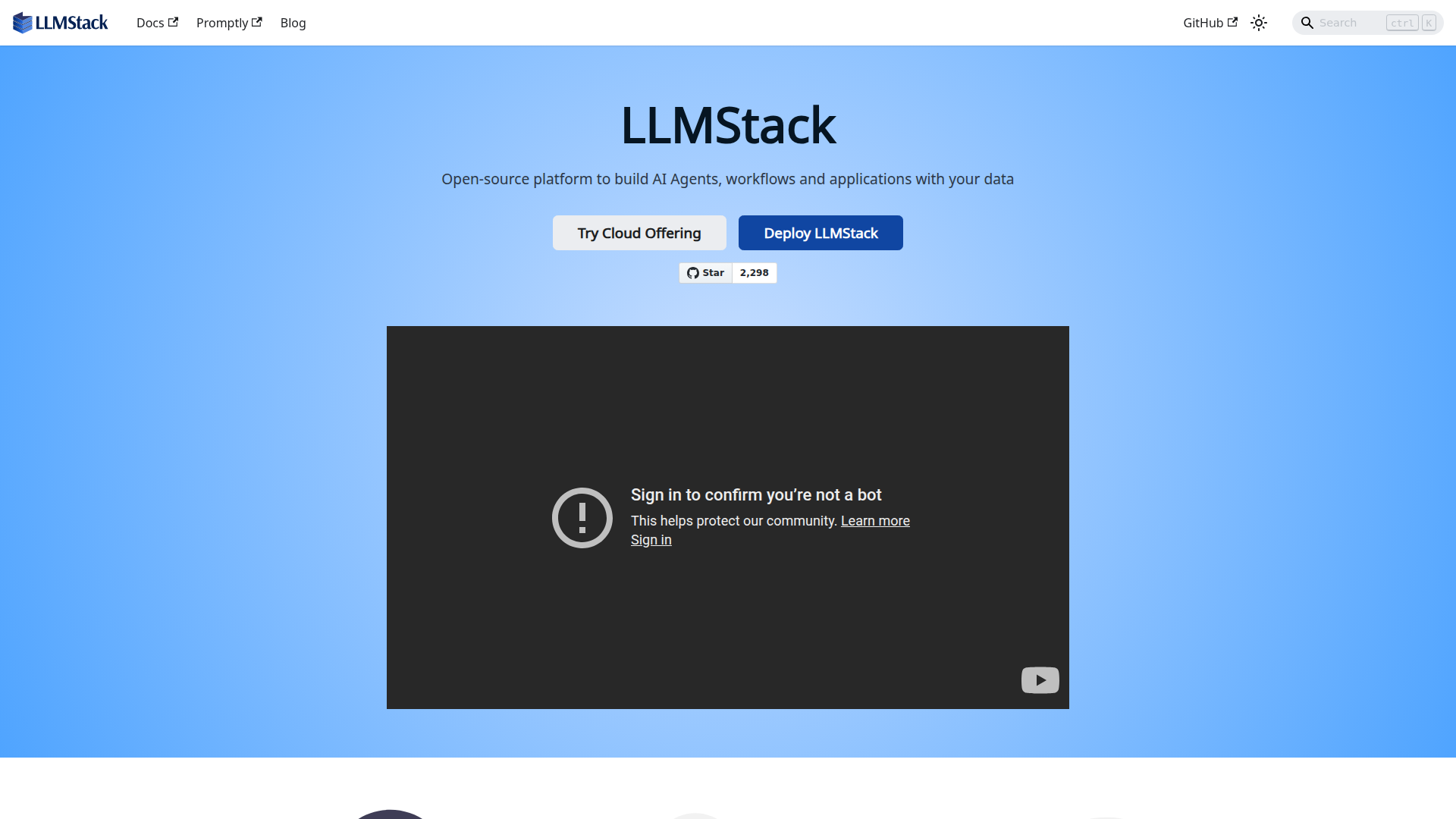
LLMStack is an open-source platform for building AI agents, workflows, and applications using organizational data. The page presents it as a no-code AI app builder that helps teams assemble model-driven apps quickly, with support for chaining models and connecting external data sources.
It appears suited to teams that want to build internal or public-facing generative AI apps without starting from scratch in code. Based on the page, its positioning is a practical builder layer for creating AI applications, chatbots, and agent-style workflows across multiple model providers and shared team environments.
Features
- No-code AI app builder — Lets users create AI agents, workflows, and applications without relying entirely on custom software development.
- Model chaining — Supports combining steps across major model providers, which is useful for building multi-stage AI workflows instead of single-prompt experiences.
- Broad model provider support — Works with providers including OpenAI, Cohere, Stability AI, and Hugging Face, giving teams flexibility in model selection.
- Bring-your-own-data workflow — Connects user data to LLMs so applications can be grounded in business content rather than only base model knowledge.
- Multiple data source imports — Supports sources such as web URLs, sitemaps, PDFs, audio, PPTs, Google Drive, and Notion imports for faster knowledge ingestion.
- Collaborative app sharing and permissions — Enables public sharing or restricted access, with viewer and collaborator roles to support team-based app development.
Helpful Tips
- Check how much no-code control is enough for your use case — If you need highly customized orchestration or strict engineering controls, confirm where the platform’s visual builder fits versus code-based development.
- Start with a focused data domain — Tools like this usually work best when initial apps are grounded in a small, well-maintained document set rather than broad unmanaged content imports.
- Design permissions early — Since the product includes public and restricted sharing, define who can view, edit, and publish apps before broader rollout.
- Test model-provider choices by workflow type — The platform supports several providers, so compare them based on task quality, latency, and output consistency for each app.
- Validate source freshness and document quality — Import breadth is helpful, but retrieval and generation quality will still depend on how current and structured the underlying data is.
OpenClaw Skills
LLMStack could likely work well inside the OpenClaw ecosystem as a front-end AI application layer for agentic workflows built around company knowledge. Likely OpenClaw skills could include document-aware assistants, internal research agents, knowledge-base copilots, proposal drafting flows, and intake agents that route tasks based on uploaded files or referenced URLs. The page does not mention a native OpenClaw integration, so this should be treated as a likely deployment pattern rather than a confirmed capability.
In practice, this combination could be useful for operations, support, consulting, and internal enablement teams that need fast AI workflow assembly around their own content. OpenClaw agents could likely orchestrate repeatable business processes while LLMStack provides the user-facing app layer, shared workspace model, and data-connected prompt workflows. That setup could reduce the effort required to turn scattered documents into usable AI tools for knowledge work, especially where non-technical teams need to collaborate on app behavior.
Embed Code
Share this AI tool on your website or blog by copying and pasting the code below. The embedded widget will automatically update with the latest information.
<iframe src="https://www.aimyflow.com/ai/llmstack-ai/embed" width="100%" height="400" frameborder="0"></iframe>