
Metoro | AI SRE For Kubernetes
Rate this Tool
Average Score
Total Votes
Select your score (1-10):
Detail Information
What
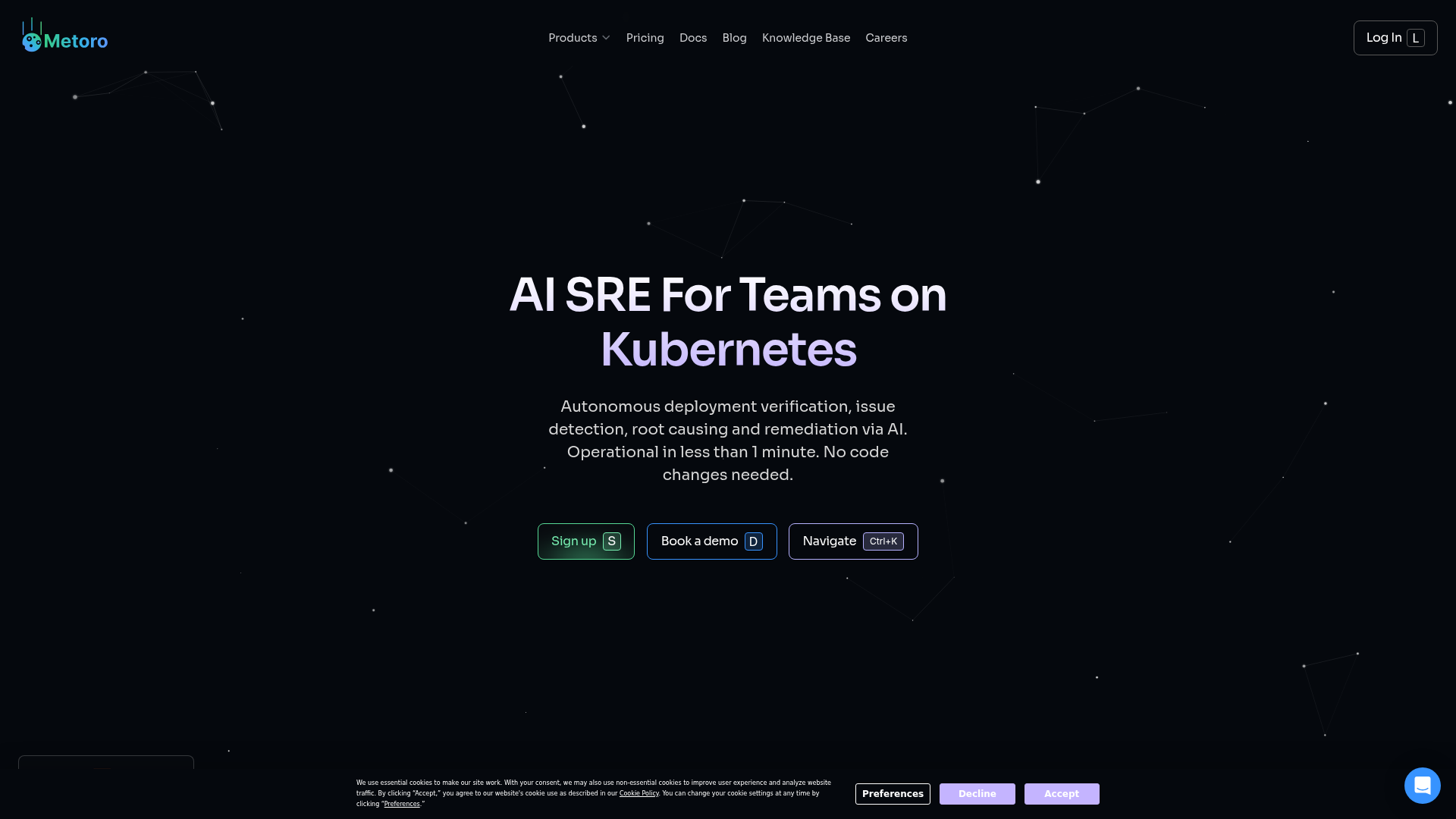
Metoro is an AI-driven SRE and observability platform for Kubernetes teams. It combines telemetry collection, issue detection, root cause analysis, deployment verification, and AI-generated remediation into one product, with a stated focus on fast setup and no code changes.
The product appears positioned for engineering, platform, and SRE teams that want Kubernetes observability plus more automation in incident investigation and resolution. Its core workflow is: deploy an agent with a Helm install, collect kernel-level telemetry via eBPF, analyze traces/logs/metrics/profiling and Kubernetes events, correlate issues with code, and in some cases raise pull requests for human review.
Features
- Autonomous issue detection and root cause analysis: Metoro analyzes observability data in real time to detect anomalies and identify likely root causes, which can reduce manual triage work.
- AI-generated fixes with pull requests: The platform states it can create PRs for detected root causes, giving teams a reviewable path from incident analysis to remediation.
- Deployment verification: AI-verified deployment checks are presented as a way to catch problems associated with releases before they become larger incidents.
- Zero-instrumentation Kubernetes observability: Metoro uses eBPF-based collectors at the kernel level, which helps teams gather telemetry without application code changes or container restarts.
- Unified observability data types: The platform includes APM, logs, traces, profiling, alerts, events, dashboards, infrastructure monitoring, cron job monitoring, and uptime monitoring in one system.
- Flexible deployment models: Organizations can choose a managed cloud service, a bring-your-own-cloud model, or on-prem deployment, including isolated environments according to the site.
Helpful Tips
- Validate the AI remediation workflow carefully: If PR generation is a key buying criterion, confirm how fixes are scoped, reviewed, tested, and approved inside your existing engineering process.
- Assess eBPF fit with your environment: Kernel-level telemetry can simplify rollout, but teams should verify compatibility with their Kubernetes distribution, node OS standards, and security controls.
- Map product value to your incident process: Metoro is strongest where teams need faster investigation across traces, logs, metrics, and code, rather than a standalone metrics-only tool.
- Review deployment option requirements early: Cloud, BYOC, and on-prem choices may materially affect data residency, operating model, and internal ownership, especially for larger enterprises.
- Pressure-test cost assumptions with real workloads: The site emphasizes predictable pricing and lower cost versus some competitors, but teams should model ingest volumes and node counts against their actual environment.
OpenClaw Skills
Metoro could fit well into the OpenClaw ecosystem as a trigger and evidence layer for SRE, platform engineering, and incident-management workflows. A likely use case would be an OpenClaw skill that listens for Metoro-detected anomalies, pulls the related traces/logs/profiling context, summarizes the probable root cause, and routes a structured incident brief to Slack, ticketing systems, or an internal runbook workflow. If PR creation data is accessible, another likely workflow could compare AI-proposed fixes against internal coding standards and change-management policies before escalation to reviewers.
A broader OpenClaw agent layer could turn Metoro into part of a semi-autonomous Kubernetes operations loop. For example, an operations agent could correlate Metoro alerts with deployment calendars, ownership maps, and service criticality, then launch tailored playbooks for rollback analysis, stakeholder notification, postmortem drafting, or recurring problem detection. This is an inferred ecosystem pattern rather than a confirmed native integration, but in practice it could help SRE and platform teams shift from reactive dashboard monitoring toward coordinated, agent-assisted operations.
Embed Code
Share this AI tool on your website or blog by copying and pasting the code below. The embedded widget will automatically update with the latest information.
<iframe src="https://www.aimyflow.com/ai/metoro-io/embed" width="100%" height="400" frameborder="0"></iframe>