
MOVE. | Agents for Hardware Engineering
Rate this Tool
Average Score
Total Votes
Select your score (1-10):
Detail Information
What
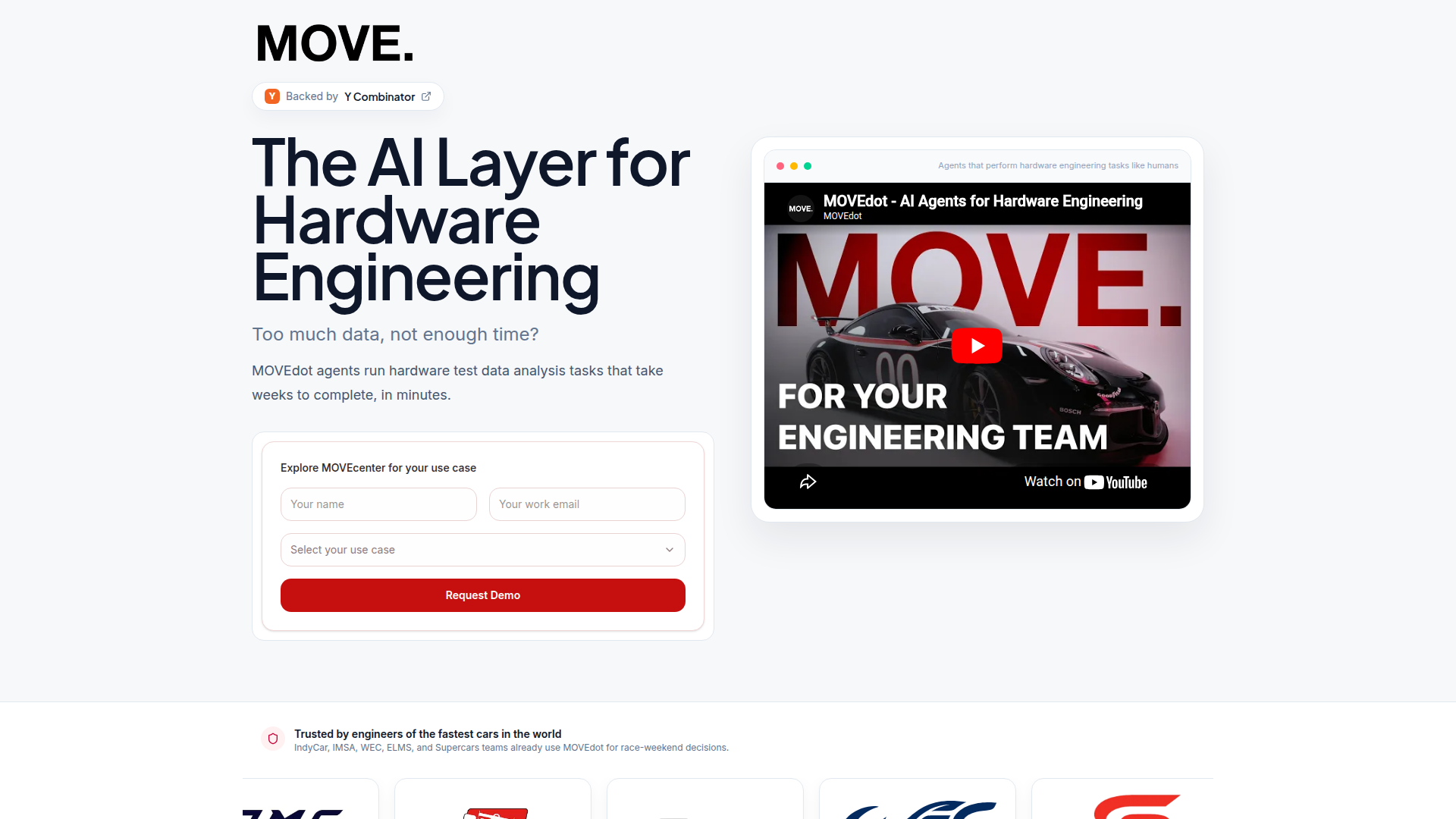
MOVE appears to be an AI software platform for hardware engineering teams that automates analysis of test and operational data. Based on the page, its core workflow is to connect multiple engineering data sources, have AI agents review the full dataset, identify correlations and issues, and return reports and answers in minutes instead of requiring long manual analysis cycles.
The product is positioned for teams working with complex hardware data, especially in motorsports and other engineering-heavy environments such as manufacturing, automotive R&D, aerospace, robotics, and end-of-line testing. The messaging suggests it is aimed at engineers and technical decision-makers who need faster iteration, broader data coverage, and quicker reporting from telemetry, sensor logs, standards, and internal documentation.
Features
- Multi-source engineering data ingestion — Connects telemetry, sensor logs, test standards, and internal documentation so analysis can start from a broader operational context.
- Agent-based data analysis — Uses AI agents to perform hardware engineering analysis tasks in a way the company describes as similar to how human engineers work.
- Full-data review — Claims to process 100% of available data, which is intended to reduce blind spots and missed findings compared with manual sampling.
- Correlation discovery across sources — Surfaces patterns and relationships that would otherwise take engineers weeks to uncover manually.
- Rapid report generation — Produces detailed analyses in minutes, helping teams shorten the time between testing and decision-making.
- Plain-English question answering — Lets users ask complex questions in natural language, which may lower the effort required to interrogate technical datasets.
Helpful Tips
- Validate on a narrow workflow first — For this category of product, start with one high-volume analysis task such as post-test review or anomaly triage before expanding to broader engineering use cases.
- Prioritize data readiness — Results will depend heavily on how well telemetry, logs, standards, and documentation are structured, accessible, and mapped across systems.
- Keep human review in the loop — The page indicates the user makes the final call, which is a sensible operating model for engineering decisions with safety, performance, or production impact.
- Assess explainability during evaluation — For adoption in technical teams, verify whether reports clearly show the evidence, source data, and reasoning behind identified correlations.
- Match deployment to your operating tempo — The strongest fit is likely in environments where fast iteration matters, such as race weekends, testing programs, or production monitoring.
OpenClaw Skills
Within the OpenClaw ecosystem, MOVE could likely support agent workflows centered on hardware test interpretation, engineering report generation, anomaly investigation, and cross-source knowledge retrieval. A likely use case would be an OpenClaw skill that watches incoming test data, routes it into a structured review process, summarizes abnormal patterns, and drafts follow-up questions for engineers based on prior standards and internal documentation. The source page does not confirm a native OpenClaw integration, so this should be viewed as a workflow opportunity rather than a stated product feature.
This combination could be especially useful for motorsports, manufacturing, and R&D teams that need to compress analysis cycles without losing technical depth. OpenClaw agents could likely orchestrate recurring tasks around MOVE outputs, such as assigning investigations, generating shift summaries, comparing session-to-session findings, or escalating probable failure patterns to the right specialists. In practice, that would move engineers further away from repetitive data triage and toward higher-value interpretation and decision work.
Embed Code
Share this AI tool on your website or blog by copying and pasting the code below. The embedded widget will automatically update with the latest information.
<iframe src="https://www.aimyflow.com/ai/movedot-ai/embed" width="100%" height="400" frameborder="0"></iframe>