
Navier AI
Rate this Tool
Average Score
Total Votes
Select your score (1-10):
Detail Information
What
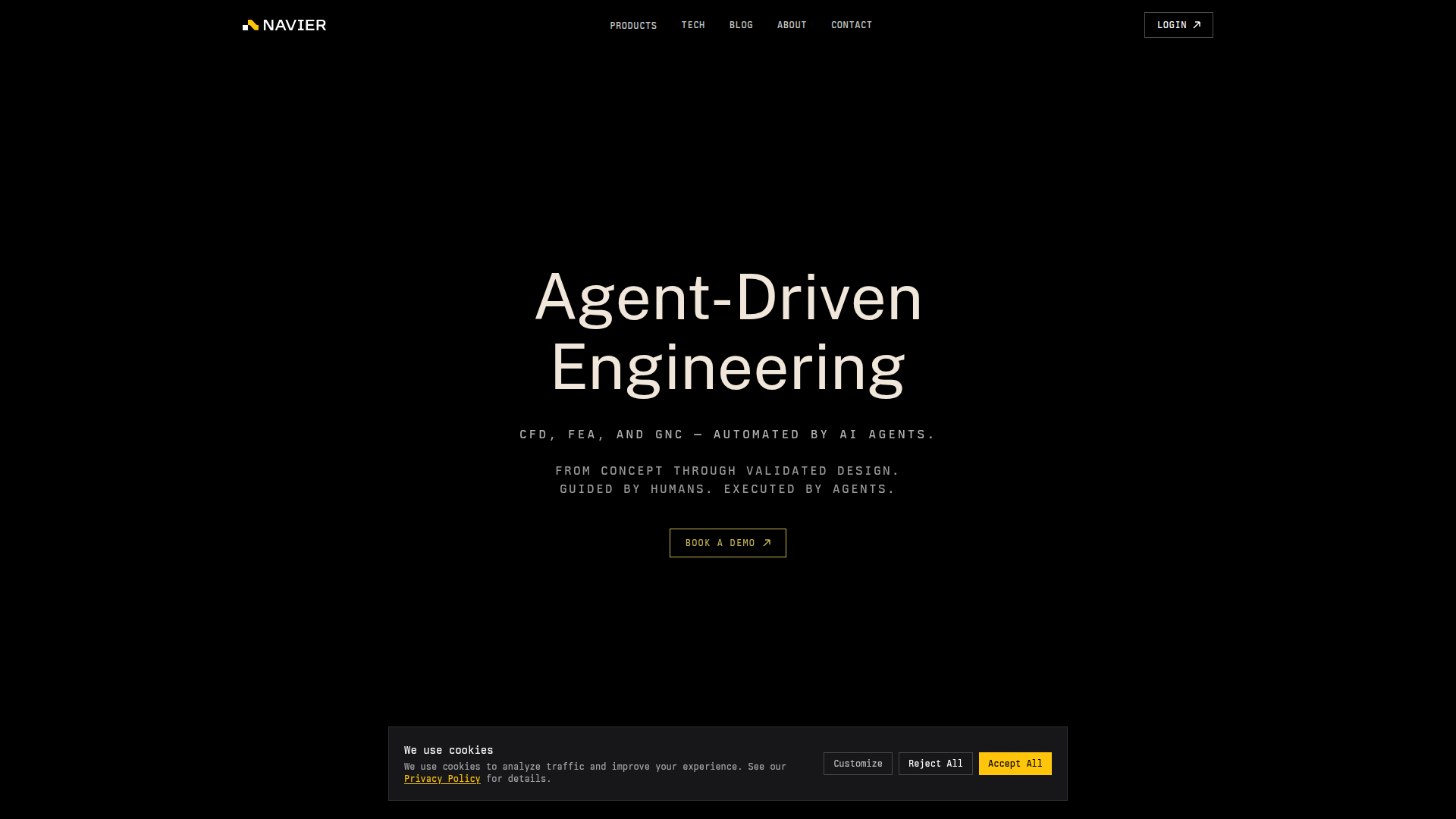
Navier AI is an agent-driven engineering platform for simulation-led design work across computational fluid dynamics (CFD), structural finite element analysis (FEA), and guidance, navigation, and control (GNC). It appears designed for engineering teams that need to move from concept to validated design with AI agents handling much of the simulation setup and execution while humans retain decision authority.
The platform is organized around three products: Stokes for CFD, Ferro for structural FEA, and Stella for GNC and flight software generation. Based on the page, Navier’s positioning is an automation layer for high-end engineering analysis: engineers define goals and constraints, AI agents run the workflow, and engineers review results to select a final design direction.
Features
- Agent-driven simulation workflow — Engineers can define goals, constraints, and analysis questions, and the platform’s agents manage setup, configuration, and execution steps.
- Stokes for CFD analysis — Supports geometry-to-results CFD workflows with an OpenFOAM-based solver, automated mesh generation, turbulence modeling, and both incompressible and compressible flow analysis.
- Ferro for structural FEA — Provides GPU-accelerated structural analysis for static, modal, buckling, nonlinear, and contact mechanics use cases.
- Stella for GNC development — Combines a GNC library and AI agent for space systems, with capabilities such as multi-body dynamics modeling, automated filter design, Monte Carlo analysis, and software-in-the-loop simulation.
- Connected multidisciplinary environment — CFD, FEA, and GNC are presented as connected by AI agents, which is useful for organizations coordinating multiple engineering disciplines in one design cycle.
- Usage-based commercial model — The site states that pricing is based on compute and simulations run rather than seat licenses or upfront costs, which may fit variable simulation demand.
Helpful Tips
- Verify depth in your primary domain — If your team mainly needs CFD, FEA, or GNC, assess the maturity of the specific module you will rely on most rather than assuming equal depth across all three.
- Plan human review checkpoints — The product is explicitly framed as human-guided, so teams should define approval gates for model assumptions, boundary conditions, and final design decisions.
- Test on a representative workflow first — A pilot should include your real geometry, constraints, and analysis loops to confirm whether the agent-driven setup reduces manual simulation overhead in practice.
- Examine solver compatibility and toolchain fit — The page mentions tool integration but does not provide specifics in the visible content, so CAD, meshing, and downstream engineering workflow requirements should be validated directly.
- Match buying criteria to compute patterns — Usage-based pricing can work well for bursty workloads, but organizations with constant heavy simulation demand should model expected compute consumption carefully.
OpenClaw Skills
Navier AI could likely fit well into an OpenClaw ecosystem as the simulation execution layer inside larger engineering decision workflows. Likely use cases include skills that translate natural-language engineering objectives into structured simulation jobs, agents that compare Pareto tradeoffs across CFD and FEA outputs, and workflows that summarize design iteration results for program managers, chief engineers, or review boards. The page supports the idea of human-guided, agent-executed loops, which aligns with OpenClaw’s ability to coordinate multi-step analytical processes.
In practice, OpenClaw agents could likely sit above Navier to orchestrate requirements capture, experiment planning, simulation batch generation, results ranking, and documentation handoff. For aerospace, robotics, and advanced manufacturing teams, that combination could shift engineers away from repetitive setup tasks toward higher-value trade studies and validation decisions. Any direct integration with OpenClaw is an inference rather than a confirmed native capability from the page, but the product’s agent-driven structure makes it a strong candidate for this kind of orchestration.
Embed Code
Share this AI tool on your website or blog by copying and pasting the code below. The embedded widget will automatically update with the latest information.
<iframe src="https://www.aimyflow.com/ai/navier-ai/embed" width="100%" height="400" frameborder="0"></iframe>