
OmniDetect — AI Detector | Multi-Engine Content Detection
Rate this Tool
Average Score
Total Votes
Select your score (1-10):
Detail Information
What
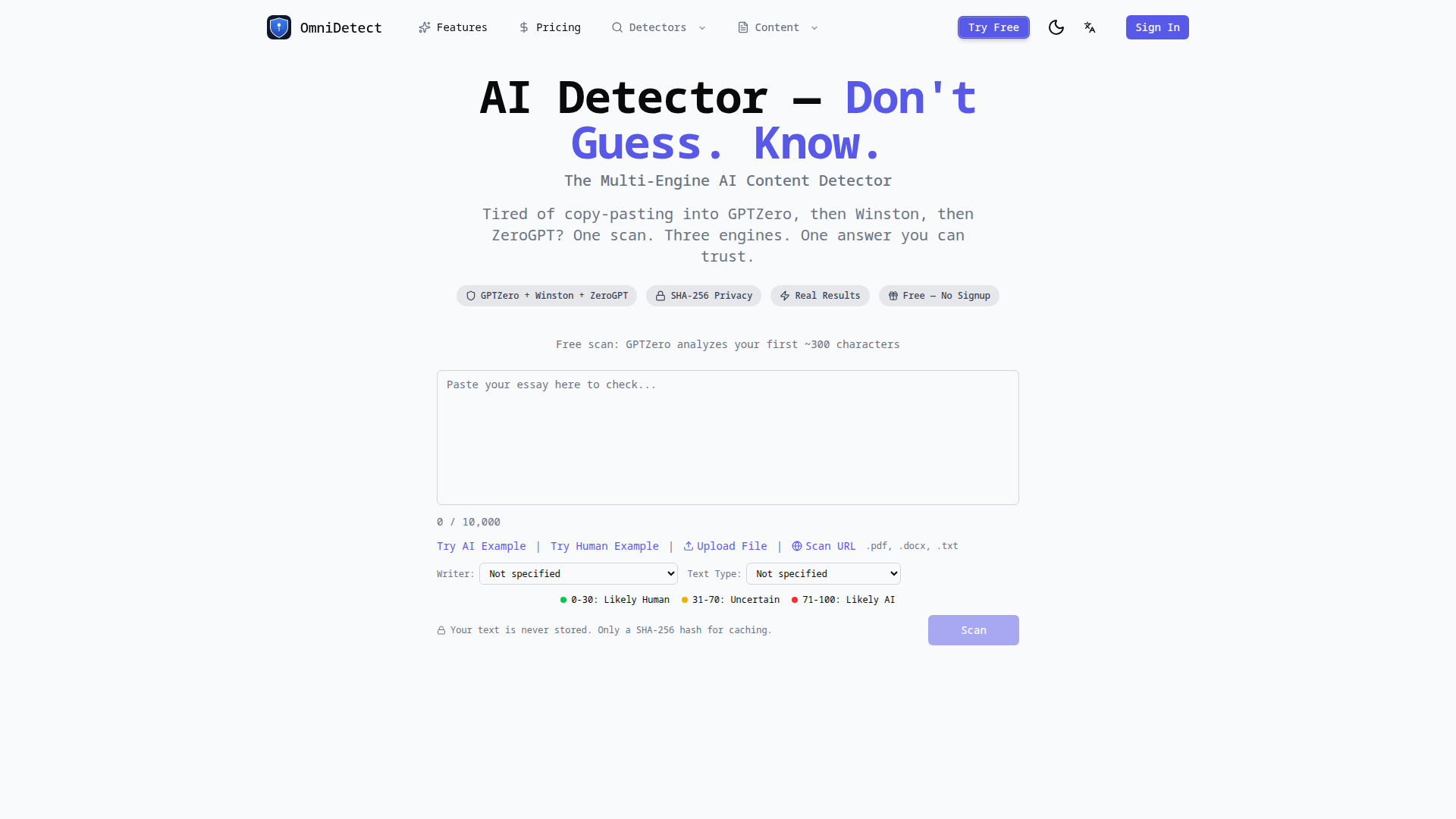
OmniDetect is an AI content detection tool that combines results from multiple detection engines into a single report. Based on the page, it runs GPTZero, Winston AI, and ZeroGPT in one scan, then summarizes the outcome as an OmniScore from 0 to 100 with bands for likely human, uncertain, and likely AI.
The product appears aimed at students, writers, educators, and content reviewers who want to verify text without checking several detector sites manually. Its core workflow is straightforward: paste text, upload a file, or scan a URL; let three engines analyze the content; then review the consensus result and any sentence-level guidance. It is positioned as a multi-engine alternative to single-detector tools, with privacy and speed emphasized as differentiators.
Features
- Multi-engine detection — Runs GPTZero, Winston AI, and ZeroGPT simultaneously so users can compare independent verdicts in one workflow.
- Consensus scoring with OmniScore — Aggregates engine outputs into a 0–100 score to make mixed detector results easier to interpret.
- Flexible input methods — Accepts pasted text, file uploads, and URL scans, which supports different review workflows for essays, articles, and web content.
- Sentence-level analysis — Highlights detection at the sentence level, which can help users identify which parts of a document may need review.
- AI Writing Coach and edit-rescan loop — Adds explanatory feedback and supports iterative revision, though the page does not fully detail how deep this coaching goes.
- Privacy-first processing — States that original text is not stored, with processing in RAM and SHA-256 hashing used for caching.
Helpful Tips
- Treat detector output as decision support, not final proof — Even with multiple engines, AI detection remains probabilistic, so high-stakes academic or editorial decisions should include human review.
- Use consensus carefully when engines disagree — A mixed result is often more informative than a single score because it signals uncertainty rather than certainty.
- Test with representative text types — Since the tool asks about writer profile and text type, accuracy may depend partly on context such as ESL writing, grammar-edited text, or technical content.
- Review privacy needs before adoption — The page makes clear privacy claims, but organizations with strict data rules should still validate handling practices and terms independently.
- Compare free and paid workflow limits — The site offers a free GPTZero-based scan and references fuller three-engine consensus as a paid capability, so buyers should map that distinction to real usage volume.
OpenClaw Skills
OmniDetect could likely fit well into OpenClaw as part of a content assurance or editorial risk workflow. A useful OpenClaw skill could take submitted text, send it for detection, normalize the OmniScore and per-engine outputs, and route the result into a review queue for teachers, editors, or trust-and-safety teams. Another likely workflow would combine document intake, AI-detection review, flagged-sentence extraction, and revision recommendations into a single agent-driven process.
In a broader OpenClaw ecosystem, this kind of product could support agents for academic integrity triage, publisher pre-screening, SEO content QA, or enterprise writing governance. These are likely use cases rather than confirmed native integrations from the page. If implemented well, the combination could shift professionals from manual spot-checking across several detector tools toward structured, auditable review pipelines with clearer escalation paths when detection signals conflict.
Embed Code
Share this AI tool on your website or blog by copying and pasting the code below. The embedded widget will automatically update with the latest information.
<iframe src="https://www.aimyflow.com/ai/omnidetect-ai/embed" width="100%" height="400" frameborder="0"></iframe>