
Ora AI
Rate this Tool
Average Score
Total Votes
Select your score (1-10):
Detail Information
What
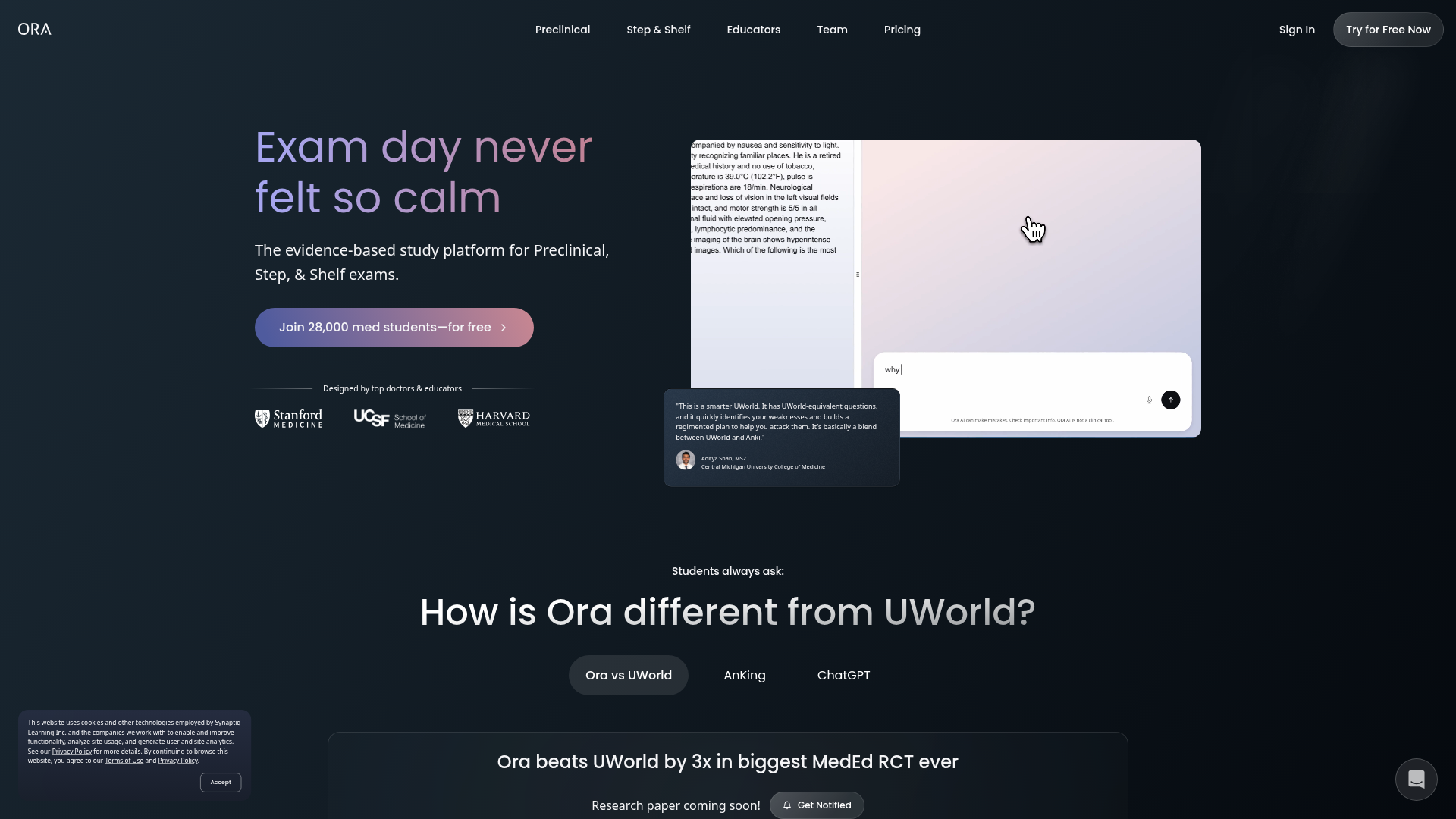
Ora AI is an evidence-focused medical study platform for preclinical coursework, USMLE Step 1/2, NBME shelf exams, and COMLEX I/II preparation. It combines a large question bank, spaced-repetition flashcards, videos, reference articles, and an in-platform AI copilot into a single study environment.
The product is aimed at medical students who want structured, performance-based preparation rather than fully manual planning. Its core workflow is to assess topic performance, generate daily study sessions tied to exam goals and dates, and rebalance schedules when students miss days. Positioning appears to be a unified alternative to fragmented tools (for example, separate QBank + flashcards + chat tools).
Features
- Spaced-Repetition QBank™ with 30,000+ questions helps learners repeatedly target weaker areas instead of only doing linear question sets.
- AI-optimized daily study planning builds personalized assignments from exam date, goals, and topic performance, reducing manual scheduling overhead.
- Integrated FSRS flashcards automatically reinforce retention using advanced spaced repetition within the same platform workflow.
- Built-in AI Copilot for medical topics provides contextual support directly inside QBank and flashcard study sessions.
- Multi-format content library (videos, articles, games) supports different learning modes, including fundamentals across 300+ video topics and in-depth concept references.
- Mobile access on iOS and Android enables continuity of study sessions across desktop and mobile contexts.
Helpful Tips
- Validate claimed outcome improvements with peer-reviewed publication details once available; the site cites an RCT but indicates the paper is still forthcoming.
- Compare fit by workflow needs: Ora appears strongest for students who want integrated planning + QBank + flashcards rather than best-in-class standalone tools.
- For curriculum alignment, test how well the platform supports your specific track (USMLE, shelf, COMLEX, or in-house exams) before full adoption.
- If institutional file upload is relevant, review the stated storage and processing model (S3 encryption, in-memory processing, no AI training on uploads) with your school’s policy team.
- Use the automatic plan rebalance feature consistently; its value is highest when learners study in frequent, trackable sessions.
OpenClaw Skills
Ora could likely pair well with OpenClaw as an orchestration layer around medical exam operations: for example, agents that transform weekly performance exports into coaching briefs, remediation plans, and advisor-ready summaries. A likely use case is an “Exam Readiness Agent” that flags weak domains (cardio, neuro, pharm), prioritizes next actions, and prepares structured study objectives for the coming week. This is an inference, not a confirmed native integration from the provided page.
Another likely OpenClaw workflow is institutional enablement for med-ed teams: agents that standardize learner support playbooks, monitor cohort-level risk signals, and route targeted interventions to mentors or educators. In practice, this could shift support from reactive tutoring toward proactive, data-informed coaching—especially in high-volume preclinical and board-prep environments.
Embed Code
Share this AI tool on your website or blog by copying and pasting the code below. The embedded widget will automatically update with the latest information.
<iframe src="https://www.aimyflow.com/ai/oraai-com/embed" width="100%" height="400" frameborder="0"></iframe>