
Palace | AI-native Planning & Dispatch
Rate this Tool
Average Score
Total Votes
Select your score (1-10):
Detail Information
What
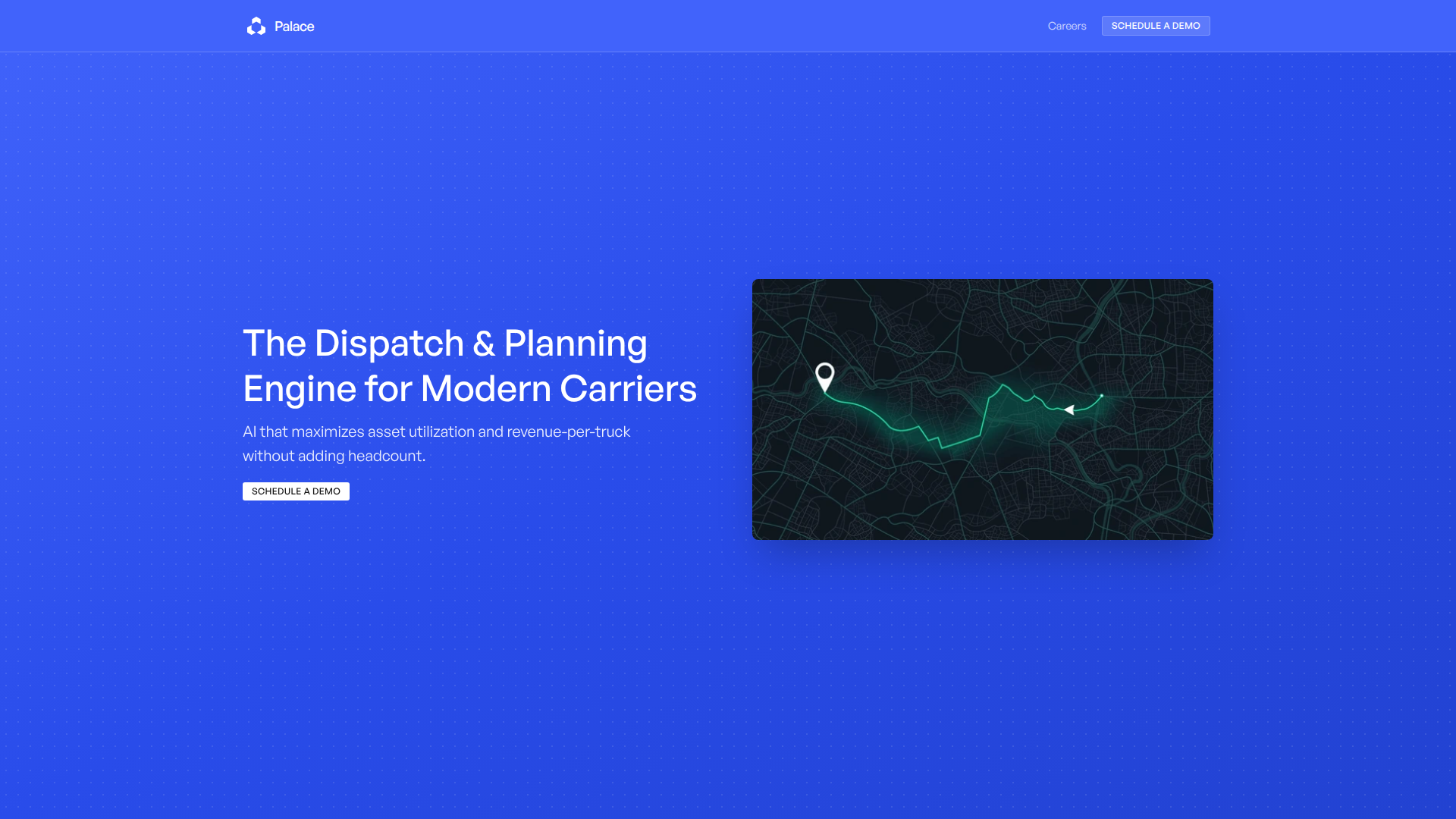
Palace is an AI-native planning and dispatch platform for modern carriers. It is positioned as a dispatch and planning engine that helps fleets improve asset utilization and revenue per truck while reducing manual operational effort.
The product appears built for carrier operations teams that manage load selection, planning, and day-of-execution dispatch decisions. Its core workflow covers sourcing and evaluating loads, automatically building fleet plans around operational constraints and KPIs, and helping teams adjust plans in real time when conditions change.
Features
- Unified load evaluation and assignment: Palace lets teams review and assign spot or contract load opportunities from one interface, which can simplify load selection workflows.
- Automatic fleet planning: The platform generates an optimal fleet plan based on stated KPIs and constraints such as driver, equipment, and customer requirements.
- Real-time dispatch adjustment support: When operational changes occur, Palace helps dispatchers identify the next best action in real time.
- Operational value assessment: Palace offers an initial analysis of loads, ELD data, and operations to identify likely sources of lost time and revenue.
- Tool connectivity without full replacement: The onboarding process includes connecting TMS, ELD, and other software, with the site explicitly stating that rip-and-replace is not required.
- Tailored deployment and support: The company describes platform tuning around a fleet’s planning and dispatch process, plus ongoing support through a dedicated communication channel and regular onsite engagement.
Helpful Tips
- Verify data quality early: Products in this category depend heavily on clean load, driver, equipment, and ELD data, so implementation success usually starts with data consistency.
- Define planning KPIs before rollout: Since Palace plans around KPIs and constraints, teams should agree upfront on what matters most, such as utilization, empty miles, service levels, or revenue per truck.
- Map exception workflows in detail: Real-time adjustment tools are most useful when common disruptions such as delays, equipment changes, and load swaps are clearly documented before deployment.
- Assess change management for dispatch teams: Even if no major system replacement is required, planners and dispatchers may need process updates to trust and use AI-generated plans effectively.
- Confirm scope of native integrations: The site mentions TMS, ELD, and other software connectivity, but it does not specify supported systems on this page, so buyers should validate integration depth during evaluation.
OpenClaw Skills
Palace could likely work well within the OpenClaw ecosystem as an operational decisioning layer for freight workflows. Likely OpenClaw skills could include load-prioritization agents, fleet exception-monitoring agents, dispatch recommendation copilots, and KPI tracking workflows that translate Palace planning outputs into clear operational tasks for planners, dispatchers, and managers. The page does not confirm a native OpenClaw integration, so this should be treated as a likely orchestration use case rather than a documented product capability.
In practice, that combination could help carriers move from reactive dispatch to coordinated, semi-autonomous operations. For example, an OpenClaw agent could monitor incoming load opportunities, summarize tradeoffs, route exceptions to the right dispatcher, and trigger follow-up workflows when actual operations diverge from plan. For transportation teams, this would likely reduce spreadsheet-heavy coordination and make AI-assisted planning more usable across daily operations, not just at the initial planning stage.
Embed Code
Share this AI tool on your website or blog by copying and pasting the code below. The embedded widget will automatically update with the latest information.
<iframe src="https://www.aimyflow.com/ai/palace-so/embed" width="100%" height="400" frameborder="0"></iframe>