
Improve your AI infrastructure - AI memory engine
Rate this Tool
Average Score
Total Votes
Select your score (1-10):
Detail Information
What
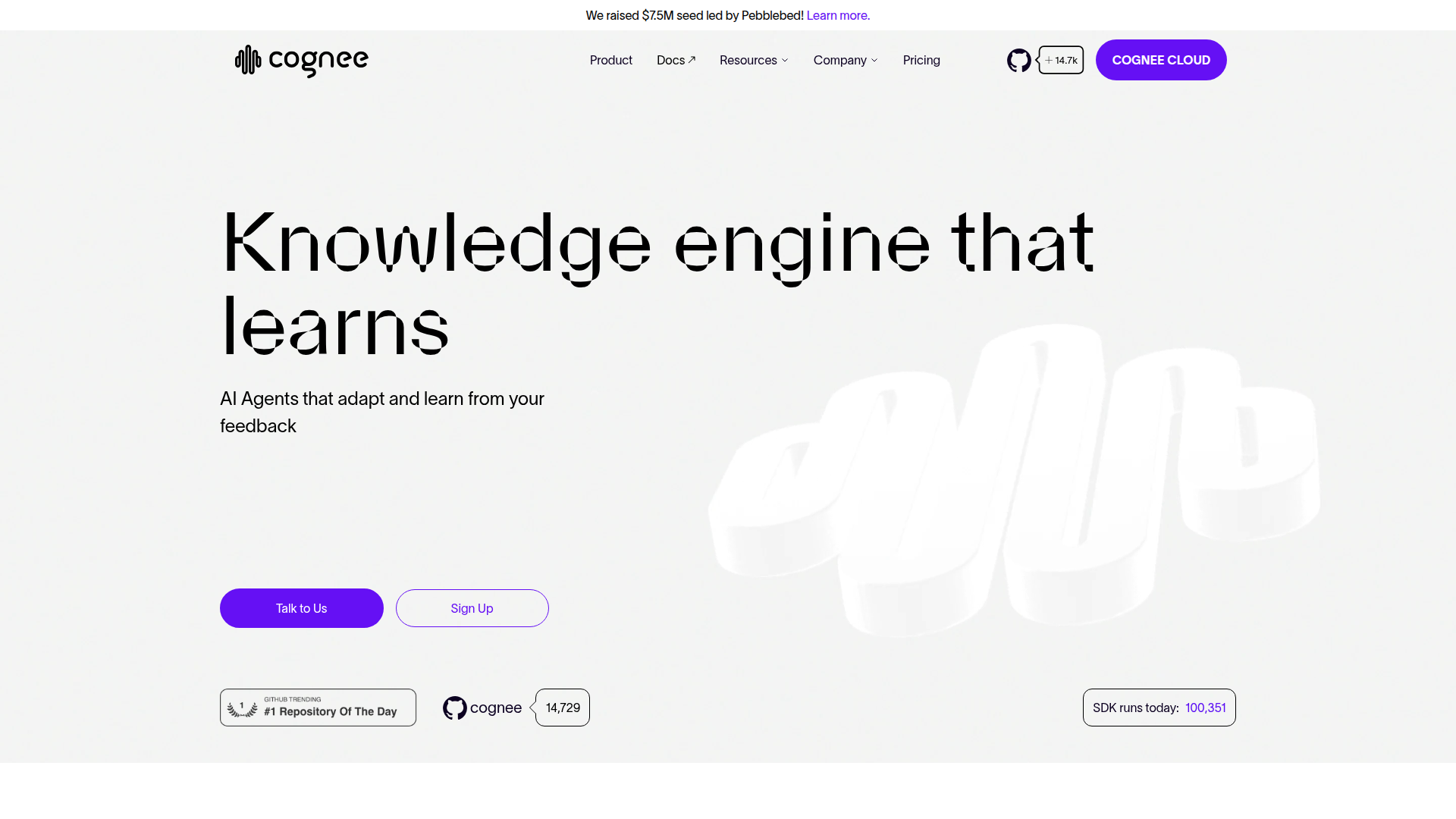
Cognee is an AI memory and knowledge engine designed to sit behind AI agents as the retrieval and reasoning layer. It focuses on turning business data into a living knowledge graph that can learn from feedback, improve over time, and support more adaptive agent behavior than standard retrieval-augmented generation setups.
The product appears aimed at engineers and teams building vertical AI agents, domain-specific copilots, or systems that need to unify siloed data. Its positioning is likely infrastructure for agent memory: a platform that combines knowledge modeling, context curation, memory management, and reasoning support instead of relying only on vector search or custom knowledge graph tooling.
Features
- Living knowledge graph creation — Converts source data into a knowledge graph structure intended to support richer relationships, better retrieval, and evolving understanding over time.
- Feedback-driven self-improvement — Learns from user or system feedback and auto-tunes concepts and synonyms so answers can improve as usage continues.
- Agent memory management — Provides session management, memory management, and agentic isolation to help agents retain relevant context without uncontrolled context growth.
- Ontology and custom data modeling — Includes ontology mapping and custom data model support, which is useful for domain-specific terminology and structured reasoning.
- Broad data ingestion — Supports 30+ or 38+ data types, including common files such as PDFs, docs, spreadsheets, audio, and images, helping teams consolidate fragmented knowledge sources.
- Flexible infrastructure choices — Supports native integrations with agentic frameworks and offers bring-your-own options across vector databases, models, and graph databases for teams with existing stacks.
Helpful Tips
- Evaluate it against your current RAG pain points — This type of platform is most relevant when your main issues are poor recall, weak domain understanding, fragmented data, or brittle retrieval behavior.
- Start with a narrow domain ontology — The strongest early results usually come from modeling one business domain clearly before trying to unify every data source and concept at once.
- Define feedback loops early — Since the product emphasizes learning from feedback, implementation quality will depend on how consistently corrections, preferences, and concept updates are captured.
- Check operational fit with your stack — The page suggests flexibility around models, vector databases, graph databases, and frameworks, so buyers should confirm which components remain reusable versus replaced.
- Validate explanation and citation needs in production — The site highlights precise and cited answers in examples, but teams should still test output quality on their own data and workflows before broad rollout.
OpenClaw Skills
Cognee could likely pair well with OpenClaw as a memory and knowledge substrate for agents that need persistent context, structured retrieval, and domain adaptation. Likely OpenClaw skills could include document-grounded research agents, internal policy assistants, case-history recall agents, and multi-step support workflows that pull from evolving organizational knowledge rather than only static prompts or vector search.
In a broader workflow, OpenClaw could orchestrate task execution while Cognee likely manages long-term memory, ontology-aware retrieval, and feedback-based refinement. That combination could be especially useful in knowledge-heavy industries such as finance, education, enterprise support, or regulated operations, where professionals need agents that can unify scattered records, preserve context across sessions, and improve their handling of specialized language over time; this is a likely use case based on the page, not a confirmed native integration.
Embed Code
Share this AI tool on your website or blog by copying and pasting the code below. The embedded widget will automatically update with the latest information.
<iframe src="https://www.aimyflow.com/ai/prometh-ai/embed" width="100%" height="400" frameborder="0"></iframe>