
Qwen
Rate this Tool
Average Score
Total Votes
Select your score (1-10):
Detail Information
What
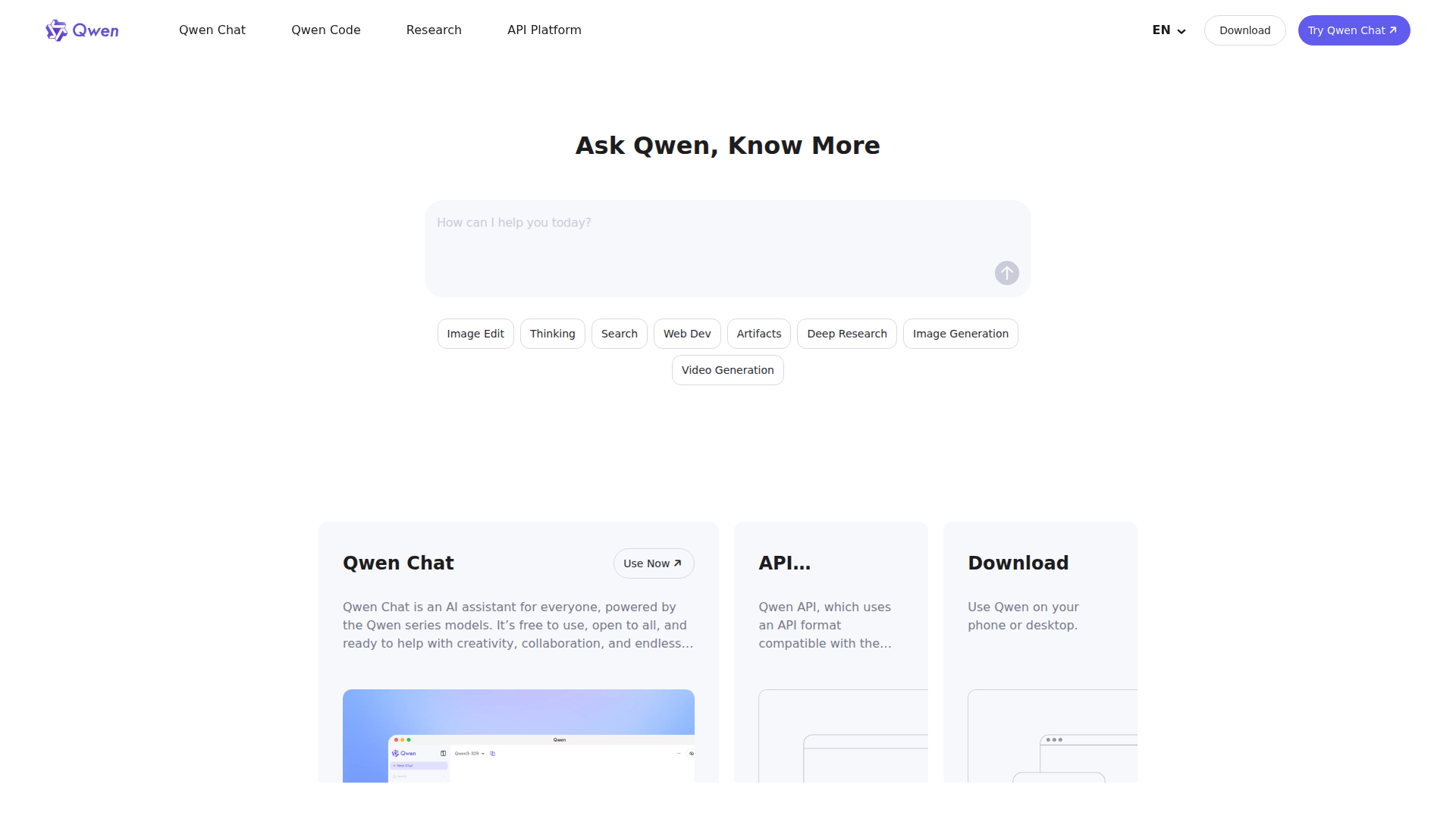
Qwen Chat is a general-purpose AI assistant built on the Qwen model series. It is presented as free to use and broadly accessible, with support for creativity, collaboration, search, reasoning, research, web development, image generation, and multimodal understanding across text, images, audio, and video.
The product appears positioned as both a consumer-facing AI workspace and an entry point into the broader Qwen platform, which also includes a downloadable app experience and an API platform compatible with the OpenAI API format. Its core workflow centers on letting users describe a task in natural language, then using specialized modes or tools to generate answers, reports, webpages, visuals, or multimodal analysis.
Features
- General AI chat assistant: Qwen Chat provides a broad conversational interface for everyday creative, collaborative, and knowledge tasks.
- Deep Research agent: It performs multi-step web research and analytical summarization to produce comprehensive, readable reports for complex tasks.
- Web search with contextual filtering: Qwen searches across the web and aims to return results that are relevant to the user’s query and intent.
- Advanced reasoning mode: The Thinking capability is designed for complex problem-solving and logical analysis, using real-time internet data according to the page.
- Natural-language web page generation: Web Dev turns a prompt into a ready-to-use webpage with code and design output, aimed at reducing the need for manual coding.
- Multimodal creation and understanding: Qwen supports image generation and can process text, images, audio, and video together for analysis or response generation.
Helpful Tips
- Separate broad chat from specialized modes: For better results, use standard chat for general drafting and Qwen’s dedicated research, web development, or image features for task-specific work.
- Validate research outputs on high-stakes tasks: Deep Research is described as efficient and multi-step, but important decisions should still include human review of sources and conclusions.
- Test prompt structure for build tasks: For Web Dev and image generation, clear constraints, examples, and expected output format will likely improve consistency and reduce rework.
- Assess API needs separately from chat use: The page confirms an API platform with OpenAI-compatible formatting, but teams should still verify model availability, limits, and deployment fit before implementation.
- Confirm multimodal depth by use case: The site states support for text, image, audio, and video understanding, but buyers should validate performance against their specific document, media, or workflow requirements.
OpenClaw Skills
Qwen Chat could fit well into the OpenClaw ecosystem as a reasoning, research, and multimodal execution layer. Likely OpenClaw skills could include a research agent that runs Deep Research for market scans, a search-and-summarize skill for competitive monitoring, a coding assistant that drafts landing pages or prototypes through Web Dev, and a multimodal analyst that reviews mixed media inputs such as screenshots, charts, audio clips, and video excerpts. The API platform’s OpenAI-compatible format suggests a practical path for orchestration, although native OpenClaw integration is not stated on the page.
In a likely B2B use case, OpenClaw could coordinate Qwen-powered agents for marketing, product, support, or analyst teams: one agent gathers web evidence, another synthesizes findings, another generates presentation-ready visuals, and another drafts a functional webpage or internal tool. Combined this way, the product could shift work from isolated prompt use toward repeatable multi-agent workflows, especially in research-heavy and content-heavy roles, while still requiring governance around review, source quality, and output validation.
Embed Code
Share this AI tool on your website or blog by copying and pasting the code below. The embedded widget will automatically update with the latest information.
<iframe src="https://www.aimyflow.com/ai/qwen-ai-home/embed" width="100%" height="400" frameborder="0"></iframe>