
Platform Overview | Robovision
Rate this Tool
Average Score
Total Votes
Select your score (1-10):
Detail Information
What
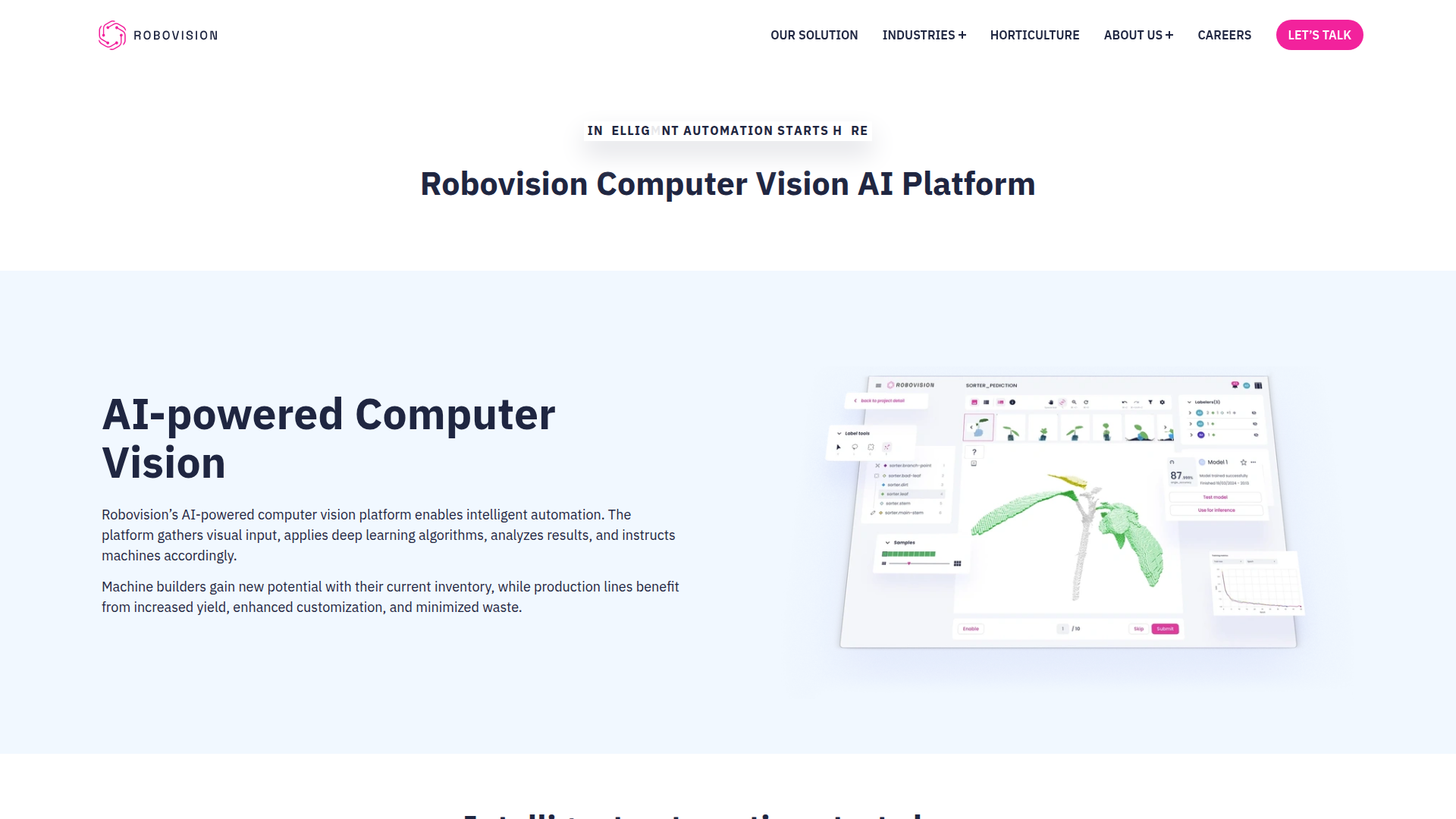
Robovision is a computer vision AI platform for industrial automation. It helps organizations capture visual data, annotate and curate it, train and test deep learning models, optimize model performance, and deploy custom AI to production environments either centrally managed or on-site.
The platform appears positioned for machine builders, manufacturers, and industrial teams in sectors such as food and beverage, packaging and logistics, semiconductors, horticulture, and healthcare. Its core value is giving teams a structured way to build and operationalize vision AI without relying on fully custom-built systems or extensive coding expertise.
Features
- End-to-end computer vision workflow — Supports the full path from data import through annotation, curation, training, testing, optimization, and deployment, which helps teams manage the AI lifecycle in one platform.
- Visual data annotation tools — Includes assisted grabcut and magnetic lasso tools for faster segmentation, which can reduce manual labeling effort for image-based projects.
- Data quality and ground-truth curation — Provides analytics to check labeled data quality and define ground truth, supporting more reliable model evaluation.
- Model performance testing and optimization — Lets users evaluate models against ground truth and calculate data confidence to identify the most relevant samples for relabeling.
- Flexible deployment options — Custom AI models can be deployed centrally or on-site, which is useful for production-line and industrial operating environments.
- Built-in vision algorithms — Offers semantic segmentation, instance segmentation, classification, object detection, anomaly detection, and multiview classification for common industrial inspection and automation tasks.
Helpful Tips
- Assess the annotation burden early — For vision AI projects, labeling quality and consistency often determine outcomes more than model choice, so review class definitions and edge cases before scaling data work.
- Match the algorithm type to the operational need — Classification, detection, segmentation, and anomaly detection solve different problems, so selection should depend on whether the task is defect finding, localization, counting, or pixel-level inspection.
- Plan for retraining and sample review — The platform’s testing and optimization stages suggest an iterative workflow, which is important because production data usually changes over time.
- Validate deployment constraints upfront — Since deployment can be central or on-site, buyers should confirm latency, hardware, and plant-environment requirements for their intended use case.
- Treat no-code accessibility as a governance question too — Easier access for domain experts can accelerate adoption, but organizations still need clear ownership for model validation, change control, and ongoing monitoring.
OpenClaw Skills
Within the OpenClaw ecosystem, Robovision could likely serve as the vision layer inside broader industrial automation workflows. Likely use cases include skills that orchestrate image intake, trigger annotation review queues, summarize model test results for operations teams, or route low-confidence predictions to human reviewers before decisions reach production equipment. The source page does not state a native OpenClaw integration, so this should be treated as a workflow inference rather than a confirmed capability.
This combination could be especially useful for manufacturing, quality inspection, robotics, and technical operations roles. OpenClaw agents could likely turn Robovision outputs into downstream actions such as incident creation, exception handling, production reporting, root-cause analysis prompts, or operator guidance. In practice, that would shift computer vision from a standalone model-development activity into a more operational system that connects plant data, human review, and machine actions in one coordinated process.
Embed Code
Share this AI tool on your website or blog by copying and pasting the code below. The embedded widget will automatically update with the latest information.
<iframe src="https://www.aimyflow.com/ai/robovision-ai-product-platform/embed" width="100%" height="400" frameborder="0"></iframe>
Explore Similar Tools
Learn Data Science and AI Online | DataCamp
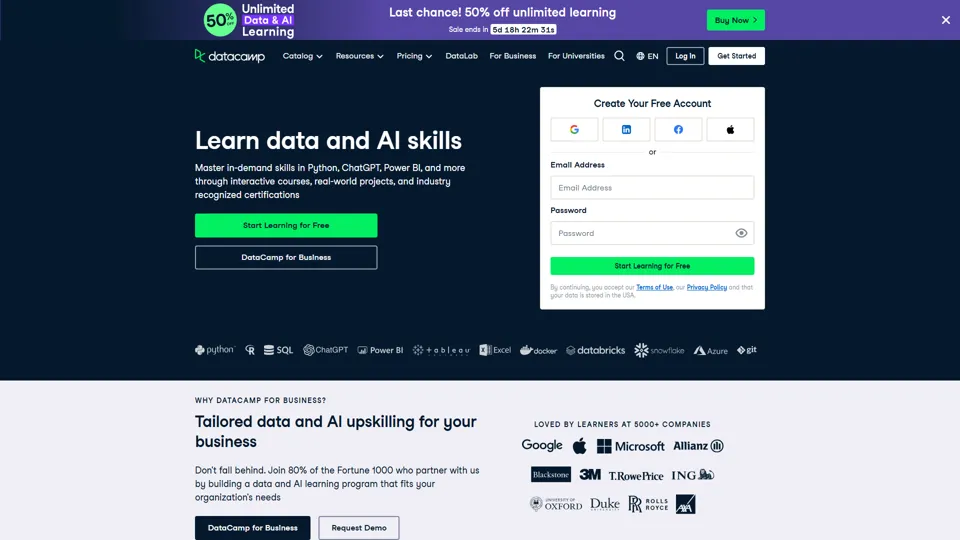
DataCamp is an online learning platform for data science and AI that helps learners build skills in Python, R, statistics, and analytics through courses and coding exercises. In the AI era, it helps analysts and technical teams upskill continuously as tools and workflows evolve faster.

Surf - Crypto's Ultimate AI
Surf is an AI-powered crypto research platform that helps traders and investors analyze cryptocurrency markets, trends, and trading opportunities. In the AI era, it helps crypto researchers synthesize fast-moving information and respond to market signals with greater speed.
Fabi.ai: AI-powered data analysis platform | SQL + Python + AI
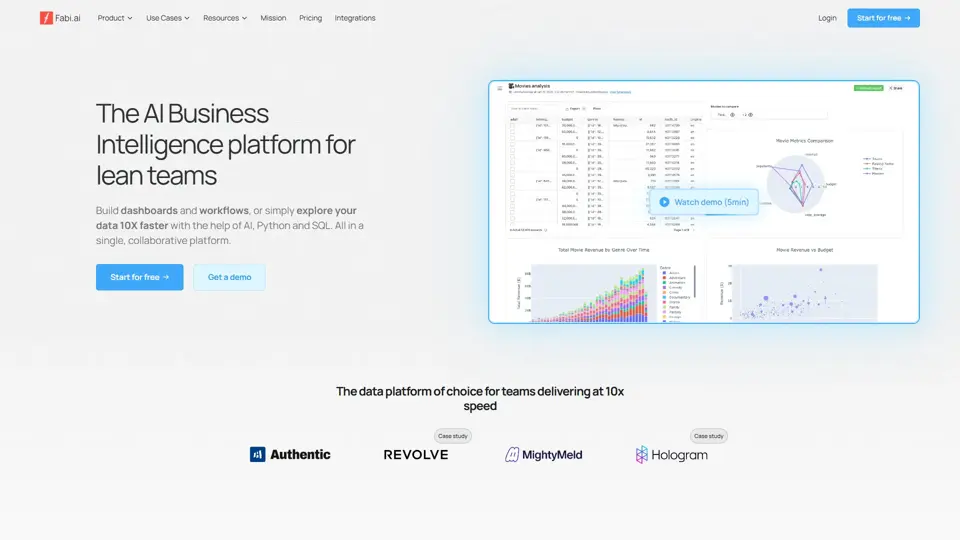
Fabi.ai is an AI-powered data analysis platform that combines SQL, Python, and automation to help analysts explore data and generate insights faster. It boosts productivity for data teams by reducing manual analysis steps and accelerating decision-making from raw data.
Mysports AI - Free AI Sports Picks & Predictions Today
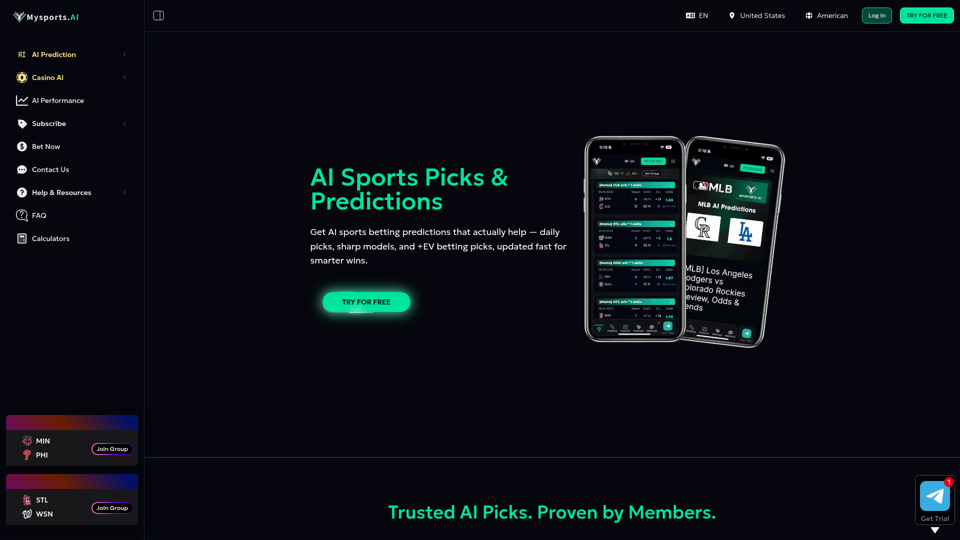
Mysports AI is an AI sports prediction platform that provides daily betting picks and probability-based forecasts such as money line, point spread, totals, parlays, and expected goals, mainly for sports bettors seeking data-informed guidance. For bettors and sports analysts, AI-generated probability models can speed routine line evaluation and help compare opportunities across leagues more consistently.
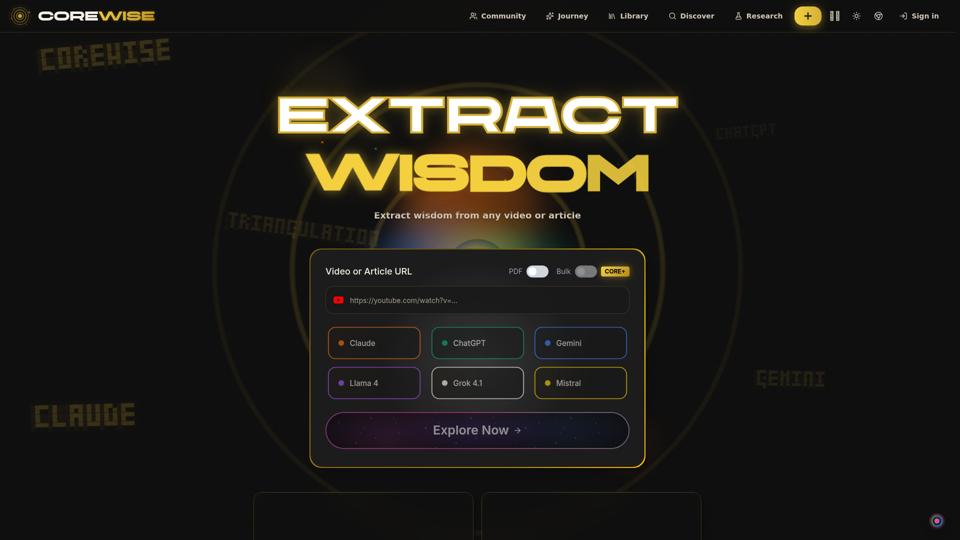
CoreWise - Extract Wisdom with Claude, Gemini, ChatGPT & More | Free
CoreWise is a free AI content analysis tool that extracts synthesized insights, key takeaways, and Q&A from videos, podcasts, articles, PDFs, and bulk content URLs, mainly for people doing research and learning from long-form media. By comparing outputs across models such as Claude, ChatGPT, Gemini, Llama, Grok, and Mistral, it can help researchers, analysts, and knowledge workers review source material faster and spot consensus or gaps more efficiently.
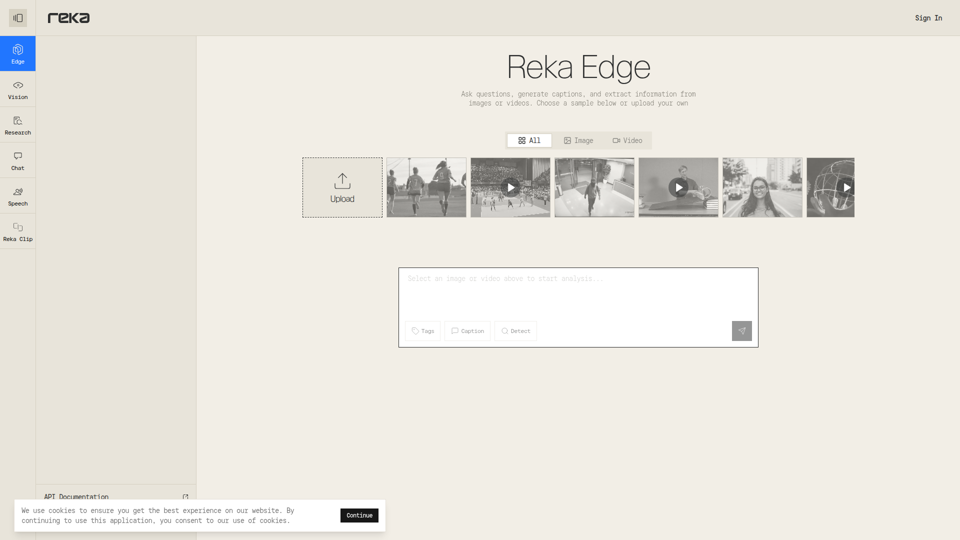
Reka Edge
Reka Edge is a vision-first AI playground that helps users ask questions, generate captions, and extract information from images and videos, mainly for teams exploring visual reasoning and real-world media analysis tasks. For researchers, analysts, and product teams, it can speed up image and video understanding workflows by making it easier to test prompts and iterate on multimodal tasks.
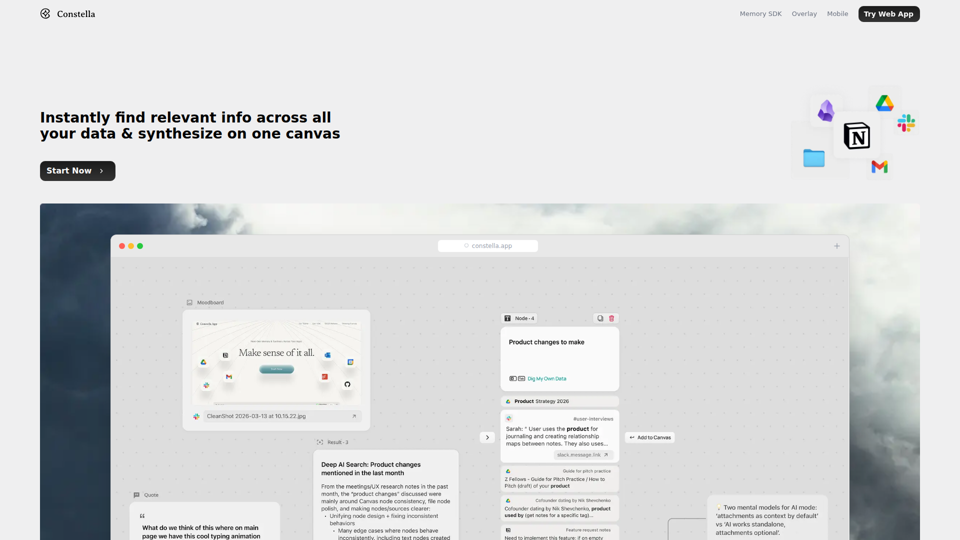
Constella — Find & Synthesize All Your Research
Constella is an AI research and memory tool that helps users find information across connected sources and synthesize it on a single canvas, mainly for researchers and other knowledge workers managing scattered notes and references. In AI-assisted workflows, it can help research, analysis, and creative roles spend less time searching across tabs and more time reviewing cited findings and developing ideas.
Cerebro - AI-Powered Knowledge Management
Cerebro is an AI-powered knowledge management tool that turns videos, articles, books, and documents into searchable insights and answers, mainly for people who do research-heavy knowledge work. For researchers, students, marketers, and other content-intensive roles, it can reduce time spent rewatching or searching sources while helping surface connections across materials.