
Rollstack | Automate your Presentations and Documents
Rate this Tool
Average Score
Total Votes
Select your score (1-10):
Detail Information
What
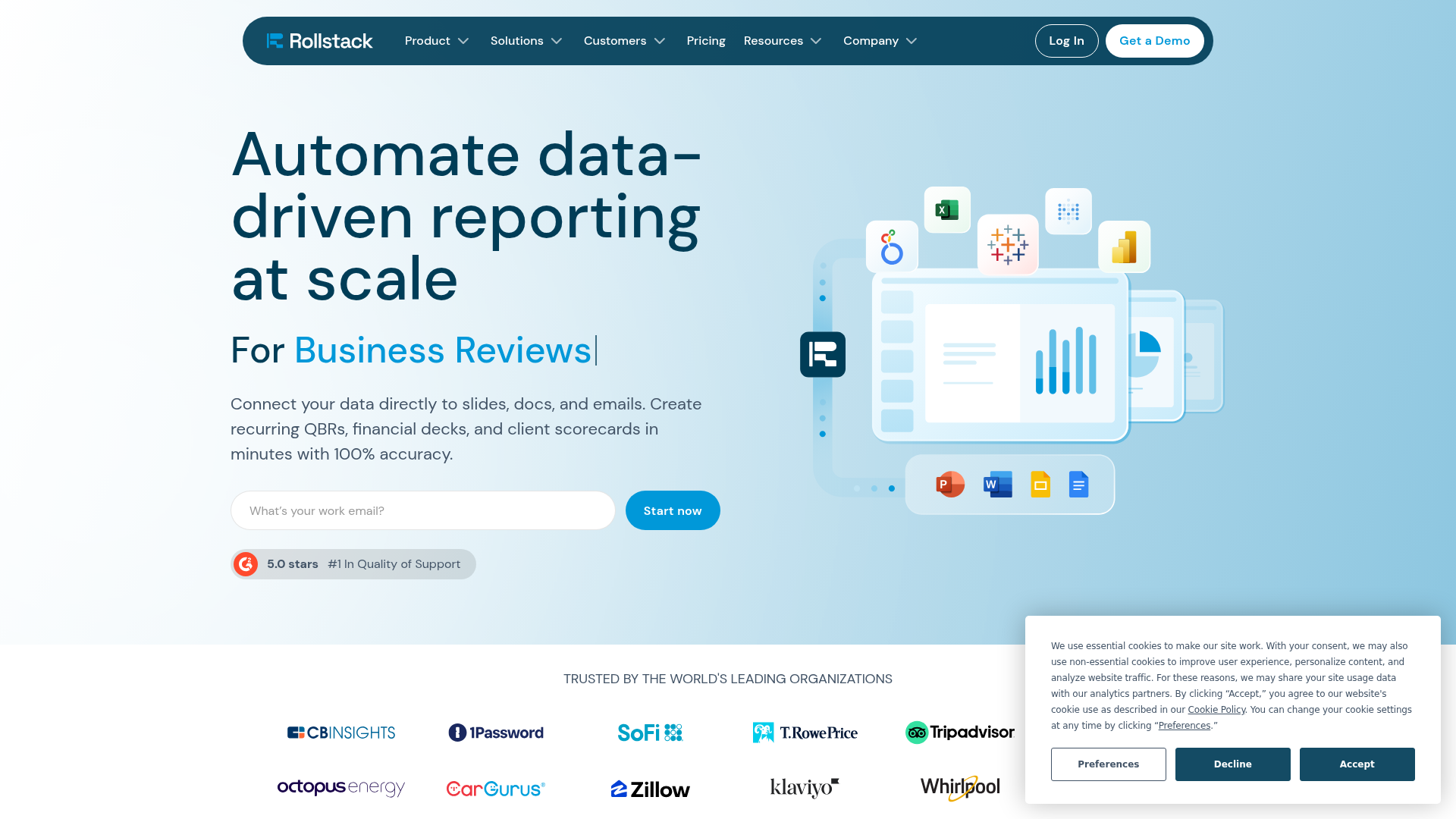
Rollstack is a reporting automation product that connects business data sources to presentations, documents, and email-based outputs. Its core job is to move data from BI tools and spreadsheets into reusable templates so teams can generate recurring reports such as QBRs, financial decks, client scorecards, and executive updates without manually copying charts and numbers.
The product appears positioned for organizations that already rely on analytics tools but still finish reporting work in PowerPoint, Word, Google Workspace, or similar document workflows. The site highlights teams in data and analytics, finance, business operations, customer success, and marketing, with industry use cases spanning financial services, healthcare, IT services, media, retail, education, and industrial sectors.
Features
- Data-source connections: Rollstack connects BI and spreadsheet sources such as Tableau, Power BI, Looker, Omni, Lightdash, Metabase, Microsoft Excel, and Google Sheets to reporting assets so data can flow into business-facing materials.
- Template-based report generation: Teams can turn presentations and documents into templates, which helps standardize recurring reports and create multiple content variants at scale.
- Scheduled updates: Reports can be refreshed automatically on a schedule, reducing the need to manually update decks and documents before recurring meetings or stakeholder reviews.
- AI-powered insights: The product states that its AI evaluates visualizations and report data to provide analysis and insights for reporting workflows.
- Distribution and sharing: Rollstack supports sharing generated content through email and other communication channels to extend automation beyond content creation.
- Governance and security controls: The site emphasizes enterprise-grade security, local storage of slides and documents in users’ drives, and a trust center; detailed governance behavior beyond that is not fully described on the page.
Helpful Tips
- Validate template discipline early: Products like this work best when reporting teams first standardize slide and document layouts, naming conventions, and KPI definitions.
- Prioritize high-frequency reporting use cases: The strongest initial fit is usually recurring executive, client, operational, or finance reporting where manual refresh work is repetitive and error-prone.
- Review AI output before broad rollout: Since the site mentions AI-generated analysis, teams should set approval rules and editorial review steps before relying on those insights in external or executive-facing documents.
- Map source ownership clearly: Successful adoption depends on knowing which dashboards, sheets, and metrics are authoritative so automated outputs do not reproduce conflicting numbers.
- Assess document ecosystem fit: Buyers should confirm which authoring and distribution environments matter most internally, especially if workflows span Microsoft 365, Google Workspace, and multiple BI platforms.
OpenClaw Skills
Within the OpenClaw ecosystem, Rollstack would likely be a strong downstream reporting action layer for agents that monitor metrics, detect changes, and prepare stakeholder-ready outputs. A likely use case would be an OpenClaw agent that watches KPI thresholds in BI systems, selects the correct reporting template, triggers a Rollstack refresh, and routes the finished deck or document to leadership, account teams, or operating reviews. The page shows relevant source and destination systems, but it does not explicitly confirm a native OpenClaw integration.
This combination could be especially useful for finance, RevOps, customer success, and analytics teams that need to convert raw dashboards into decision-ready narratives. Likely OpenClaw skills around Rollstack could include board-pack preparation, customer health review generation, monthly business review orchestration, anomaly-to-report workflows, and approval chains for AI-assisted commentary. In practice, that would shift work away from manual report assembly and toward exception handling, interpretation, and stakeholder communication.
Embed Code
Share this AI tool on your website or blog by copying and pasting the code below. The embedded widget will automatically update with the latest information.
<iframe src="https://www.aimyflow.com/ai/rollstack-com/embed" width="100%" height="400" frameborder="0"></iframe>