
Shasta Health | AI Workflow Automation for Clinics
Rate this Tool
Average Score
Total Votes
Select your score (1-10):
Detail Information
What
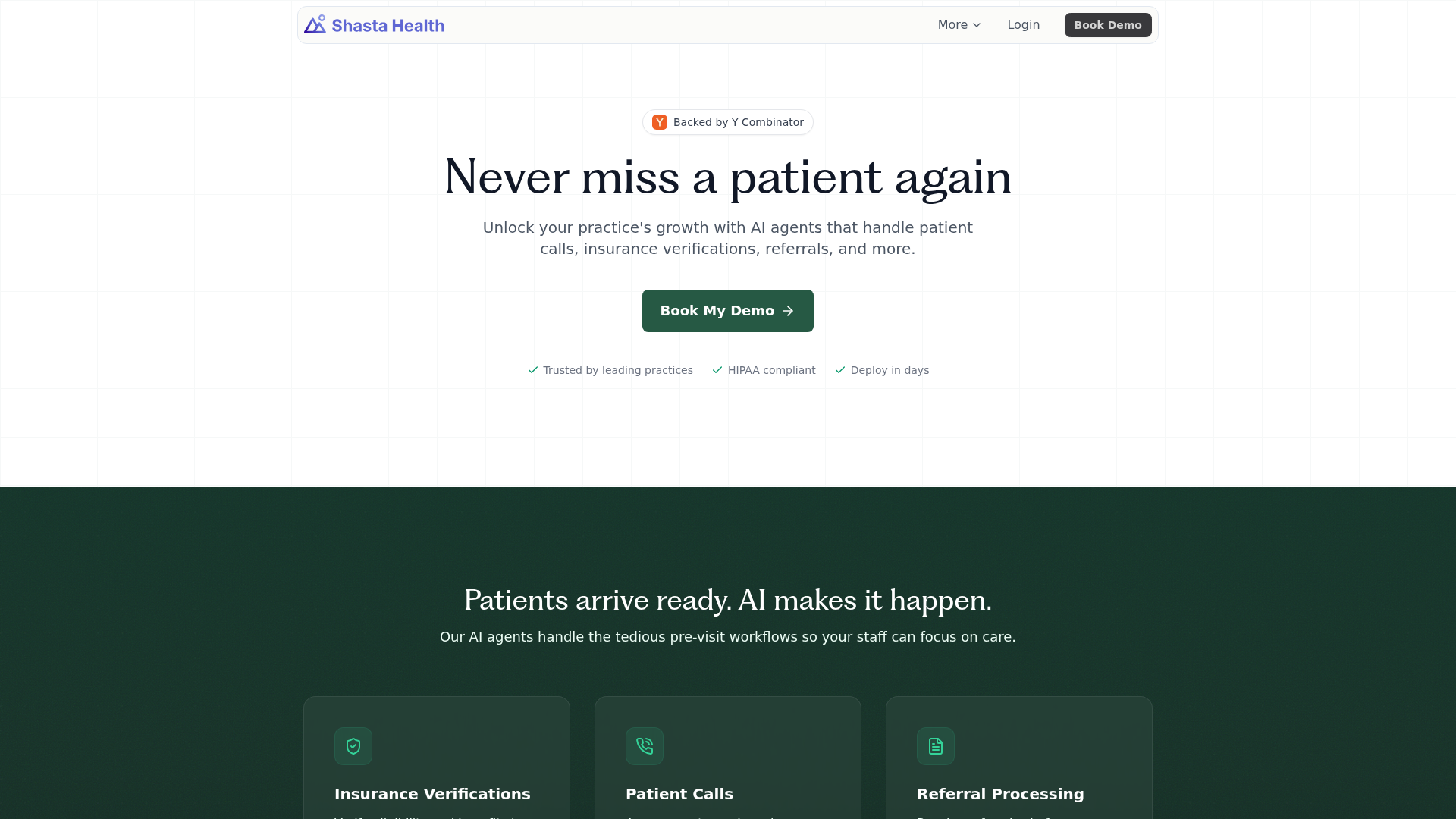
Shasta Health is an AI workflow automation product for clinics that focuses on pre-visit and front-desk administrative work. Based on the page, it is designed for outpatient practices that need help with patient calls, insurance verifications, referral intake, and related coordination tasks.
Its core workflow is to take repetitive clinic operations that usually require staff to navigate payer portals, wait on insurance lines, process faxed referrals, update the EMR, and contact patients, then have AI agents perform those steps continuously. The product appears positioned as a clinic operations layer that works with existing systems without requiring traditional API-heavy EMR integrations.
Features
- Insurance verification automation: The AI checks eligibility and benefits in real time by navigating payer portals and calling insurers when portal data is incomplete, which helps clinics capture details such as copays, deductibles, authorization requirements, and referral needs.
- 24/7 patient call handling: The platform answers, routes, and resolves patient calls around the clock, reducing missed calls and front-desk overload while supporting appointment-related workflows.
- Appointment scheduling support: Shasta can review provider availability, match patient preferences, offer time options, confirm details, and send confirmations, which streamlines scheduling for follow-up and new visits.
- Referral processing from fax to EMR: The system receives referrals on an existing fax line, parses demographics and clinical details, and enters them into the EMR, reducing manual intake work.
- Referral follow-up calls: After referral intake, the AI can contact patients to gather missing information, verify insurance, answer visit questions, and schedule appointments, helping move referrals toward booked visits faster.
- Works with existing clinic systems: The company states that its AI learns staff workflows and navigates the EMR without requiring APIs or complex integrations, which may shorten deployment time for clinics with legacy tools.
Helpful Tips
- Validate workflow fit at the task level: For this type of product, clinics should map exact handoff points for verifications, referrals, and calls to confirm where AI can act independently and where staff review is still needed.
- Review exception handling carefully: The strongest value often comes from edge cases such as incomplete insurance data, missing referral details, or complex patient questions, so buyers should assess how exceptions are surfaced and resolved.
- Start with high-volume administrative queues: Insurance verification, referral intake, and missed-call recovery are typically the best initial use cases because they are repetitive, measurable, and operationally costly when delayed.
- Confirm monitoring and quality controls: Since the page mentions dashboards, guardrails, and quality tracking, clinics should examine what supervisors can review, edit, or audit before expanding usage broadly.
- Assess EMR workflow realism: Because the product emphasizes working without APIs, implementation teams should verify how reliably it can navigate their specific EMR environment and how changes in screens or workflows are managed.
OpenClaw Skills
Shasta Health could fit well into the OpenClaw ecosystem as an operational execution layer for clinic admin workflows. Likely OpenClaw skills could include a referral-intake agent that classifies incoming documents and triggers downstream tasks, an insurance-readiness agent that monitors upcoming appointments and requests benefit checks, and a call-triage workflow that routes unresolved issues to staff with structured context. The source page does not describe a native OpenClaw integration, so these should be treated as likely orchestration use cases rather than confirmed product capabilities.
Combined with OpenClaw, the product could support more coordinated multi-step healthcare operations across scheduling, intake, verification, and patient communication. For example, a clinic operations team could use OpenClaw agents to prioritize tomorrow’s visits, identify records missing authorizations or benefit details, trigger Shasta-style execution on those cases, and escalate only the exceptions that require human judgment. In practice, that kind of setup could shift front-desk and referral teams from repetitive data handling toward oversight, patient support, and exception management.
Embed Code
Share this AI tool on your website or blog by copying and pasting the code below. The embedded widget will automatically update with the latest information.
<iframe src="https://www.aimyflow.com/ai/shasta-health/embed" width="100%" height="400" frameborder="0"></iframe>