
Slicker - AI-Powered Payment Recovery
Rate this Tool
Average Score
Total Votes
Select your score (1-10):
Detail Information
What
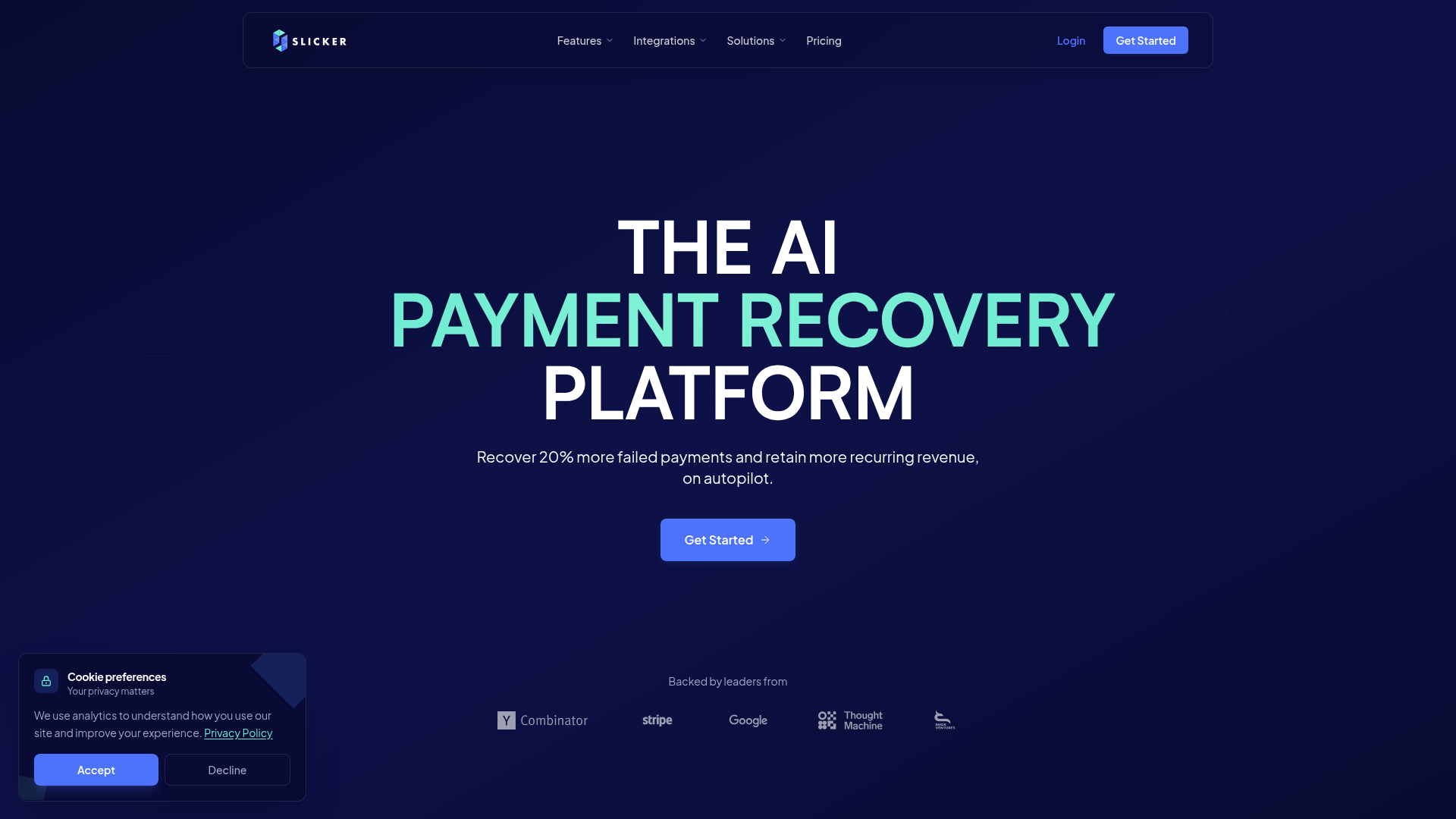
Slicker is an AI-powered payment recovery platform focused on failed recurring payments. It is designed for businesses with subscription or recurring revenue models that want to reduce involuntary churn and recover revenue without adding manual payment operations.
The platform analyzes failed transactions, chooses a recovery strategy, executes retries or customer communications, and reports outcomes in a central dashboard. Based on the page, Slicker is positioned as a specialized payment recovery layer that works through existing billing systems and payment providers rather than requiring a separate payments process.
Features
- AI-driven failure analysis: Slicker evaluates each failed payment using network messages, gateway error codes, and customer behavioral signals to decide the most suitable recovery approach.
- Smart retries: The platform determines whether to retry, when to retry, and how much to retry, with support for multi-gateway selection and routing to improve recovery outcomes.
- Targeted dunning emails: It sends customer communications only when action is required, tailoring messages to the failure reason, recovery stage, and needed next step.
- Payment links within branded messaging: Recovery emails can include one-click payment links that direct users to the merchant’s website, helping preserve brand continuity during repayment.
- Evaluation and testing framework: Slicker says it uses AABB testing to compare performance against an existing solution and demonstrate whether it delivers a statistically significant uplift.
- Dashboard and reporting: Users get a consolidated view of payment failures, recovery rates, and performance across plans and countries in a single reporting interface.
Helpful Tips
- Validate fit against your billing stack: Slicker lists native integrations for several billing systems and payment providers, so implementation risk is likely lower when your current setup matches those supported systems.
- Assess failure mix before rollout: This type of product is most useful when a meaningful share of churn comes from failed payments rather than voluntary cancellations or broader retention issues.
- Review messaging control requirements: Since Slicker can send customer-facing dunning emails, teams should confirm brand, tone, and escalation policies before deployment.
- Use controlled evaluation carefully: The platform emphasizes comparative testing, which is valuable, but buyers should still review how test groups, baseline recovery logic, and success criteria are defined.
- Check internal ownership early: Payment recovery often touches finance, growth, billing operations, and customer lifecycle teams, so adoption is smoother when ownership is explicit.
OpenClaw Skills
Within the OpenClaw ecosystem, Slicker could likely support skills focused on revenue recovery operations, failed-payment triage, and subscription retention monitoring. A likely workflow would have an OpenClaw agent ingest Slicker dashboard data, summarize decline patterns by country, plan, or payment method, and generate operational recommendations for finance or growth teams. The source page does not state a native OpenClaw integration, so this should be treated as a likely orchestration use case rather than a confirmed capability.
OpenClaw agents could also be built around adjacent processes such as churn-risk reporting, dunning content review, issuer-decline analysis, and executive revenue-impact briefings. For SaaS, media, fitness, or e-learning businesses, that combination could shift payment recovery from a narrow billing function into a more automated revenue-operations workflow, where teams continuously identify failure causes, evaluate retry strategies, and adapt customer communications with less manual analysis.
Embed Code
Share this AI tool on your website or blog by copying and pasting the code below. The embedded widget will automatically update with the latest information.
<iframe src="https://www.aimyflow.com/ai/slickerhq-com/embed" width="100%" height="400" frameborder="0"></iframe>