
sudocode - lightweight context management for coding agents
Rate this Tool
Average Score
Total Votes
Select your score (1-10):
Detail Information
What
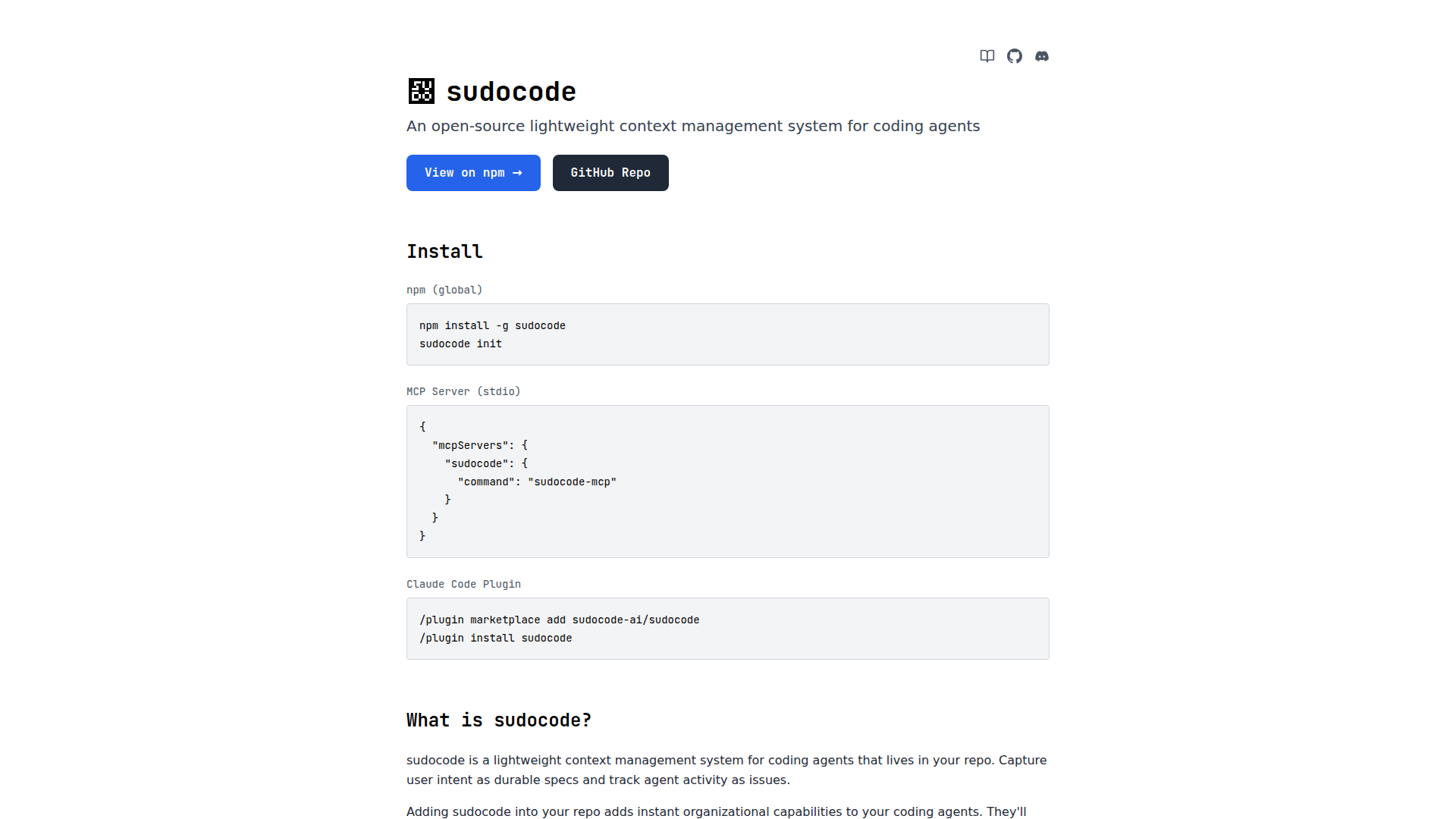
sudocode is an open-source, lightweight context management system for coding agents that lives inside a software repository. It is designed for teams and developers who want AI coding agents to retain task context, follow durable specifications, and coordinate work over longer-running, more complex development efforts.
The product positions the git repo as a distributed context database. Its workflow centers on capturing user intent as specs, turning that intent into agent issues, tracking agent executions, and recording resulting artifacts so context evolves alongside the codebase rather than being lost in temporary chat history.
Features
- Repo-native context storage: Stores context directly in the repository, which keeps specifications, task history, and execution state under team control without relying on an external service.
- 4-tier context model: Organizes work into Specs, Issues, Agents, and Artifacts, giving coding agents a structured way to move from requirements to execution and resulting changes.
- Dual human and machine formats: Uses Markdown and YAML for human editing, alongside JSONL and SQLite for machine-oriented processing, which supports both reviewability and automation.
- Bidirectional linking and backlinks: Connects specs and issues through graph relationships with automatic backlink tracking, making it easier to trace why work exists and how it relates.
- Graph-based planning support: Supports topological ordering, hierarchy, and dependency management so agent work can be sequenced more clearly across multi-step tasks.
- Agent feedback loops with git auditability: Lets agents update specs with findings during execution while preserving an auditable history through git-based change tracking.
Helpful Tips
- Use it where work spans multiple sessions: This kind of system is most valuable when coding agents need continuity across long-horizon tasks, handoffs, or iterative design changes.
- Start with strong specs: Because the model is spec-driven, adoption will be smoother if teams define clear requirements and decision records before expecting consistent agent execution.
- Treat repo hygiene as part of implementation: Since context lives in version-controlled files, teams should set conventions for naming, linking, and reviewing specs and issues to avoid clutter.
- Evaluate fit against your current agent workflow: It is best suited to teams that want durable, repo-centered coordination; the page does not indicate broader project management or enterprise governance features.
- Plan for human review loops: The structure supports agent updates to context, but practical success will likely depend on humans validating changes to specifications and task decomposition.
OpenClaw Skills
Within the OpenClaw ecosystem, sudocode could likely serve as a durable memory and task-state layer for coding-focused agents. A useful OpenClaw skill could read repository specs, generate or refine issues, inspect dependency relationships, and launch implementation workflows while preserving links between requirements, execution paths, and resulting artifacts. The page mentions MCP server support and a Claude Code plugin, which suggests practical alignment with agent-based toolchains, though a native OpenClaw integration is not stated.
A broader likely use case is an OpenClaw workflow for software teams that combines planning, implementation, and auditability in one loop: intake a product request, convert it into a spec, decompose it into issues, assign specialized coding or review agents, and summarize artifact-level changes back into human-readable documentation. For engineering organizations, that combination could shift agent usage from isolated prompt sessions toward more persistent, traceable software delivery processes anchored in the repo itself.
Embed Code
Share this AI tool on your website or blog by copying and pasting the code below. The embedded widget will automatically update with the latest information.
<iframe src="https://www.aimyflow.com/ai/sudocode-ai/embed" width="100%" height="400" frameborder="0"></iframe>