
Getting Started - SWE-agent documentation
Rate this Tool
Average Score
Total Votes
Select your score (1-10):
Detail Information
What
SWE-agent is an open-source agent framework for software engineering tasks. It lets a chosen language model use tools autonomously to work on real GitHub repositories, fix issues, identify cybersecurity vulnerabilities, and handle custom tasks defined by the user.
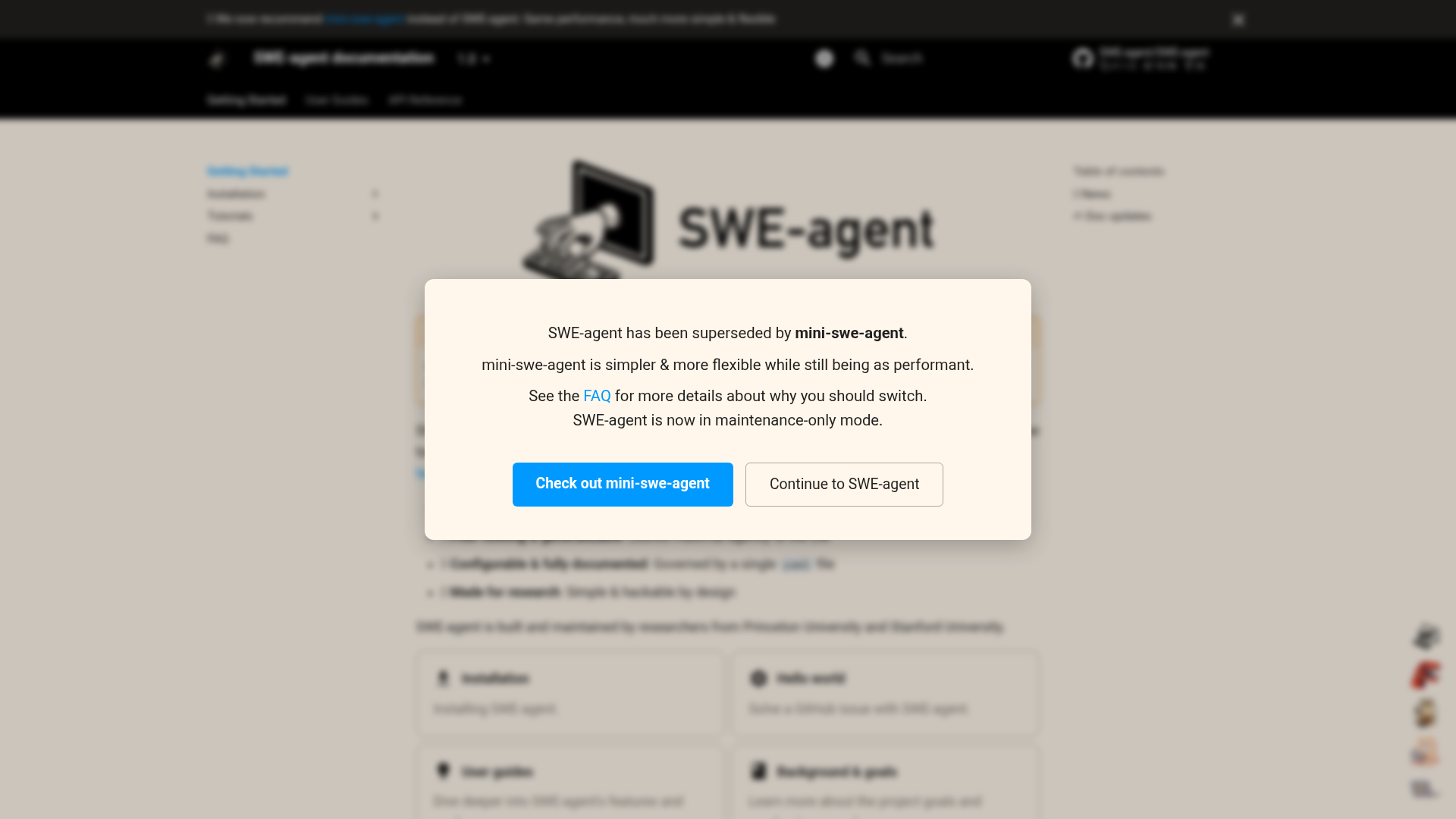
The documentation positions it for researchers, developers, and technical teams experimenting with agentic coding workflows. It appears to be designed as a configurable, research-friendly system with a single YAML-based setup, but the page also clearly states that SWE-agent has been superseded by mini-swe-agent and is now in maintenance-only mode.
Features
- Autonomous repository task execution — The agent can use tools with an LLM to operate on real GitHub repositories, which supports issue resolution and other coding workflows.
- Issue-fixing workflow — The product is explicitly presented as able to solve GitHub issues, making it relevant for automated debugging and code change tasks.
- Cybersecurity vulnerability discovery — The documentation states it can be used to find vulnerabilities, extending its use beyond general software maintenance.
- Custom task support — It can perform user-defined tasks, which suggests flexibility for specialized engineering or research workflows.
- Single YAML configuration model — Core behavior is governed by one YAML file, which can simplify setup, reproducibility, and experimentation.
- Research-oriented, hackable design — The project emphasizes openness, documentation, and modifiability, which is useful for teams studying or extending agent behavior.
Helpful Tips
- Prefer evaluating mini-swe-agent first — The documentation explicitly recommends mini-swe-agent over SWE-agent, so new implementations should likely start there unless legacy compatibility matters.
- Use SWE-agent mainly for legacy or research contexts — Since it is in maintenance-only mode, it is better suited to existing workflows, comparative research, or environments already built around it.
- Validate task scope carefully — The page describes broad capabilities, but production reliability for specific workflows should be tested against your repositories, issue types, and tooling requirements.
- Assess configuration and tooling depth early — The docs show substantial coverage of tools, environments, templates, and API configuration, so implementation planning should include agent governance and environment setup.
- Check model and multimodal requirements — The documentation references support for models such as GPT-4o and Claude Sonnet 4, plus multimodal updates, so model selection may affect capabilities and operating complexity.
OpenClaw Skills
Within the OpenClaw ecosystem, SWE-agent could likely serve as the execution layer for code-focused agents that triage issues, inspect repositories, prepare patches, and document technical findings. A likely OpenClaw workflow would combine intake skills that classify GitHub issues, planning skills that choose remediation paths, and engineering agents that run SWE-agent-style tool use against selected repositories.
This combination could be especially useful for software teams, security researchers, and engineering operations groups. For example, OpenClaw could orchestrate a multi-step software maintenance pipeline: monitor issue queues, prioritize by severity, generate structured problem statements, invoke SWE-agent for repository work, and route outputs into review or reporting workflows. The source page does not describe a native OpenClaw integration, so this is best understood as a likely orchestration use case rather than a confirmed built-in connection.
Embed Code
Share this AI tool on your website or blog by copying and pasting the code below. The embedded widget will automatically update with the latest information.
<iframe src="https://www.aimyflow.com/ai/swe-agent-com/embed" width="100%" height="400" frameborder="0"></iframe>