
Talc AI
Rate this Tool
Average Score
Total Votes
Select your score (1-10):
Detail Information
What
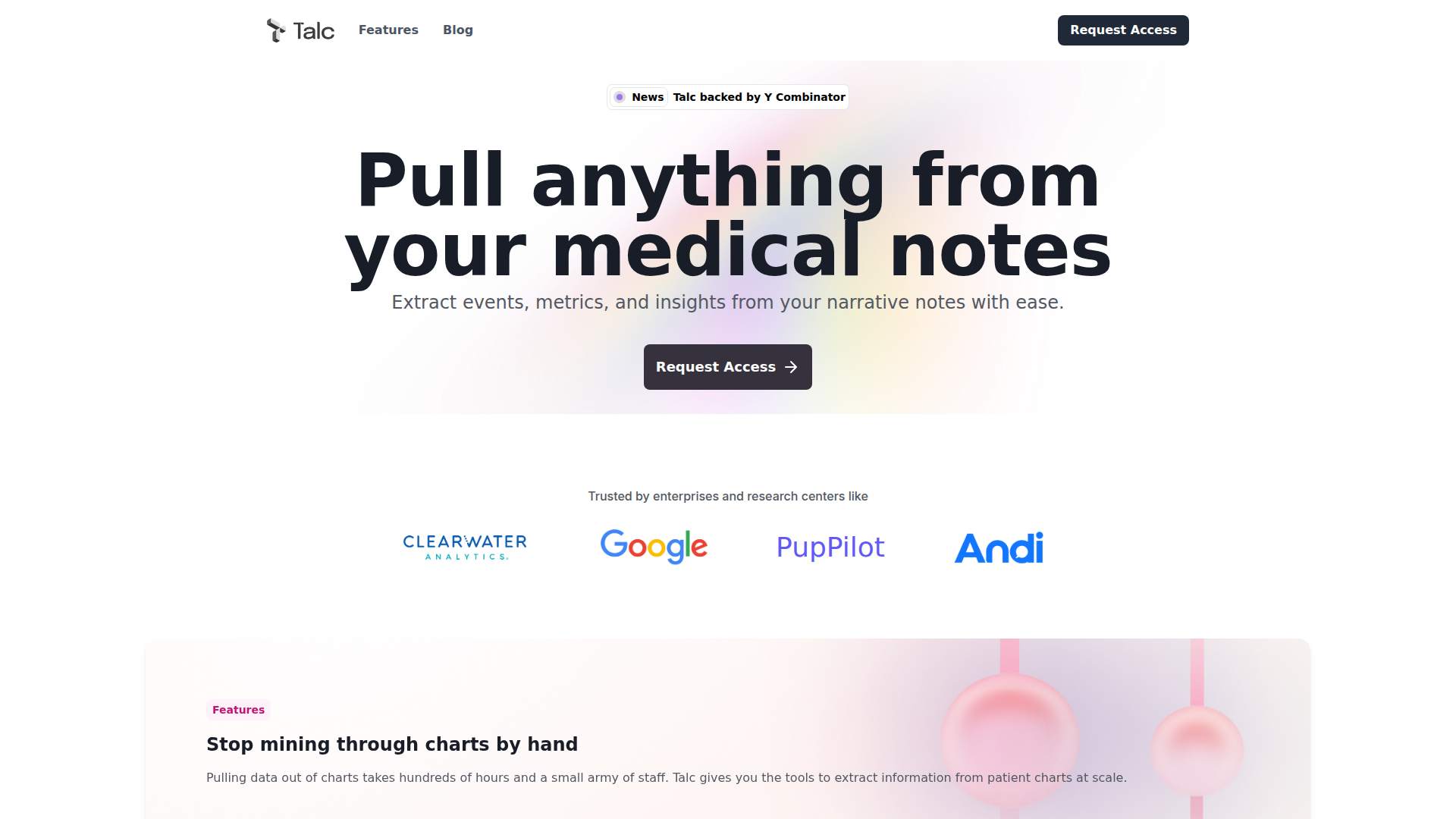
Talc AI is a healthcare data extraction product that pulls events, metrics, and other structured insights from narrative medical notes. It is designed for teams that need to abstract information from patient charts without relying on fully manual chart review.
The product appears positioned for enterprises and research centers working with large volumes of clinical documentation. Its core workflow is: define a custom abstraction rubric, run that rubric across many notes, review cited evidence and ambiguous cases, and complete chart-based data extraction faster than hand-entry workflows.
Features
- Narrative note extraction: Pulls events, metrics, and insights from unstructured medical notes so teams can convert chart text into usable structured data.
- Custom abstraction rules: Lets users define their own rubric for patient safety metrics or niche clinical queries, which is useful for site-specific research and operational needs.
- Scaled chart processing: Applies the defined rubric across thousands of notes, reducing the manual effort required for large chart review projects.
- Source citation for outputs: Cites the underlying source material, which helps reviewers verify extracted findings against the original chart content.
- Ambiguity flagging for human review: Identifies uncertain cases for manual review, supporting a human-in-the-loop workflow where precision matters.
- Fast iteration cycle: Provides initial results in minutes and finished jobs in hours, enabling teams to refine abstraction logic more quickly than traditional manual processes.
Helpful Tips
- Validate on your own use case: Performance in clinical abstraction can vary by metric, charting style, and patient population, so local testing is important before operational rollout.
- Start with high-value abstractions: Products like this are often most useful for repetitive, rules-driven chart review tasks where manual extraction is costly and slow.
- Design a review process for edge cases: Since ambiguous cases are flagged for humans, teams should plan reviewer workflows, escalation rules, and quality checks early.
- Define rubrics carefully: The value of custom abstraction depends heavily on precise definitions, inclusion criteria, and exception handling in the rubric.
- Review security and deployment details directly: The site references healthcare deployment and HIPAA BAAs in cloud environments, but buyers should still confirm technical, legal, and operational fit for their setting.
OpenClaw Skills
Talc AI could likely fit well into an OpenClaw workflow as a clinical abstraction engine inside broader healthcare operations or research pipelines. Likely use cases include an OpenClaw skill that submits chart abstraction jobs, normalizes extracted outputs into registries or research datasets, and routes ambiguous findings to reviewers with the cited note snippets attached.
In a larger OpenClaw ecosystem, agents could be built for protocol-specific abstraction, quality measure tracking, cohort identification, or retrospective chart review management. If connected through custom workflow layers rather than a confirmed native integration, this combination could help clinical operations, nursing informatics, and research teams move from manual spreadsheet-based extraction toward auditable, semi-automated evidence review processes.
Embed Code
Share this AI tool on your website or blog by copying and pasting the code below. The embedded widget will automatically update with the latest information.
<iframe src="https://www.aimyflow.com/ai/talc-ai/embed" width="100%" height="400" frameborder="0"></iframe>