
Narrative
Rate this Tool
Average Score
Total Votes
Select your score (1-10):
Detail Information
What
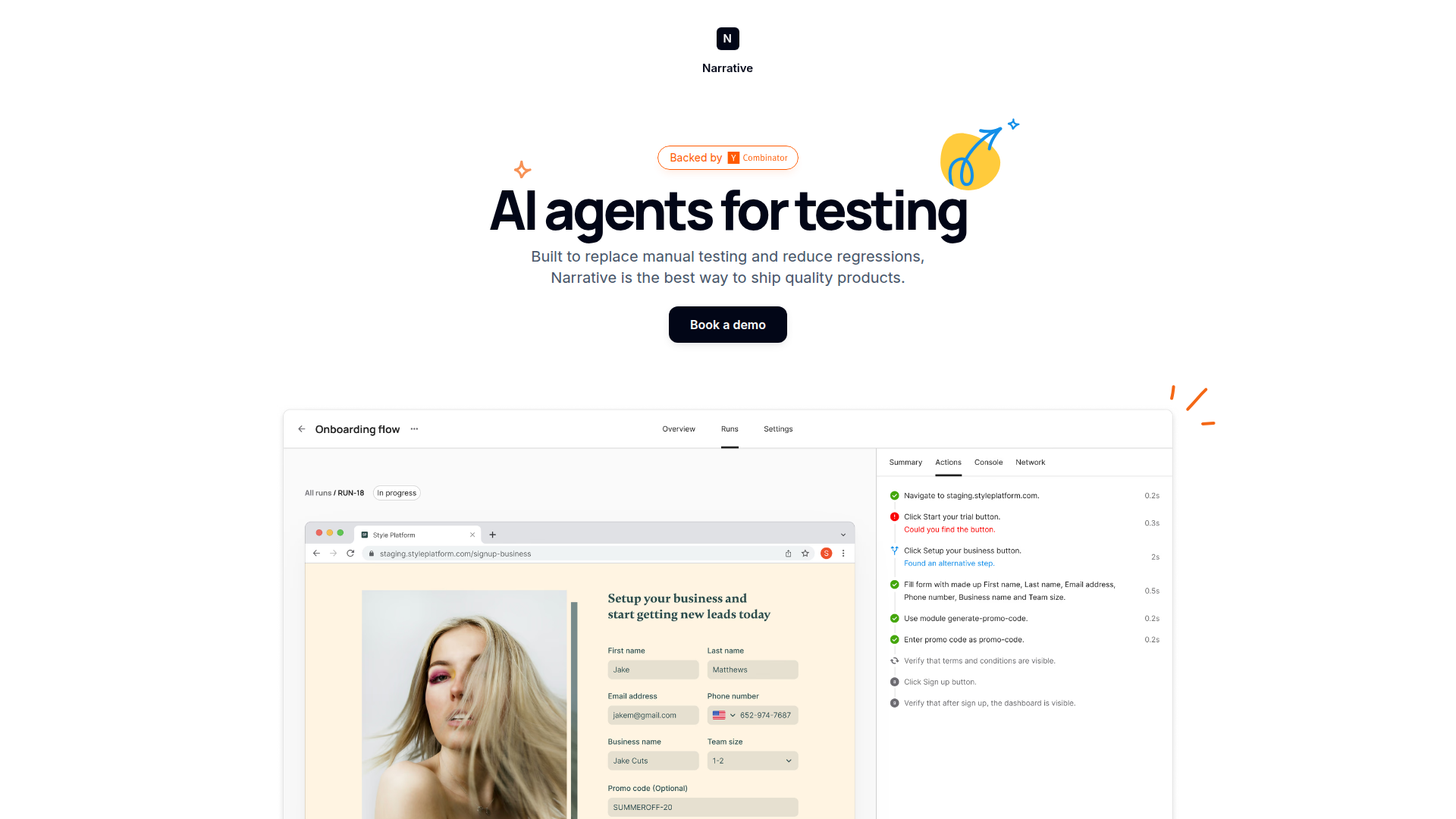
Narrative is an AI-backed testing product designed to reduce manual testing effort and help teams ship software with fewer regressions. Based on the page, it focuses on creating, running, and maintaining end-to-end product tests without requiring traditional test code, using natural-language-style inputs, recorded user steps, AI assertions, and auto-healing behavior.
It appears to serve product, QA, engineering, and release teams that need faster test coverage across common web application workflows such as onboarding, checkout, search and filtering, analytics dashboards, uploads/downloads, and role-based journeys. Its positioning is likely a no-code or low-code AI test automation platform built for modern software delivery and CI/CD-based release processes.
Features
- No-code test creation: Users can create tests by writing in product language or recording actions in the product, which lowers the barrier for non-developers and speeds up initial test setup.
- AI assertions: The platform can verify how the product looks and behaves using AI-based checks, reducing the need to write manual assertion logic.
- Auto-healing for test stability: Smart auto-healing helps tests remain usable despite UI changes, timing issues, and unstable selectors, which can reduce flaky test maintenance.
- Parallel test execution: Tests run across many browsers in parallel and are presented as fitting into CI/CD workflows, supporting faster feedback during releases.
- Built-in debugging artifacts: Console logs, network activity, and video are automatically captured to help engineers diagnose failures more efficiently.
- Test suggestion support: Narrative says it suggests additional tests so teams can improve coverage and avoid missing important paths.
Helpful Tips
- Evaluate whether your team’s main bottleneck is test creation, flaky maintenance, or debugging speed, since Narrative’s value proposition is strongest in those areas.
- Start with a few high-risk user journeys such as onboarding, checkout, or admin flows to verify whether AI assertions and auto-healing perform reliably in your product.
- Confirm how well the CI/CD integration works in your environment, since the page states compatibility but does not provide implementation details.
- Review data handling carefully if your tests involve sensitive user content, especially because the platform captures screenshots, video, logs, and network activity.
- Treat security and compliance claims conservatively: the page mentions encryption, SSO, role-based access, and SOC 2 Type II as in progress, so buyers should validate current status during procurement.
OpenClaw Skills
Narrative could likely fit into the OpenClaw ecosystem as the execution layer for QA-focused agents and release-readiness workflows. For example, an OpenClaw skill could translate bug reports, PR summaries, or feature specs into candidate test scenarios, then use Narrative as the likely downstream system for no-code test creation and execution. Another likely workflow is a release agent that reviews failing runs, clusters issues by probable root cause using Narrative’s logs, video, and network traces, and routes findings to engineering or product owners.
This combination could be especially useful for software teams trying to shift quality earlier in the delivery cycle. In a likely OpenClaw use case, product operations or QA managers could run agents that monitor coverage gaps, suggest missing user journeys, and trigger regression suites on critical changes. If implemented well, that could move testing from a manual checkpoint into a more continuous, intelligence-assisted process for product, QA, and engineering teams.
Embed Code
Share this AI tool on your website or blog by copying and pasting the code below. The embedded widget will automatically update with the latest information.
<iframe src="https://www.aimyflow.com/ai/trynarrative-com/embed" width="100%" height="400" frameborder="0"></iframe>