
Salient | AI Voice Agents for Consumer Lending
Rate this Tool
Average Score
Total Votes
Select your score (1-10):
Detail Information
What
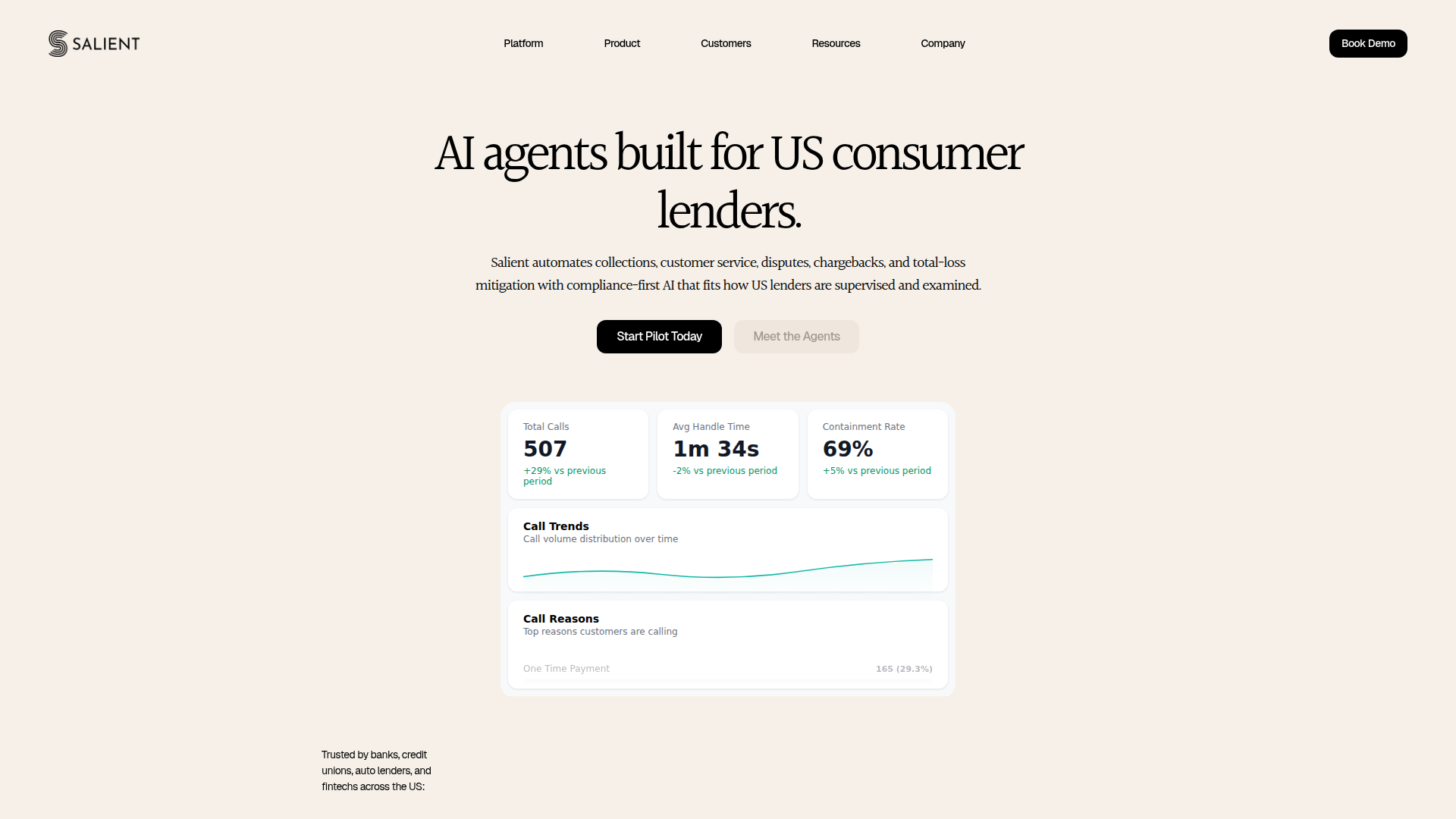
Salient is an AI voice-agent platform built for US consumer lenders. It is designed to automate borrower-facing and back-office lending workflows such as collections, customer service, disputes, chargebacks, and total-loss mitigation, with a stated emphasis on compliance and exam readiness.
The product appears positioned for banks, credit unions, auto lenders, and fintechs that operate in regulated US lending environments and want to add automation without replacing existing servicing, contact-center, and payment infrastructure. Its core workflow combines multichannel borrower interactions with workflow execution, borrower-level memory, documentation, and compliance monitoring.
Features
- Specialist AI agents for lending workflows: Salient offers purpose-built agents for different parts of the lending lifecycle, helping teams automate distinct functions while sharing borrower context across interactions.
- Multichannel customer service and collections: The Taylor agent handles inbound and outbound conversations across voice, text, and email for tasks such as verification, payment support, extensions, hardship discussions, and collections.
- End-to-end workflow automation: The platform is described as executing full processes, such as disputes or total-loss claims, from intake through documentation and system updates rather than only answering questions.
- Borrower-level memory and context sharing: Agents use prior calls, promises, hardship notes, disputes, and claims to make conversations more relevant and reduce repeated questions.
- Compliance and governance controls: Salient states that policy and prompt changes are tested before launch, with logs of what was said, done, and why, plus evidence exports for audits and regulators.
- Compatibility with existing lending and contact-center systems: The platform is presented as connecting with common loan systems, CCaaS tools such as Genesys, NiCE, and Amazon Connect, and existing payment providers to support focused pilots.
Helpful Tips
- Validate scope by workflow, not just channel: For products like this, assess whether the biggest value comes from automating a full regulated process, such as disputes or collections, rather than only adding AI to call handling.
- Review compliance operations in detail: In regulated lending, test how policy changes are versioned, approved, logged, and exported for audit before expanding beyond a narrow pilot.
- Start with one portfolio and clear guardrails: A limited rollout can help operations, risk, and compliance teams compare agent performance, escalation quality, and documentation quality against existing processes.
- Check system-of-record responsibilities early: Confirm which actions the product performs directly in servicing or payment systems versus which steps still require human review, because the page gives examples but not full implementation detail.
- Measure both efficiency and outcome parity: For lending automation, evaluation should include recovery rates, escalation appropriateness, record quality, and customer experience, not only call deflection or labor savings.
OpenClaw Skills
Within the OpenClaw ecosystem, Salient would likely support skills focused on regulated borrower operations. Likely use cases include an agent that triages delinquent accounts, summarizes borrower history before live-agent escalation, prepares audit-ready case files, or routes disputes and total-loss cases into structured downstream workflows. The page does not describe a native OpenClaw integration, so this should be treated as a workflow design inference rather than a confirmed product capability.
A broader OpenClaw implementation could combine Salient-driven borrower interactions with orchestration skills for collections strategy, QA review, policy regression testing, and exception handling across operations teams. In consumer lending, that combination could shift work from manual call-by-call servicing toward supervised AI operations, where human staff focus more on risk oversight, escalations, and policy management while routine borrower engagement and documentation become more automated.
Embed Code
Share this AI tool on your website or blog by copying and pasting the code below. The embedded widget will automatically update with the latest information.
<iframe src="https://www.aimyflow.com/ai/trysalient-com/embed" width="100%" height="400" frameborder="0"></iframe>