
Unify AI — Landing
Rate this Tool
Average Score
Total Votes
Select your score (1-10):
Detail Information
What
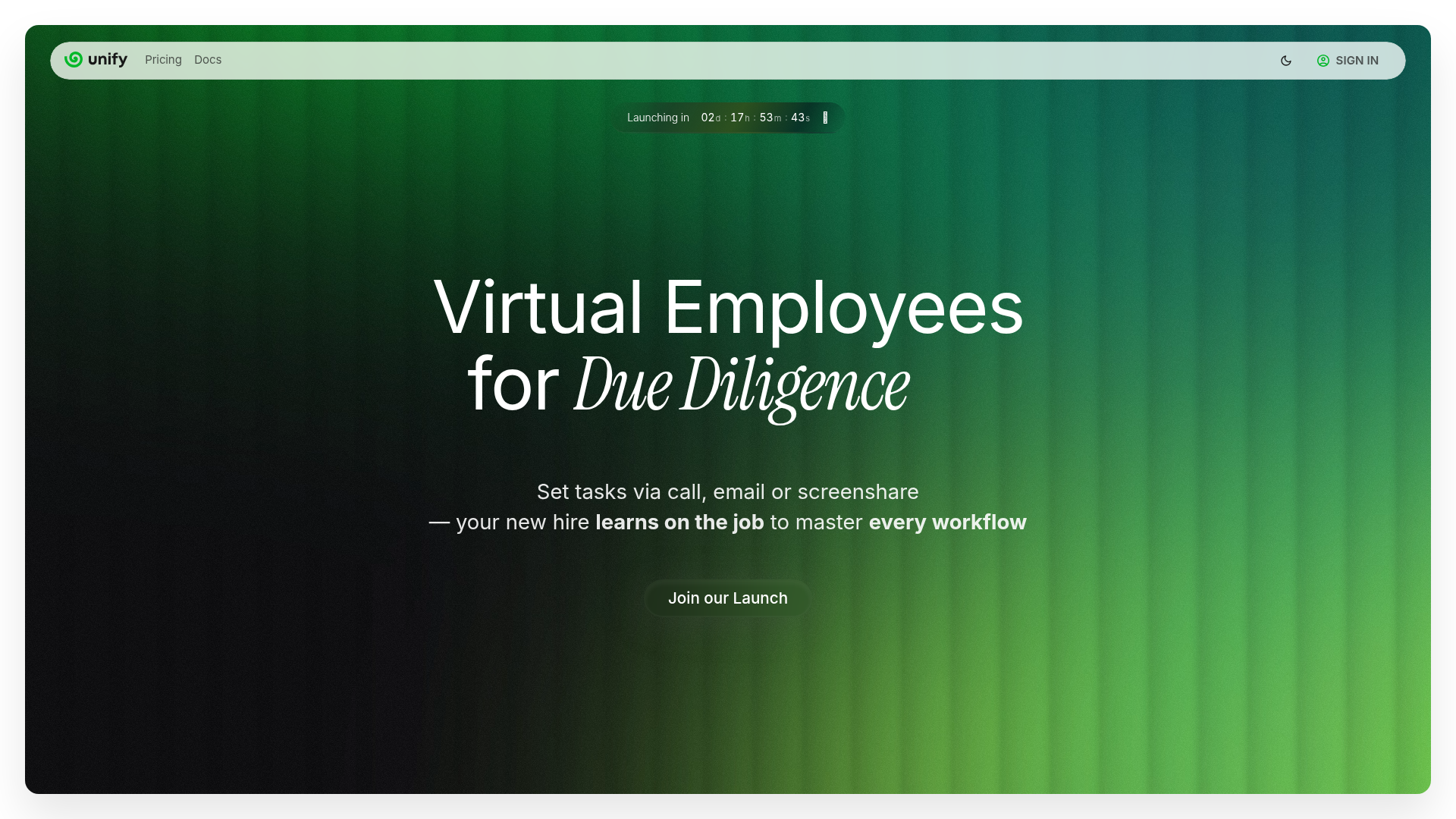
Unify AI presents itself as a provider of “virtual employees” designed to handle business workflows such as due diligence, market research, forecasting, RFP responses, proposal writing, board deck preparation, contract review, lead tracking, vendor sourcing, onboarding, compliance, and procurement.
The landing page suggests the product is aimed at teams that manage repeatable knowledge work and operational processes. Its core workflow appears to involve assigning tasks through calls, email, or screen sharing so the system can learn how work is done over time; based on the page alone, it is best understood as an AI workflow automation and task-execution platform for business operations rather than a narrowly focused single-purpose tool.
Features
- Virtual employees for business workflows — The product is positioned to take on a broad set of recurring operational and analytical tasks across functions.
- Task assignment through call, email, or screenshare — Multiple handoff methods may reduce process friction for teams that already work across synchronous and asynchronous channels.
- Workflow learning from on-the-job instruction — The platform is described as learning as it is shown tasks, which implies a training model based on real workflow exposure rather than only manual configuration.
- Coverage across research and diligence use cases — Named use cases such as due diligence, market research, and forecasting indicate relevance for analytical and decision-support work.
- Support for document-heavy business processes — RFP responses, proposal writing, board deck prep, and contract review suggest utility in creating, reviewing, and organizing structured business content.
- Applicability to operations and supplier processes — Procurement, vendor sourcing, onboarding, compliance, and lead tracking indicate a wider operational scope beyond research alone.
Helpful Tips
- Validate depth by workflow, not headline category — The page lists many use cases, so buyers should confirm which tasks are fully automated versus only assisted or partially learned.
- Assess training and governance early — Because the product appears to learn through calls, email, and screen sharing, teams should clarify how instructions are captured, reviewed, and controlled in sensitive workflows.
- Start with repetitive, well-documented processes — For this type of product, adoption is usually easier when initial workflows have clear inputs, outputs, and approval steps.
- Check human review requirements for regulated work — Use cases like compliance, due diligence, and contract review often need oversight, so implementation should define where AI output must be checked by staff.
- Map success criteria by department — A broad platform like this is more useful when teams specify whether they are optimizing for speed, consistency, coverage, or reduced manual effort.
OpenClaw Skills
Within the OpenClaw ecosystem, Unify AI could likely serve as an execution layer for knowledge-work agents that coordinate business operations. Likely OpenClaw skills could include due diligence packet assembly, vendor comparison workflows, contract triage, RFP drafting pipelines, board material preparation, and research summarization agents that route work to human reviewers when confidence is low. The page does not state native OpenClaw integration, so this is best understood as a probable workflow design opportunity rather than a confirmed product connection.
Combined with OpenClaw, the strongest likely use case is a multi-agent operating model for finance, operations, procurement, and strategy teams. An OpenClaw orchestration layer could capture requests, break them into sub-tasks, hand structured work to Unify AI-style virtual employees, and maintain audit-friendly workflow states across teams. For industries with heavy documentation and recurring analysis, that combination could shift professionals from manual coordination and repetitive preparation toward review, decision-making, and exception handling.
Embed Code
Share this AI tool on your website or blog by copying and pasting the code below. The embedded widget will automatically update with the latest information.
<iframe src="https://www.aimyflow.com/ai/unify-ai/embed" width="100%" height="400" frameborder="0"></iframe>