
Articulate - AI-Powered Construction Drawing Analysis
Rate this Tool
Average Score
Total Votes
Select your score (1-10):
Detail Information
What
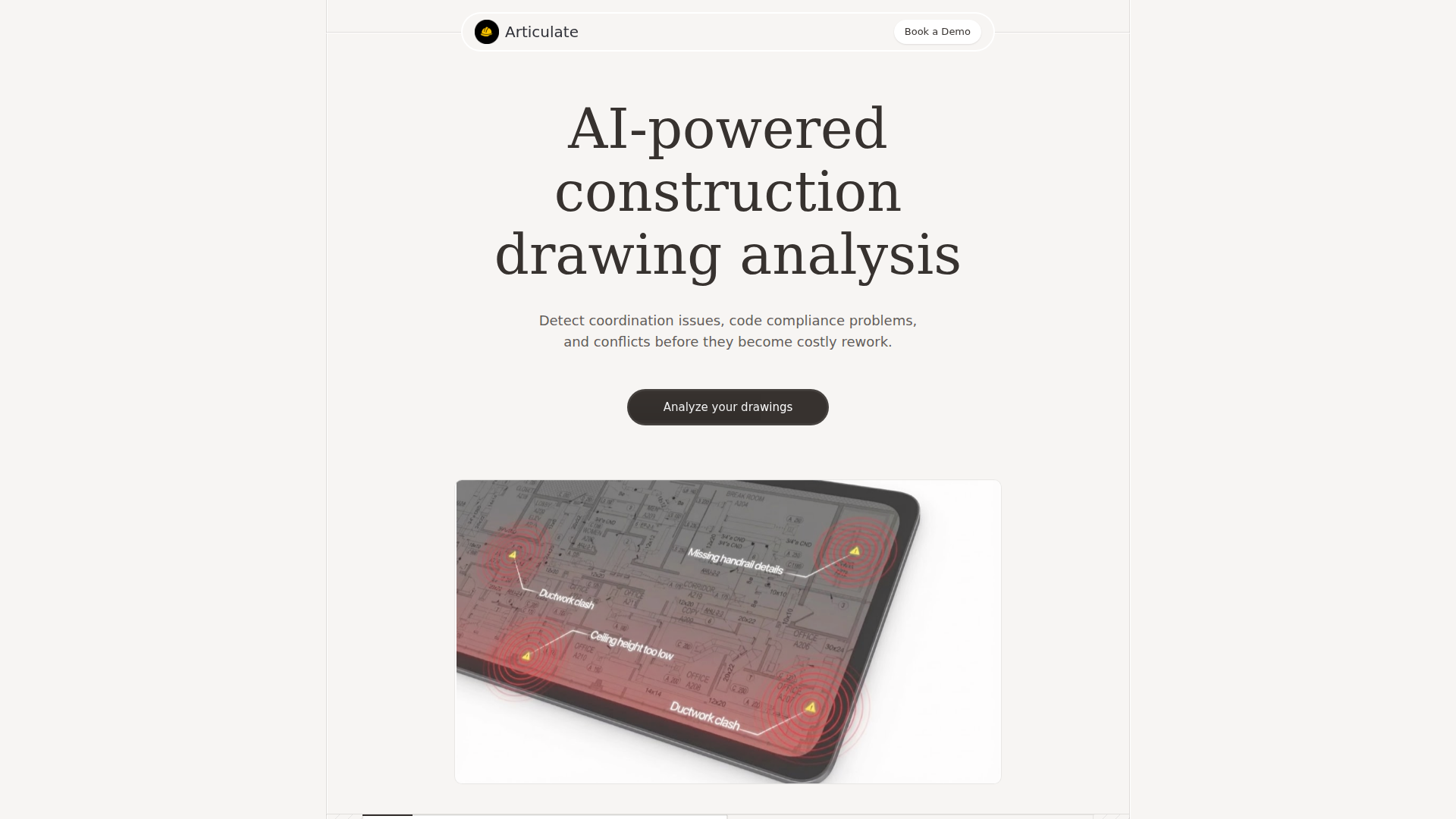
Articulate is an AI-powered construction drawing analysis platform for architects, engineers, general contractors, and related construction teams. It reviews 2D PDF drawing sets to identify coordination issues, code compliance problems, missing information, clashes, and other plan-level risks before they turn into RFIs, change orders, or field rework.
The product appears positioned as a preconstruction review and QA/QC tool that works directly from drawings rather than requiring BIM or 3D models. Its core workflow is straightforward: upload PDF plans or connect project data from Procore or Autodesk, let the AI analyze sheets across multiple issue categories, then review precisely marked findings and optionally push issues into RFI workflows.
Features
- AI drawing analysis for 2D PDFs — Reviews construction drawing sets directly from PDF files, which can help teams assess plans without depending on BIM or 3D model maturity.
- Multi-category issue detection — Flags problems across coordination, code compliance, missing information, structural, MEP, fire safety, accessibility, constructability, dimensions, QA/QC, and specification-related checks to support broader preconstruction review.
- Precise issue location on drawings — Marks detected issues with exact coordinates on PDF pages, making it easier for reviewers to find and validate each item quickly.
- Severity-based verification workflow — The site states issues are verified across three AI models and labeled by severity, which can help teams prioritize higher-risk findings first.
- RFI generation and workflow connectivity — Supports one-click RFI creation and native integration with Procore; the site also states Autodesk connectivity for pulling drawings and keeping review activity closer to project workflows.
- Full-text building code reference — Provides searchable access to code texts including IBC, IRC, NEC, and IPC, which can streamline code lookups during plan review.
Helpful Tips
- Validate scope by drawing type and discipline — Before rollout, confirm which sheet types, project phases, and issue categories are most reliable for your mix of architectural, structural, and MEP documents.
- Use it as a first-pass review layer, not the only review — AI-detected issues can reduce manual effort, but technical leads should still verify findings before formal RFIs or design decisions are made.
- Measure value through avoided downstream work — Track reductions in RFIs, coordination misses, and revision cycles to judge whether the platform is improving preconstruction efficiency in your environment.
- Check integration depth early — If your team relies on Procore or Autodesk workflows, verify exactly how project sync, issue transfer, and RFI handoff behave in practice.
- Assess code coverage carefully — The site lists several major code references, but buyers should confirm whether local amendments, project-specific standards, and jurisdictional nuances are supported for their use case.
OpenClaw Skills
Articulate could fit well into the OpenClaw ecosystem as a likely upstream signal source for construction review workflows. An OpenClaw skill could ingest Articulate issue outputs, classify them by discipline and severity, route them to the right reviewer, generate draft coordination summaries, and assemble weekly risk digests for project teams. If issue coordinates and sheet references are accessible, another likely workflow would turn findings into structured action queues tied to project milestones, subcontractor scopes, or design review meetings.
More advanced OpenClaw agents could likely combine Articulate findings with code search, document retrieval, and project correspondence analysis to support preconstruction operations. For example, an agent for general contractors could cluster recurring issue patterns across projects, suggest standard RFI language, and identify where drawing conflicts may affect schedule, procurement, or field execution. This is an inferred use case rather than a confirmed native integration, but the combination could make drawing review more systematic, auditable, and proactive for design and construction teams.
Embed Code
Share this AI tool on your website or blog by copying and pasting the code below. The embedded widget will automatically update with the latest information.
<iframe src="https://www.aimyflow.com/ai/usearticulate-com/embed" width="100%" height="400" frameborder="0"></iframe>