
Vanna 2.0 – Build Agents Your Users Can Actually Use
Rate this Tool
Average Score
Total Votes
Select your score (1-10):
Detail Information
What
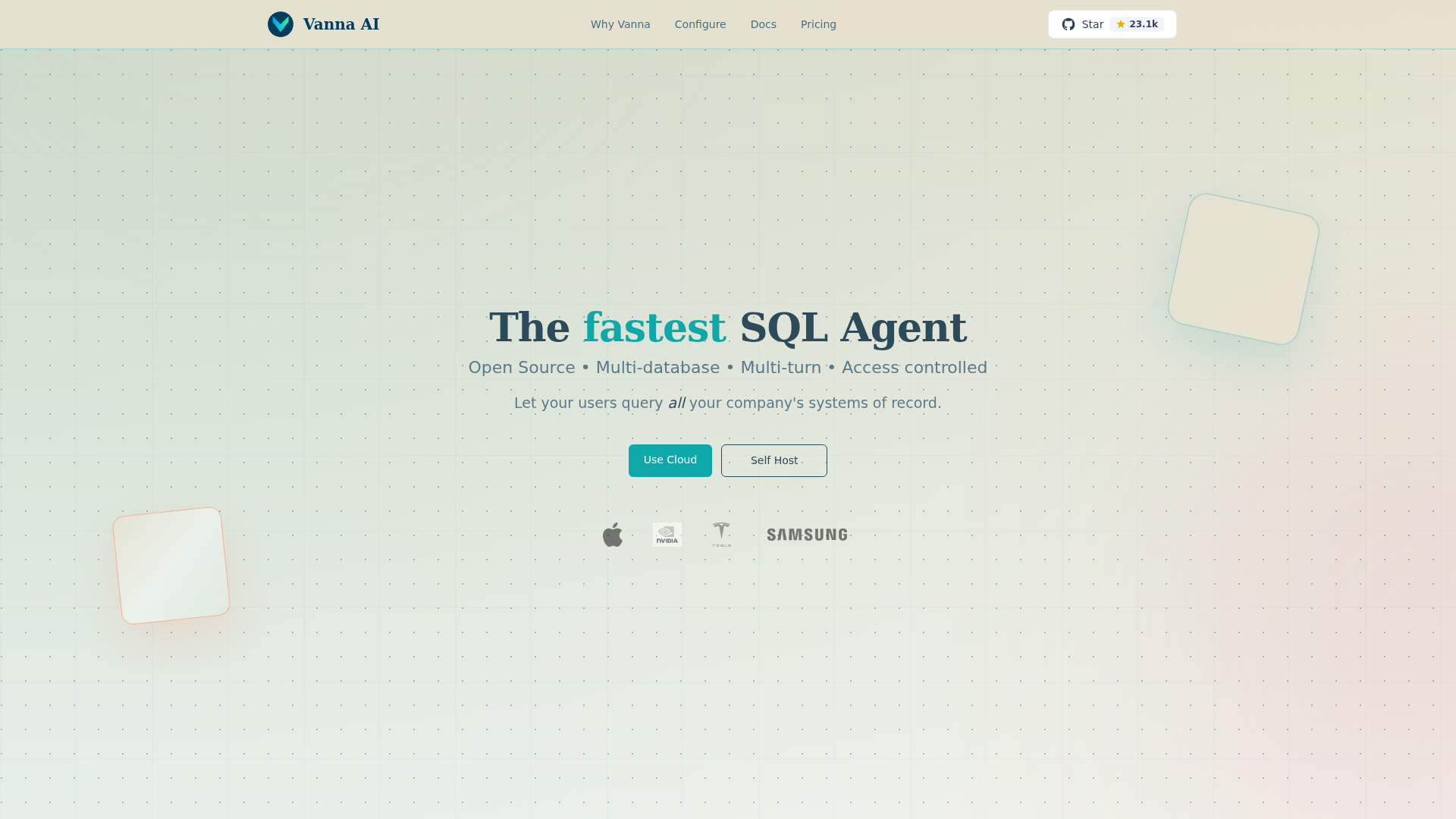
Vanna 2.0 is an open-source SQL agent framework that lets users query company data systems in natural language and receive answers through AI-powered SQL generation. It is positioned as a fast way to build database-facing agents that are usable by both technical and non-technical users, with support for multi-database, multi-turn, and access-controlled deployments.
The product appears to serve teams that want to make structured data easier to access across an organization without requiring every user to write SQL manually. Its core workflow is to connect an LLM provider and a database, configure the stack, and use Vanna to translate user questions into SQL across systems of record, with optional hosted admin features available through Vanna Cloud.
Features
- Natural-language-to-SQL generation — Converts user questions into SQL so teams can spend less time writing queries and more time interpreting results.
- Multi-database support — Works with databases including SQLite, PostgreSQL, MySQL, Snowflake, and BigQuery, which helps organizations use one framework across different data environments.
- LLM provider flexibility — Supports multiple model providers such as Anthropic, OpenAI, Gemini, and Ollama, reducing dependence on a single model stack.
- Multi-turn interaction — Supports conversational workflows, which is useful when users need to refine questions across several steps rather than write a perfect query once.
- Access control and admin tooling — Optional hosted features include access control, observability, audit logs, agent memory, file storage, and data retention for more controlled production use.
- Open-source and self-hosting option — Offers an OSS path alongside cloud and self-hosted usage, which may help teams that want more deployment control and less vendor lock-in.
Helpful Tips
- Validate semantic accuracy early — For any NL-to-SQL product, the key evaluation criterion is not just whether SQL runs, but whether it answers the business question correctly.
- Start with a narrow schema scope — Initial adoption is usually easier when the agent is limited to a few well-documented tables or systems before expanding to broader enterprise data.
- Define access boundaries carefully — Since the product is designed to expose systems of record through natural language, role-based visibility and auditability should be reviewed before broad rollout.
- Match model choice to deployment needs — Vanna supports several LLM providers, so teams should compare performance, privacy posture, latency, and hosting preferences against their own requirements.
- Treat hosted admin features as a governance layer — Features like observability, logs, memory, and retention are most valuable when the product is used beyond prototypes and into production workflows.
OpenClaw Skills
Vanna could fit well into the OpenClaw ecosystem as a structured-data reasoning layer for agents that need to answer operational, financial, product, or support questions from enterprise databases. A likely use case would be an OpenClaw skill that translates a user request into a governed SQL workflow, retrieves results from approved systems, and then formats the output into summaries, dashboards, or follow-up actions. The page does not describe a native OpenClaw integration, so this should be treated as a likely workflow pattern rather than a confirmed capability.
OpenClaw agents built around Vanna could support data analyst copilots, internal business intelligence assistants, revenue operations agents, or support reporting workflows. In practice, that combination could help organizations move from static dashboards toward conversational data access, where business users ask questions directly and OpenClaw orchestrates the surrounding steps such as permission checks, prompt routing, explanation generation, and escalation to human analysts when confidence is low.
Embed Code
Share this AI tool on your website or blog by copying and pasting the code below. The embedded widget will automatically update with the latest information.
<iframe src="https://www.aimyflow.com/ai/vanna-ai/embed" width="100%" height="400" frameborder="0"></iframe>