
VectorShift: The End-to-End AI Automations Platform
Rate this Tool
Average Score
Total Votes
Select your score (1-10):
Detail Information
What
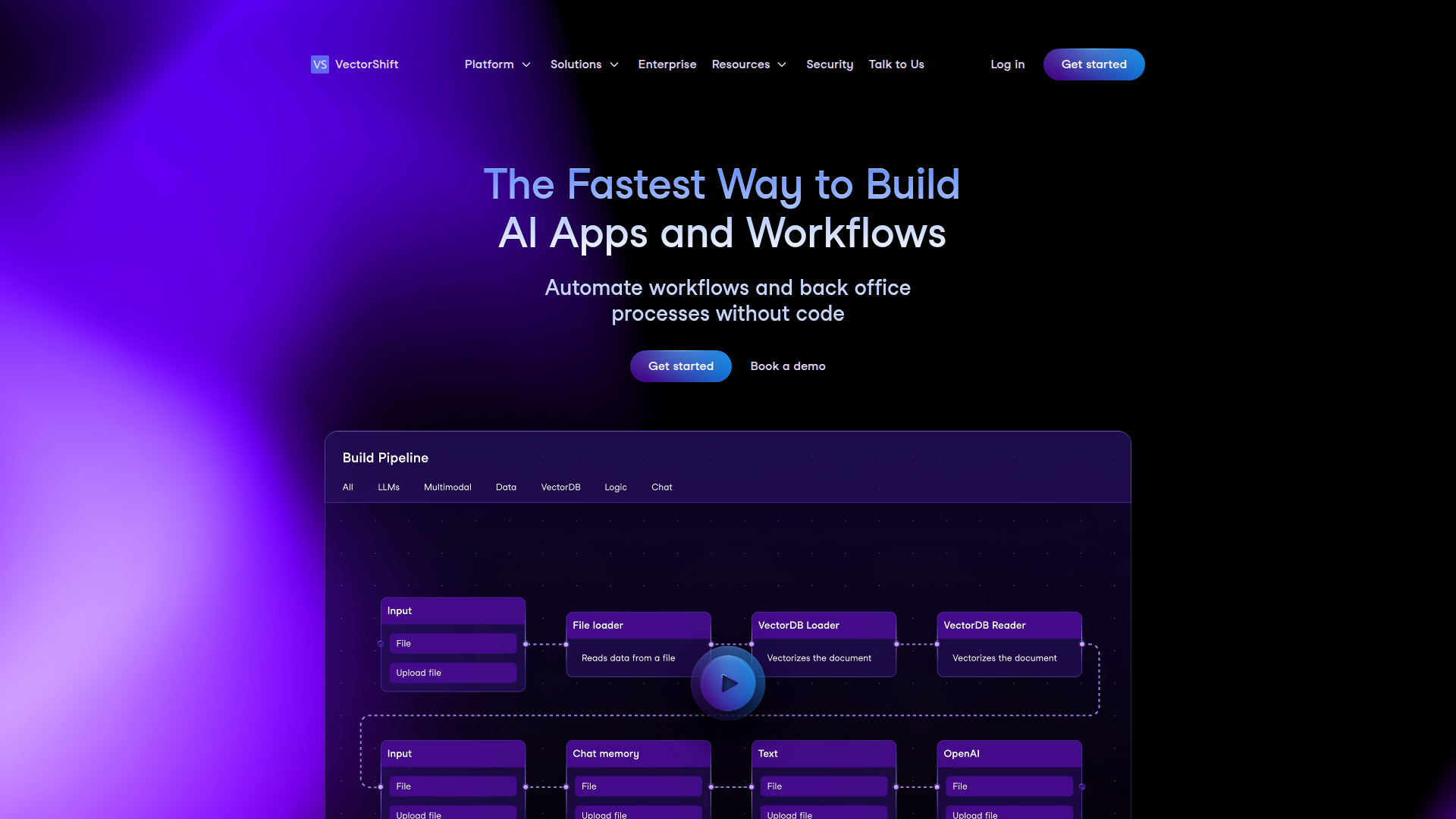
VectorShift is an end-to-end AI automation platform for building, deploying, and managing AI applications and workflows. It is designed for teams that want to automate back-office processes, build AI apps without code, or use a code SDK when deeper developer control is needed.
The platform appears positioned as a flexible AI application layer for business use cases such as assistants, chatbots, workflow automation, knowledge search, report generation, proposal generation, and personalized outreach. Its core workflow combines templates, data connections, a drag-and-drop builder, model access, and deployment options such as chat interfaces or API endpoints.
Features
- No-code AI app builder: Drag-and-drop components let teams create and iterate on AI workflows without coding, which can reduce setup time for internal automation and prototyping.
- Python code SDK with no-code interoperability: Developers can access platform functionality through APIs and move work between visual pipelines and code, supporting both business users and technical teams.
- Multi-model access: The platform provides access to models from providers including OpenAI, Anthropic, Google, Hugging Face, AWS, Mistral AI, and Llama, which helps teams compare or standardize model usage in one environment.
- Data ingestion across formats: VectorShift can work with websites, documents, CSVs, PDFs, videos, and audio, enabling question answering, summarization, and analysis across mixed business content.
- Search and retrieval capabilities: The product highlights search tools and “optimal data retrieval” methods, which are useful for knowledge search, assistant experiences, and document-based answers.
- Integrations and trigger-based automations: Live-sync connections and action-based triggers across tools such as Google Drive, OneDrive, Salesforce, HubSpot, Notion, and Airtable support cross-system workflows like monitoring inputs and sending follow-up actions.
Helpful Tips
- Assess the no-code/code split early: This type of platform is strongest when business teams can prototype workflows while developers govern production logic, APIs, and deployment standards.
- Start with a bounded use case: Document Q&A, internal knowledge search, call summaries, or proposal generation are typically easier to validate than broad enterprise-wide automation programs.
- Review data source quality before rollout: AI workflow performance depends heavily on the structure, freshness, and permissions of connected content such as contracts, CRM records, and knowledge bases.
- Clarify deployment needs upfront: VectorShift supports chatbot-style delivery and API endpoints, so teams should choose based on whether the audience is end users, internal operators, or downstream systems.
- Verify enterprise requirements directly: The site references security and enterprise solutions, but buyers should confirm governance, admin controls, and implementation details for their environment.
OpenClaw Skills
Within the OpenClaw ecosystem, VectorShift could likely serve as a strong execution layer for AI-powered business workflows. A likely use case would be OpenClaw agents that orchestrate intake, retrieval, reasoning, and action across VectorShift pipelines—for example, a revenue operations agent that monitors new documents, extracts key terms, updates structured systems, and routes exceptions to human review.
Another likely OpenClaw pattern would be industry-specific skills built on top of VectorShift’s document, search, and automation capabilities. Teams in operations, sales, support, procurement, or professional services could use OpenClaw to wrap VectorShift workflows into reusable agents such as contract review assistants, proposal drafting copilots, onboarding bots, or knowledge search specialists. If implemented well, that combination could shift work from manual coordination toward governed, repeatable AI operations, though native OpenClaw integration is not stated on the source page.
Embed Code
Share this AI tool on your website or blog by copying and pasting the code below. The embedded widget will automatically update with the latest information.
<iframe src="https://www.aimyflow.com/ai/vectorshift-ai/embed" width="100%" height="400" frameborder="0"></iframe>