
Webhound / Long-Running Autonomous Research
Rate this Tool
Average Score
Total Votes
Select your score (1-10):
Detail Information
What
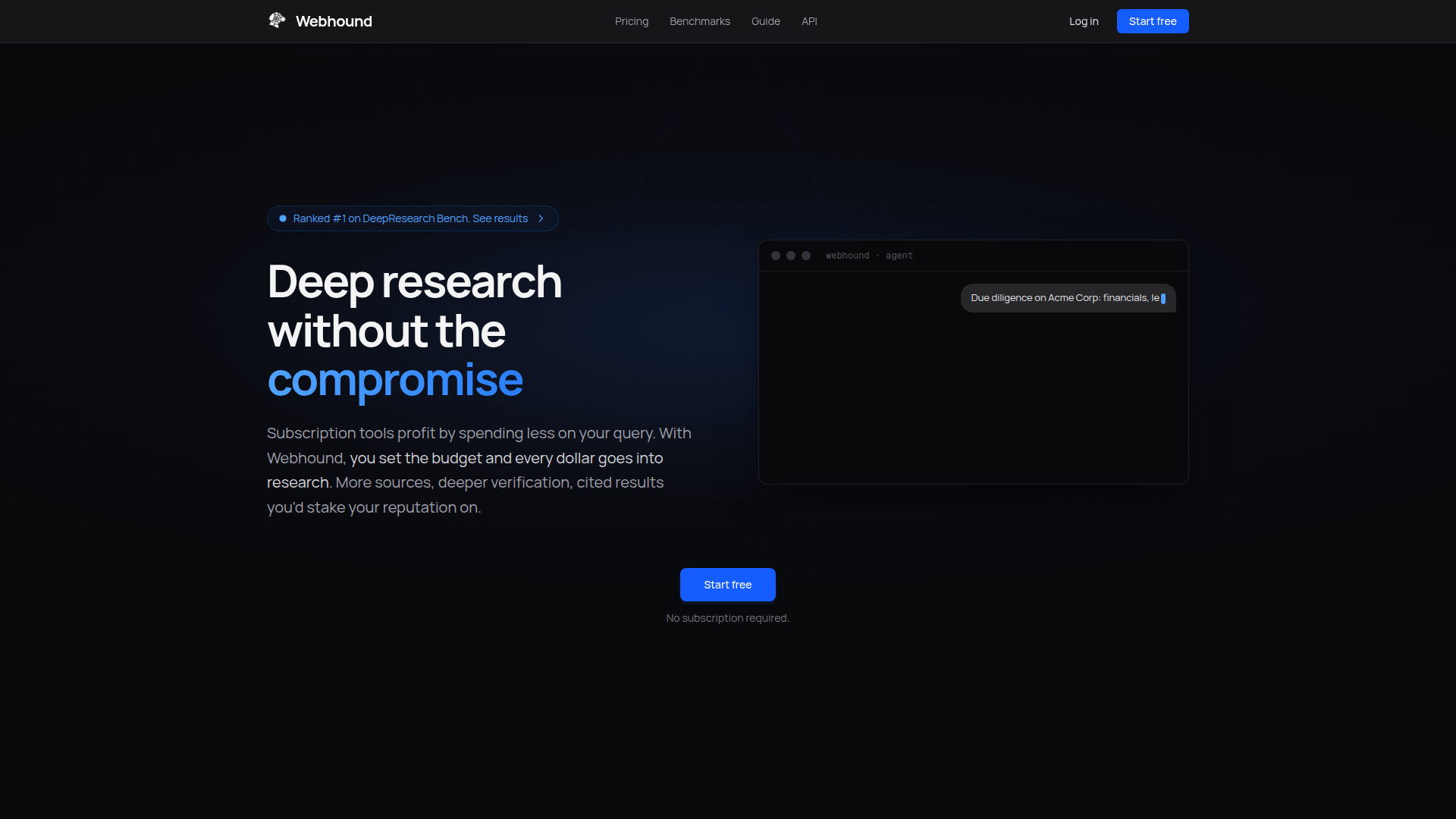
Webhound is a long-running autonomous research platform built for people and teams making high-stakes decisions. It uses a conversational agent to scope a research task, propose a plan with query, budget, model, and output type, then run the work in the background and return cited reports or structured datasets.
The product appears positioned as a pay-per-research alternative to subscription-based research tools, with emphasis on controllable budget, source-backed outputs, and deeper verification. The website highlights use cases across due diligence, market and competitive analysis, talent and vendor research, technical research, GTM research, and benchmark-focused content research.
Features
- Conversational research planning: The agent takes a research brief in chat and proposes an approval card with query, budget, model, and output format before any spending occurs.
- Long-running autonomous research: Research jobs can run for hours or days in the background, allowing users to keep chatting, launch multiple sessions, and return when results are ready.
- Inline citations on claims: Reports include clickable source links for individual claims, and the product states that unsupported facts are excluded.
- Structured dataset generation: Webhound can turn web content into sourced tables with user-defined columns and export them as CSV files.
- Python-based analysis on real data: The agent can write and run Python for transformations, charts, analysis, and file generation using uploaded or connected datasets.
- Workspace and workflow support: Nested folders, working directories, memory across conversations, uploads, multi-step pipelines, and a REST API support repeated or programmatic research workflows.
Helpful Tips
- Test report quality on a narrow brief first: For due diligence or competitive work, start with a tightly defined question and verify whether the citation quality and source coverage match your internal standards.
- Use datasets when comparison matters: If the goal is vendor evaluation, prospect enrichment, or benchmarking, a structured table is likely more useful than a narrative report alone.
- Treat budget as a research depth control: The site states that higher budgets increase search cycles, sources, and verification passes, so align spend with the risk and value of the decision.
- Plan human review for sensitive conclusions: Even with citations and verification, high-impact outputs such as hiring, investment, or regulatory risk assessments should still pass through expert review.
- Check API and pipeline fit early: Teams considering operational use should validate how well the REST API, uploads, and sequential workflows fit existing research or analytics processes.
OpenClaw Skills
Within the OpenClaw ecosystem, Webhound could likely serve as a research execution layer for analyst, operations, and strategy workflows. A practical OpenClaw skill could accept a business question, translate it into a Webhound research plan, monitor the long-running session, then route the resulting report or dataset into downstream analysis, summarization, or decision support steps. If native integration is not currently stated, this should be treated as a likely orchestration use case rather than a confirmed built-in connector.
More advanced OpenClaw agents could be built around recurring competitive monitoring, vendor screening, sourcing benchmark statistics, or enriching internal account lists with web research. In sectors such as consulting, private markets, recruiting, B2B sales, and product strategy, that combination could shift work from manual tab-by-tab investigation toward managed research pipelines with explicit budgets, traceable citations, and reusable structured outputs.
Embed Code
Share this AI tool on your website or blog by copying and pasting the code below. The embedded widget will automatically update with the latest information.
<iframe src="https://www.aimyflow.com/ai/webhound-ai/embed" width="100%" height="400" frameborder="0"></iframe>