How AI fits this role
Applied Mathematician in the Age of AI
Role Overview
Applied mathematicians translate abstract mathematical theory into practical solutions for real-world problems. In industry, this most commonly means working inside quantitative finance, aerospace and defense, pharmaceutical R&D, semiconductor design, logistics optimization, and increasingly, AI/ML research infrastructure itself. The highest-volume commercial context is financial services — hedge funds, investment banks, and insurance actuarial teams — where applied mathematicians build pricing models, risk frameworks, stochastic simulations, and optimization engines that directly drive revenue and capital allocation decisions.
The day-to-day reality is less about elegant proofs and more about model ownership: formulating the right mathematical structure for a messy problem, validating that structure against empirical data, and defending its assumptions to stakeholders who will act on its outputs. Applied mathematicians sit at the intersection of domain expertise, computational implementation, and epistemic rigor — a combination that makes the role structurally different from data science or software engineering, even when the tooling overlaps.
In most organizations, applied mathematicians are embedded in small, high-leverage teams. They are rarely the most numerous technical staff, but their work tends to underpin systems that process enormous transaction volumes or inform decisions with significant financial, safety, or regulatory consequences.
How AI Is Transforming This Role
The transformation is not displacement — it is compression and elevation. AI tools are collapsing the time between problem formulation and working prototype, which changes what applied mathematicians are expected to deliver and at what cadence.
The most concrete shift is in the model development pipeline. Historically, an applied mathematician might spend weeks implementing a numerical solver, validating edge cases, and benchmarking performance before any business stakeholder saw results. Today, large language models can scaffold that implementation in hours, and symbolic computation tools like Wolfram Language or SymPy integrated with LLM interfaces can handle routine derivations. This compresses the "build" phase and pushes more time toward the "formulate" and "validate" phases — which remain deeply human.
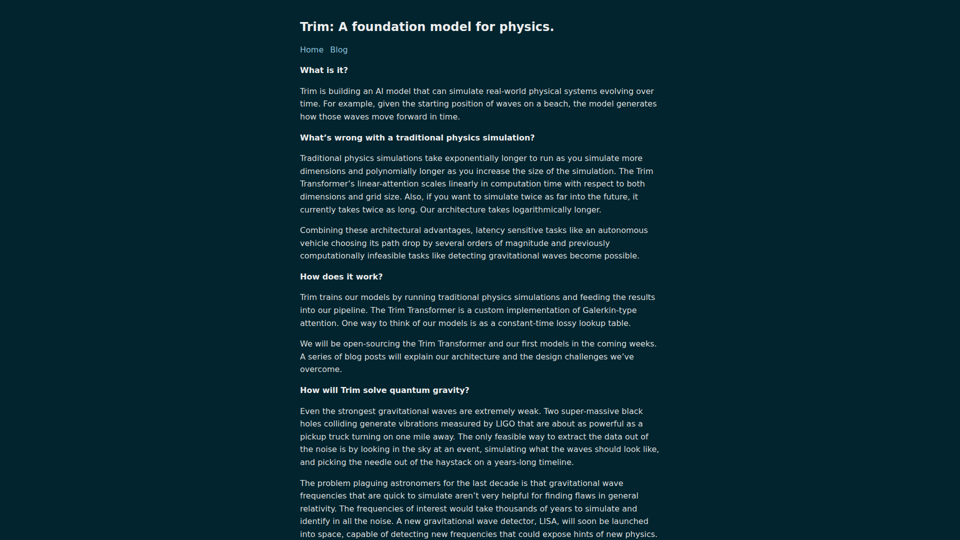
A second shift is in surrogate modeling and simulation. In aerospace, pharma, and materials science, physics-based simulations (CFD, FEA, molecular dynamics) are computationally expensive. Neural surrogate models — trained to approximate high-fidelity simulators at a fraction of the cost — are now standard practice in advanced engineering environments. Applied mathematicians are increasingly responsible for designing the training regimes, assessing surrogate fidelity, and knowing when the approximation breaks down. This requires deeper understanding of both the underlying physics and the failure modes of neural approximators.
In quantitative finance, the pressure is coming from ML-driven alpha generation competing with classical factor models. Applied mathematicians who built careers on stochastic calculus and PDE-based option pricing are now expected to understand when a transformer-based sequence model outperforms a classical term structure model — and more importantly, why, and under what market regimes it will fail.
The net effect: the role is becoming more strategic and less implementational, but the bar for mathematical depth is rising, not falling, because AI-generated implementations need rigorous human oversight to be trustworthy.
Tasks AI Can Automate
- Routine symbolic manipulation — expanding, simplifying, and differentiating expressions; solving standard ODEs and PDEs with known closed-form solutions
- Boilerplate numerical implementation — translating a well-specified algorithm (e.g., Runge-Kutta, conjugate gradient, Monte Carlo integration) into working Python, Julia, or MATLAB code
- Literature synthesis — identifying relevant prior work, summarizing methodological approaches across papers, flagging standard benchmarks for a given problem class
- Parameter sensitivity sweeps — running grid searches or Latin hypercube sampling across parameter spaces once the model structure is fixed
- Report and documentation generation — producing first-draft technical documentation, methodology sections, and model validation summaries from structured inputs
- Unit test scaffolding — generating test cases for numerical routines based on known analytical solutions or boundary conditions
- Data pipeline construction — assembling standard preprocessing, normalization, and feature engineering pipelines for well-defined input formats
- Visualization generation — producing standard diagnostic plots (residuals, convergence curves, sensitivity heatmaps) from model outputs
Skills Becoming More Valuable
Problem formulation under ambiguity. The ability to take a vague business or scientific question and translate it into a well-posed mathematical problem — choosing the right abstraction, identifying what can be modeled and what cannot — is increasingly the scarce input. AI can execute; it cannot reliably formulate.
Model criticism and failure mode analysis. As AI-generated models proliferate, the ability to stress-test assumptions, identify distributional shift, and articulate the conditions under which a model will produce misleading outputs is critical. This requires both mathematical depth and domain knowledge.
Uncertainty quantification (UQ). Bayesian inference, conformal prediction, and probabilistic numerics are growing in importance as organizations demand calibrated confidence intervals, not just point estimates. Regulatory pressure in finance and pharma is accelerating this.
Cross-domain translation. Applied mathematicians who can move fluidly between, say, optimal control theory and reinforcement learning, or between survival analysis and reliability engineering, are disproportionately valuable because they can identify structural analogies that domain specialists miss.
Communication of mathematical risk. Explaining model limitations, assumption sensitivity, and tail risks to non-technical decision-makers — in a way that actually changes behavior — is a skill that compounds in value as model outputs drive higher-stakes decisions.
Scientific ML and physics-informed neural networks (PINNs). Designing hybrid models that embed physical constraints into neural architectures requires both deep mathematical understanding and practical ML engineering skill.
Skills Becoming Less Important
- Manual implementation of standard algorithms — if the algorithm is in a textbook and the problem is well-specified, code generation handles this adequately
- Rote symbolic computation — hand-calculating Jacobians, Hessians, or Fourier transforms for standard function classes is no longer a differentiating skill
- Standalone expertise in a single numerical method — being the team's "finite element person" or "Monte Carlo person" without broader modeling judgment is a narrowing niche
- Data wrangling and pipeline plumbing — time spent on ETL, format conversion, and data cleaning is compressing rapidly with AI-assisted tooling
- Producing first-draft technical write-ups — the mechanical assembly of methodology documentation is increasingly automated; the intellectual contribution is in the review and correction
Current AI Adoption in This Industry
Adoption is uneven but accelerating, with the frontier concentrated in a small number of high-resource environments.
In quantitative finance, leading hedge funds (Renaissance, Two Sigma, D.E. Shaw) have been using ML in production for over a decade. The current wave is about integrating LLMs into research workflows — automated hypothesis generation, code synthesis for backtesting, and natural language interfaces to proprietary data systems. Mid-tier asset managers are 2–4 years behind.
In aerospace and defense, neural surrogate models for CFD and structural analysis are in active production use at Boeing, Airbus, and major defense contractors. The adoption barrier is certification: regulators require explainability and validation standards that slow deployment of black-box models in safety-critical paths.
In pharmaceutical R&D, AI-driven molecular simulation and ADMET prediction are now standard in early-stage drug discovery pipelines. Applied mathematicians here are increasingly working alongside computational chemists to validate ML-predicted binding affinities against physics-based free energy calculations.
In semiconductor design, companies like NVIDIA and TSMC use ML-assisted optimization for chip floorplanning, thermal modeling, and yield prediction. The mathematical complexity of these problems means applied mathematicians remain central to model design even as implementation is increasingly automated.
Across industries, the common pattern is: AI handles the high-volume, well-structured subproblems; applied mathematicians own the problem formulation, model architecture decisions, and validation frameworks.
Future Workflow Evolution
The applied mathematician's workflow in 2027 will look structurally different from 2022, even if the core intellectual contribution remains the same.
Problem intake will increasingly involve AI-assisted scoping — LLMs that can parse a business problem description, suggest candidate mathematical frameworks, and flag analogous solved problems from literature. The mathematician's job shifts to evaluating these suggestions critically rather than generating them from scratch.
Model development will be iterative and AI-augmented. The pattern will be: formulate structure → generate implementation via AI → validate against analytical test cases → stress-test assumptions → iterate. The mathematician's leverage point is in the formulation and validation steps, not the implementation.
Validation and governance will become a formal workflow stage, not an afterthought. As model outputs drive regulated decisions (capital requirements, drug approvals, flight certification), applied mathematicians will own structured model risk management processes — documentation, independent validation, ongoing monitoring — that are currently informal in many organizations.
Collaboration interfaces will change. Applied mathematicians will increasingly work with AI agents that can run experiments, retrieve literature, and generate code in response to natural language specifications. The skill of writing precise, mathematically rigorous prompts — and knowing when the agent's output is subtly wrong — will be operationally important.
Specialization pressure will increase. The generalist applied mathematician who does a bit of everything will face more competition from AI-augmented specialists. The durable positions will be those combining deep domain knowledge (e.g., fixed income derivatives, turbulence modeling, pharmacokinetics) with mathematical breadth and AI fluency.
Common AI Use Cases
- Automated theorem proving assistance — using tools like Lean 4 with LLM interfaces to verify mathematical arguments in formal verification contexts
- Neural surrogate models for expensive simulations in aerospace, climate modeling, and materials science
- LLM-assisted code generation for numerical solvers, optimization routines, and statistical models
- Symbolic regression (e.g., PySR, Eureqa) to discover interpretable mathematical relationships from data
- Bayesian optimization for experimental design and hyperparameter tuning in simulation-heavy workflows
- Physics-informed neural networks (PINNs) for solving PDEs in domains where classical numerical methods are computationally prohibitive
- Automated sensitivity analysis using AI-driven sampling strategies to identify critical model parameters
- Natural language interfaces to mathematical software — querying Mathematica, MATLAB, or Julia environments via LLM front-ends
Recommended AI Stack
Core computation and symbolic math
- Wolfram Language / Mathematica — still the gold standard for symbolic computation; increasingly accessible via LLM interfaces
- Julia with ModelingToolkit.jl — for equation-based modeling with automatic differentiation and symbolic-numeric integration
- SymPy + GPT-4/Claude API — for LLM-assisted symbolic manipulation in Python workflows
Scientific ML and surrogate modeling
- JAX + Flax or Equinox — for differentiable programming and physics-informed models
- DeepXDE — purpose-built for PINNs and operator learning
- SciML ecosystem (Julia) — for neural ODEs, universal differential equations, and scientific ML pipelines
Optimization
- Gurobi / CPLEX — commercial solvers for large-scale linear and mixed-integer programs
- Pyomo + HiGHS — open-source alternative for mathematical programming
- Optuna / BoTorch — for Bayesian optimization in experimental design contexts
LLM-assisted research and development
- GitHub Copilot or Cursor — for code synthesis in numerical computing workflows
- Elicit or Consensus — for AI-assisted literature review and methodology synthesis
- Notebooklm — for synthesizing technical documentation and model specifications
Uncertainty quantification
- PyMC or Stan — for Bayesian inference and probabilistic modeling
- MAPIE or Crepes — for conformal prediction and calibrated uncertainty intervals
Risks & Challenges
Model laundering. AI-generated implementations can look correct while containing subtle mathematical errors — wrong sign conventions, incorrect boundary conditions, numerical instability in edge cases. The risk is that speed of generation outpaces rigor of validation, particularly in organizations where applied mathematicians are under delivery pressure.
Assumption opacity. LLMs trained on mathematical literature will reproduce standard assumptions without flagging when those assumptions are violated in a specific application context. An applied mathematician who delegates too much to AI tooling may inherit assumptions they haven't consciously accepted.
Skill atrophy in junior roles. If early-career applied mathematicians use AI to skip the implementation phase, they may not develop the low-level intuition needed to recognize when a model is behaving pathologically. This is a genuine pipeline risk for the profession.
Regulatory lag. In finance, pharma, and aerospace, model validation requirements were written for classical statistical models. AI-augmented workflows — where the boundary between human and machine contribution is blurred — create compliance ambiguity that organizations are still navigating.
Reproducibility and auditability. AI-assisted model development creates documentation challenges. If a model architecture was partly suggested by an LLM and iteratively refined, reconstructing the intellectual provenance for a regulatory audit or peer review is non-trivial.
Overconfidence in surrogate fidelity. Neural surrogates trained on simulation data can extrapolate poorly outside their training distribution. Applied mathematicians who don't rigorously characterize the surrogate's validity domain create downstream risk when the surrogate is used in optimization loops that push toward unexplored regions.
Future Outlook (3–5 Years)
The applied mathematician role will not be automated away — but it will bifurcate. One branch becomes more strategic: mathematicians who own problem formulation, model governance, and cross-domain synthesis will be more valuable than ever, operating at higher leverage with AI handling implementation. The other branch — those whose value was primarily in implementing known algorithms — will face significant displacement pressure.
The most durable applied mathematicians will be those who develop what might be called mathematical judgment: the ability to look at an AI-generated model, a surrogate approximation, or an optimization result and know, from first principles, whether it can be trusted and under what conditions it will fail. This is not a skill that AI currently replicates reliably.
Demand will grow in domains where mathematical rigor intersects with high-stakes decisions: climate modeling, AI safety (formal verification, robustness guarantees), quantum computing algorithm design, and precision medicine. These are areas where the cost of mathematical error is high enough that human oversight remains non-negotiable.
The academic pipeline will need to adapt. Graduate programs that train applied mathematicians primarily in classical numerical methods without exposure to scientific ML, uncertainty quantification, and AI-augmented workflows will produce graduates who are underprepared for the commercial environment they enter.
Compensation will polarize. Top applied mathematicians in quantitative finance and AI research infrastructure will see continued wage growth. Mid-tier roles in industries where AI can handle the bulk of the mathematical workload will face compression.
Final Insight
The applied mathematician's core value proposition has always been the ability to impose mathematical structure on problems that resist it — to find the right abstraction, not just execute the right algorithm. AI is an extraordinarily powerful executor, but it is a weak formulator. It can solve the problem you give it; it cannot reliably tell you whether you've given it the right problem.
That gap — between execution and formulation — is where applied mathematicians will live for the foreseeable future. The professionals who thrive will be those who use AI to compress the distance between insight and implementation, freeing more cognitive bandwidth for the work that actually requires mathematical depth: stress-testing assumptions, designing validation frameworks, and making the judgment calls that determine whether a model is fit for the decision it's being asked to support.
The risk is not irrelevance. The risk is complacency — assuming that because the role survives, it doesn't need to change. Applied mathematicians who don't develop fluency with scientific ML, probabilistic programming, and AI-augmented research workflows will find themselves increasingly dependent on tools they don't understand, which is precisely the failure mode their role exists to prevent.