
Manifest | The Open Source LLM Router for OpenClaw
Rate this Tool
Average Score
Total Votes
Select your score (1-10):
Detail Information
What
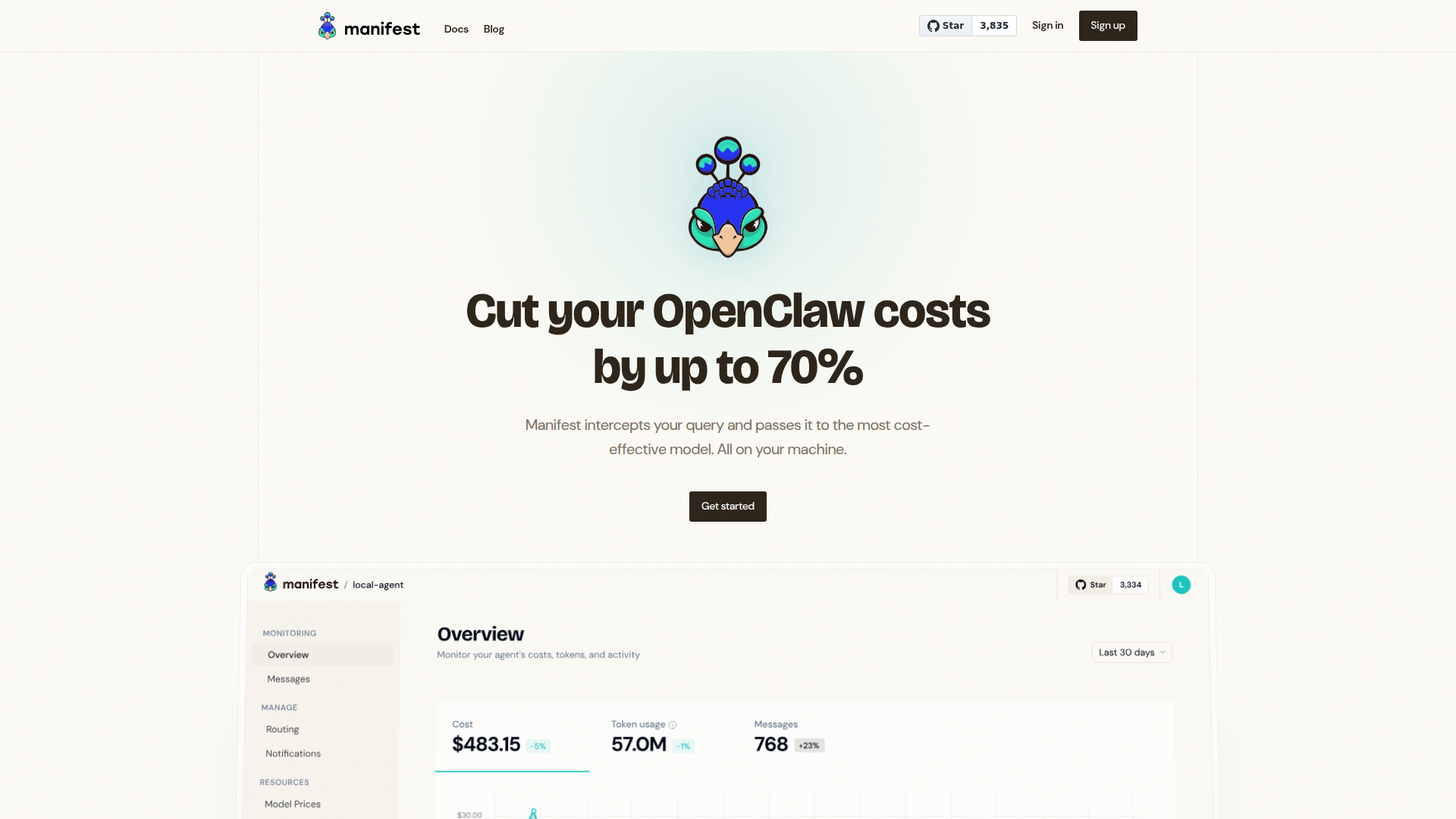
Manifest is an open source LLM router for OpenClaw that intercepts requests and sends each query to a more cost-appropriate model. The product is positioned around reducing unnecessary model spend by avoiding the use of large models for simple tasks.
It appears designed for OpenClaw users who want lower operating costs, more control over routing, and stronger privacy by keeping query scoring on their own machine. The core workflow is straightforward: analyze each request locally, route it to the most suitable model, and expose telemetry and cost data so teams can monitor usage.
Features
- Local query routing: Manifest analyzes each query locally in under 2ms and chooses the most adapted model, which helps avoid overpaying for simple requests.
- Cost-aware model selection: The router is built to pass work to the most cost-effective model for a given task, supporting lower OpenClaw usage costs.
- Privacy-preserving architecture: Query scoring happens on the user's machine, and the cloud version is described as a blind proxy, which is intended to limit data exposure.
- Message-level cost tracking: Users can analyze the cost of each message and set limits or alerts when budgets are exceeded.
- OpenTelemetry-based telemetry: Telemetry is collected and exported in the OpenTelemetry format, which supports data ownership and observability workflows.
- Open source OpenClaw plugin: Manifest is fully open source and available as a native OpenClaw plugin with one-command installation and no coding required.
Helpful Tips
- Validate routing quality, not just savings: For products like this, cost reduction is most useful when paired with acceptable output quality across different task types.
- Define routing policies by task complexity: The biggest benefit typically comes from separating lightweight actions from high-reasoning or high-context workloads.
- Use budget alerts early: Cost visibility is more valuable when teams set limits and alerts before scaling usage across users or agents.
- Review telemetry ownership and export paths: Since telemetry uses OpenTelemetry, buyers should confirm how they want to store, process, and govern that operational data.
- Check self-hosting and extension needs: Because the product is open source, implementation teams should assess whether they want a simple plugin deployment or a more customized routing layer.
OpenClaw Skills
Within the OpenClaw ecosystem, Manifest likely fits best as a routing and cost-governance layer beneath agents, assistants, and multi-step workflows. A likely use case is pairing Manifest with OpenClaw skills that classify intent, estimate task complexity, or tag requests by sensitivity before handing them to the most appropriate model. This could help teams standardize how model selection happens across many automations instead of relying on a single default model.
Another likely use case is building OpenClaw agents for finance, operations, support, or internal knowledge work that dynamically trade off cost, latency, and capability. For example, a workflow could route simple retrieval, summarization, or formatting tasks to lower-cost models while reserving stronger models for deeper reasoning or ambiguous requests. If implemented well, that combination could make agent-based work more operationally sustainable for teams running high volumes of LLM tasks, though the page does not explicitly describe these advanced orchestration patterns as native features.
Embed Code
Share this AI tool on your website or blog by copying and pasting the code below. The embedded widget will automatically update with the latest information.
<iframe src="https://www.aimyflow.com/ai/manifest-build/embed" width="100%" height="400" frameborder="0"></iframe>
Explore Similar Tools
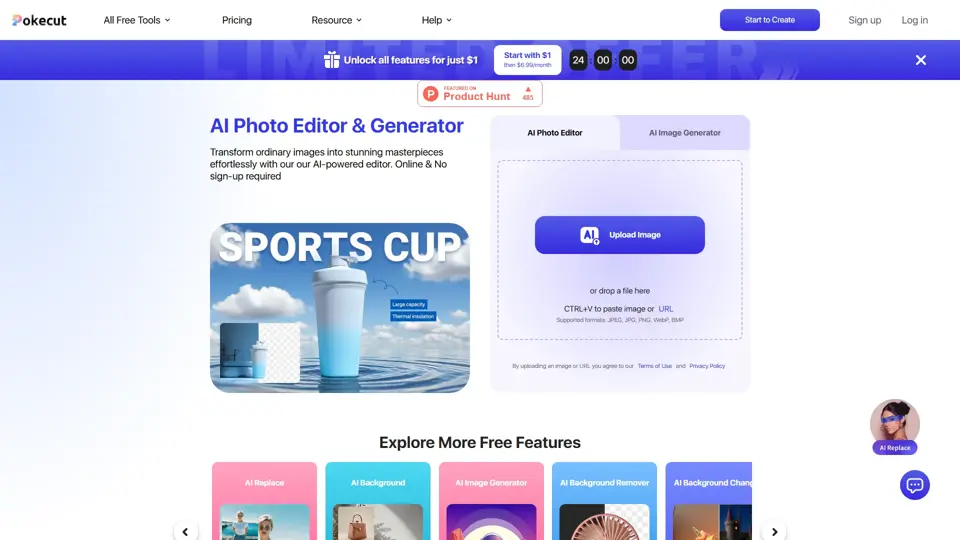
Free AI Photo Editor: Edit & Generate Image Online | Pokecut
Pokecut is an AI photo editor that helps users remove backgrounds, enhance images, and generate visuals online, mainly for ecommerce sellers, marketers, and creators who need quick design-ready assets. It speeds up routine image production so visual teams can create polished content with less manual editing.
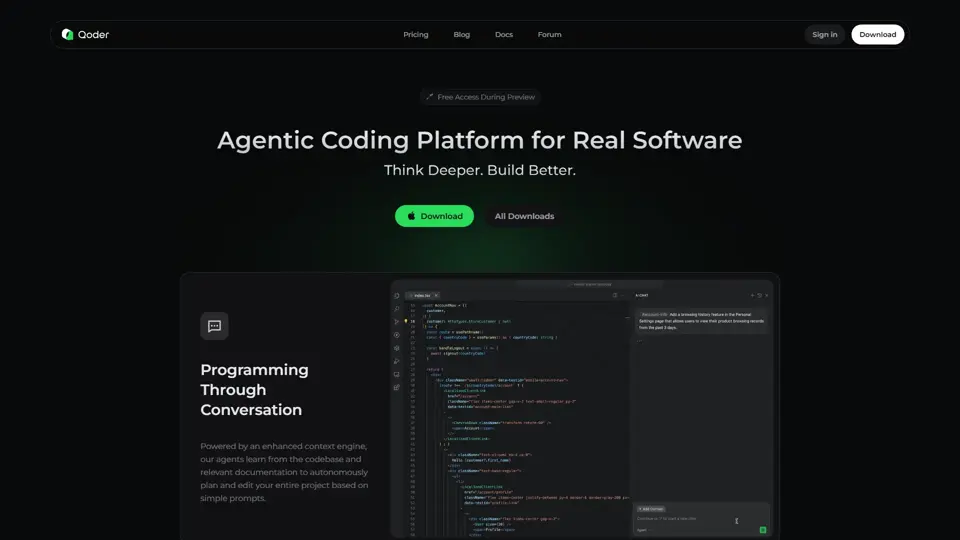
Qoder - The Agentic Coding Platform
Qoder is an agentic coding platform that helps developers understand codebases and execute software tasks with AI agents, mainly for professional software engineers and development teams. It improves engineering throughput by combining strong code context with advanced models for more reliable task completion.

Seedance 2.0
Seedance 2.0 is ByteDance's AI video generation model designed to create high-quality videos from prompts and multimodal inputs, mainly for creators, developers, and media teams. In the AI era, it helps visual content roles turn ideas into production-ready motion assets with far less manual editing effort.
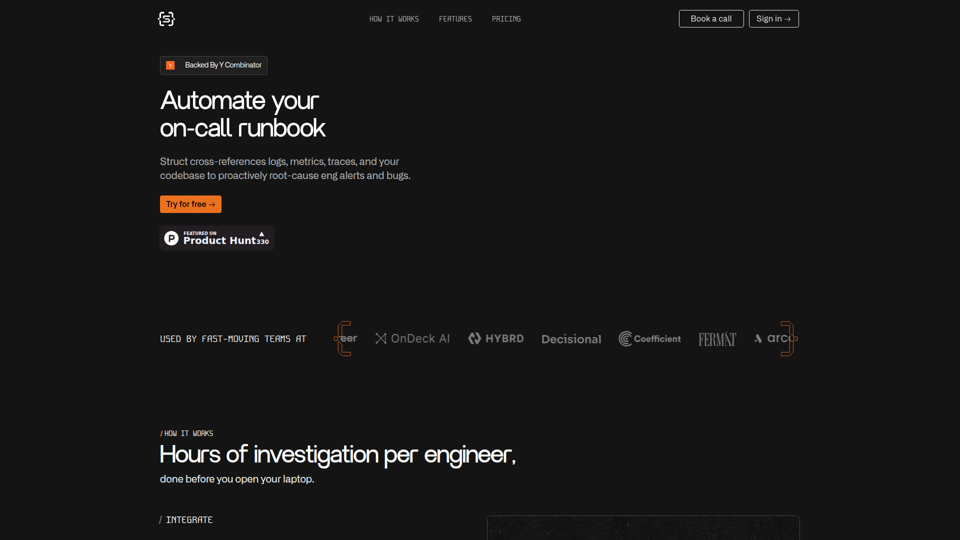
Struct | Automate your on-call runbook
Struct is an AI on-call agent that investigates engineering alerts and bugs by analyzing logs, metrics, traces, and codebases, mainly for software engineers and SRE teams. In the AI era, it helps incident responders shorten triage time by delivering root-cause findings and suggested fixes directly in workflows.
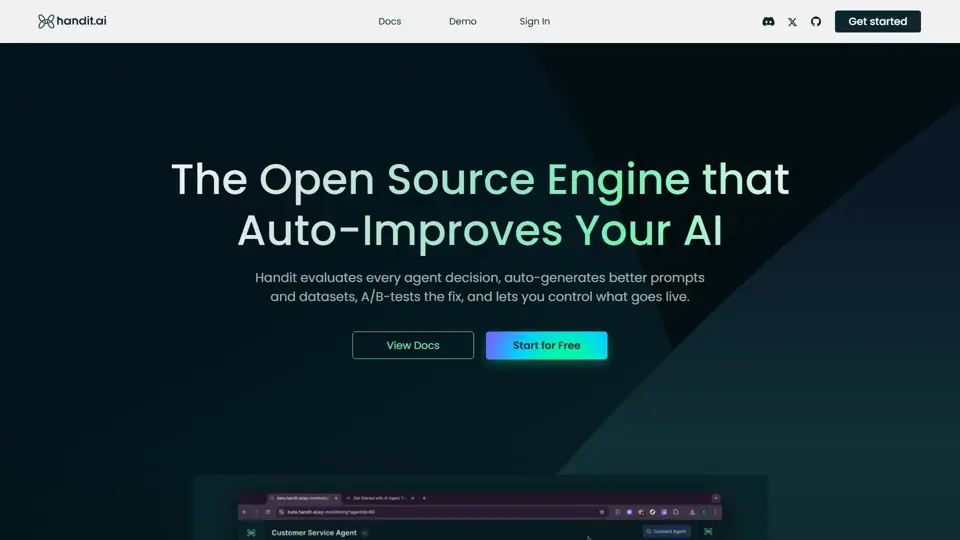
Handit.ai — The Open Source Engine that Auto-Improves Your AI Agents
Handit.ai is an open-source optimization engine that evaluates AI agent decisions, generates improved prompts and datasets, and A/B tests changes for teams building and operating AI agents. It helps AI engineers and product teams improve agent quality faster while keeping tighter control over production behavior.
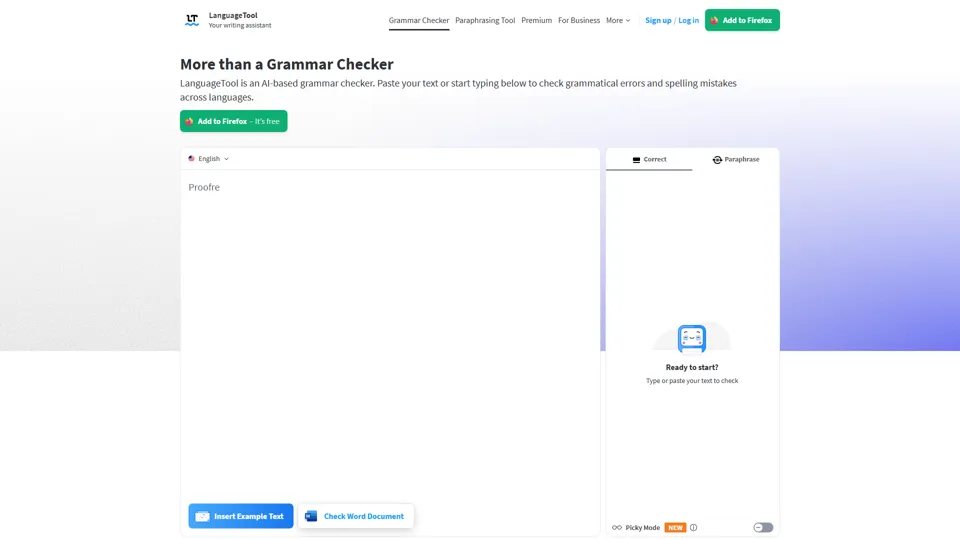
Free AI Grammar Checker - LanguageTool
LanguageTool is an AI-powered grammar and writing assistant that helps users check grammar, spelling, punctuation, and style across more than 30 languages, mainly for students, professionals, and multilingual teams. It helps writing-heavy roles communicate more clearly and edit faster at scale.
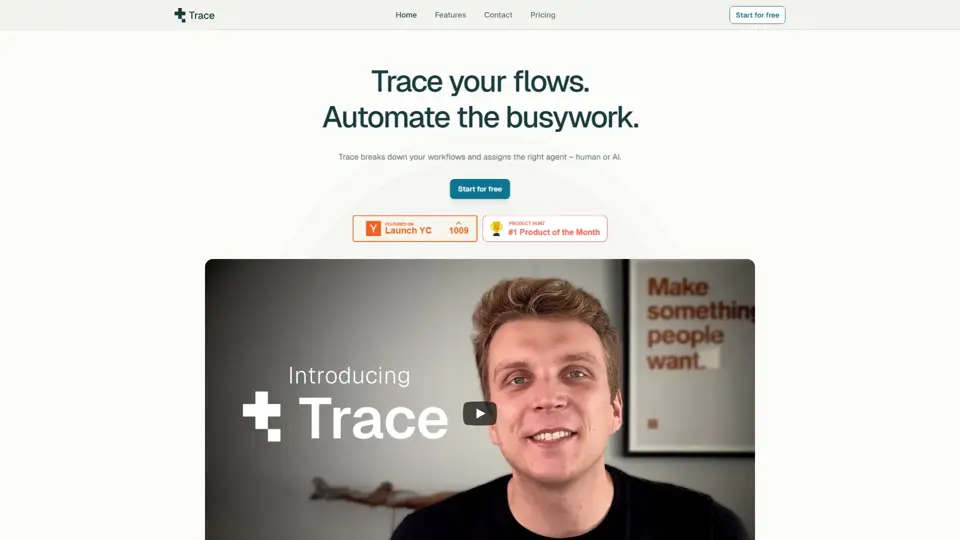
Trace
Trace is a software tool designed to support digital workflows, likely focused on helping teams organize, monitor, or analyze work more effectively. In the AI era, tools that centralize operational visibility help technical and business roles make faster decisions with less manual follow-up.
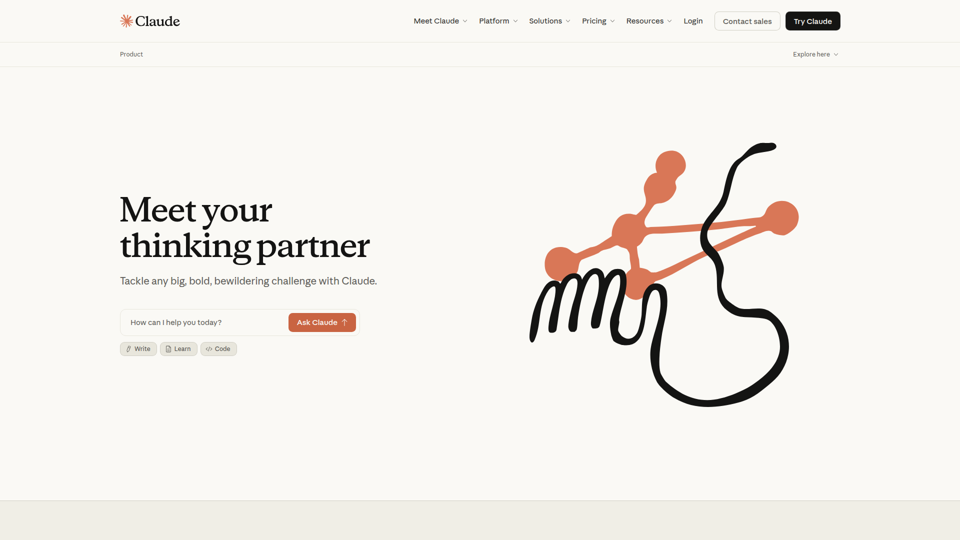
The AI for Problem Solvers | Claude by Anthropic
Claude by Anthropic is an AI assistant for problem solvers that helps users tackle complex work such as writing, coding, data analysis, research, and organizing tasks, mainly for professionals, developers, and teams handling difficult projects. In AI-enabled workflows, it can help knowledge workers and software teams move faster from analysis to execution while keeping people in control of approvals and file access.