
MIAPI — Grounded AI Answers API
Rate this Tool
Average Score
Total Votes
Select your score (1-10):
Detail Information
What
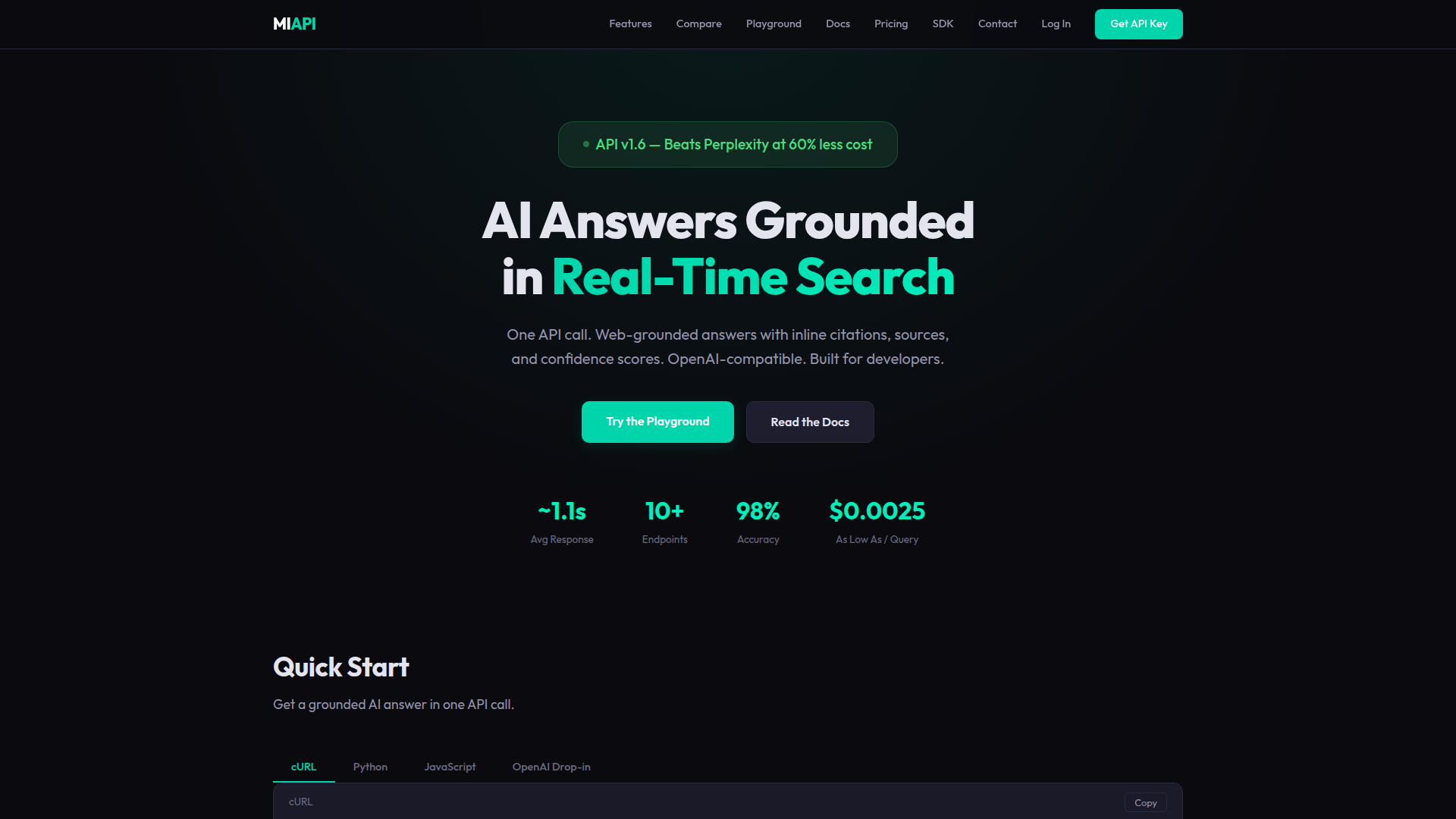
MIAPI is a grounded AI answers API for developers who need responses backed by real-time web search. It returns synthesized answers with inline citations, source links, and confidence scores, and it also exposes raw search, news, image, and streaming endpoints.
The product appears positioned as a developer-first alternative to other grounded answer APIs, with OpenAI-compatible chat completions and a separate answer endpoint for more configurable retrieval. It serves teams building search-assisted assistants, RAG workflows, research features, and applications that need current information rather than model-only responses.
Features
- Grounded answer endpoint:
/v1/answersearches the web and returns an AI-generated answer with optional citations, sources, confidence, cache status, and response timing. - OpenAI-compatible chat API:
/v1/chat/completionsacts as a drop-in replacement for OpenAI chat code, reducing migration effort for teams that want web-grounded outputs. - Knowledge mode: The API can answer from user-provided text, the web, or both together, which is useful for lightweight RAG and domain-specific question answering.
- Search-only mode:
/v1/searchreturns raw web results without LLM synthesis, giving developers more control in custom pipelines or bring-your-own-model architectures. - Streaming responses: SSE support streams sources first and then the answer token by token, which helps improve perceived responsiveness in interactive apps.
- Specialized retrieval endpoints: Separate
/v1/newsand/v1/imagesendpoints provide recent articles and web images with structured metadata for use cases beyond plain text answers.
Helpful Tips
- Test grounding quality by query type: Evaluate factual, time-sensitive, and niche-domain prompts separately, because grounded answer APIs often perform differently across broad search, recent news, and proprietary-context questions.
- Use domain controls where accuracy matters: The
search_domainsandexclude_domainsparameters can help reduce noisy sources and make outputs more predictable for business or research workflows. - Choose endpoint style based on product design: Use
/v1/answerwhen you need retrieval controls and metadata, and/v1/chat/completionswhen compatibility with existing OpenAI-style tooling is the main priority. - Validate confidence and sources in your app layer: The API provides confidence scores and citations, but production workflows should still apply human review or rule-based checks for high-stakes use cases.
- Check operational fit beyond core API behavior: The page lists usage, key management, caching headers, rate limits, and an MCP server, so buyers should confirm these operational details match their deployment and governance needs.
OpenClaw Skills
Within the OpenClaw ecosystem, MIAPI could likely serve as a retrieval and grounding layer for agents that need current, cited answers. Likely use cases include research assistants, competitive intelligence agents, customer-support copilots that combine company knowledge with public web data, and monitoring workflows that summarize news with source attribution.
OpenClaw skills could also be built around MIAPI's search-only, news, and image endpoints to separate retrieval from reasoning in multi-agent systems. For example, one agent could gather current sources via MIAPI, another could score credibility or classify findings, and a third could generate a structured brief or response draft. If implemented well, that combination could make knowledge work in product, research, operations, and support more auditable and easier to verify, though the source page does not explicitly confirm a native OpenClaw integration.
Embed Code
Share this AI tool on your website or blog by copying and pasting the code below. The embedded widget will automatically update with the latest information.
<iframe src="https://www.aimyflow.com/ai/miapi-uk/embed" width="100%" height="400" frameborder="0"></iframe>
Explore Similar Tools

Free AI Photo Editor: Edit & Generate Image Online | Pokecut
Pokecut is an AI photo editor that helps users remove backgrounds, enhance images, and generate visuals online, mainly for ecommerce sellers, marketers, and creators who need quick design-ready assets. It speeds up routine image production so visual teams can create polished content with less manual editing.
Qoder - The Agentic Coding Platform
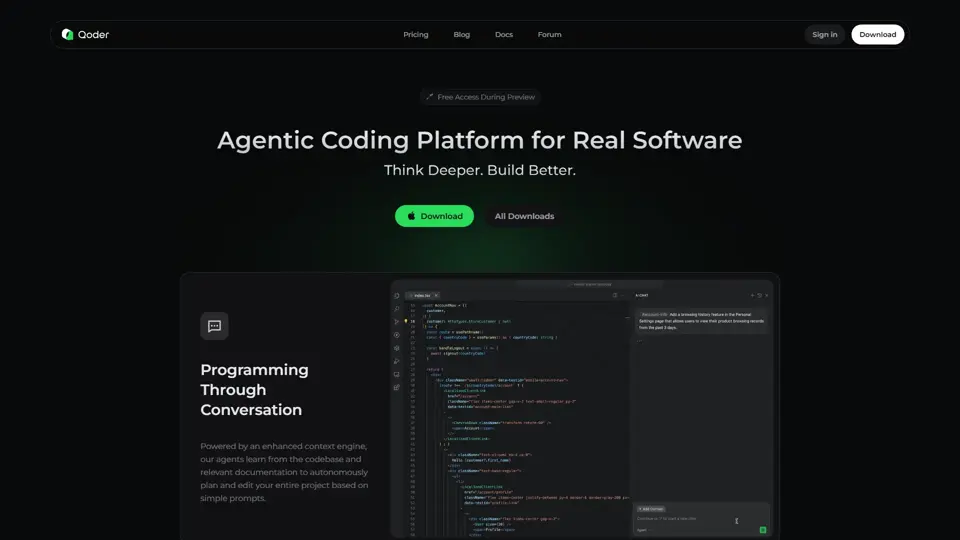
Qoder is an agentic coding platform that helps developers understand codebases and execute software tasks with AI agents, mainly for professional software engineers and development teams. It improves engineering throughput by combining strong code context with advanced models for more reliable task completion.

Seedance 2.0
Seedance 2.0 is ByteDance's AI video generation model designed to create high-quality videos from prompts and multimodal inputs, mainly for creators, developers, and media teams. In the AI era, it helps visual content roles turn ideas into production-ready motion assets with far less manual editing effort.
Struct | Automate your on-call runbook
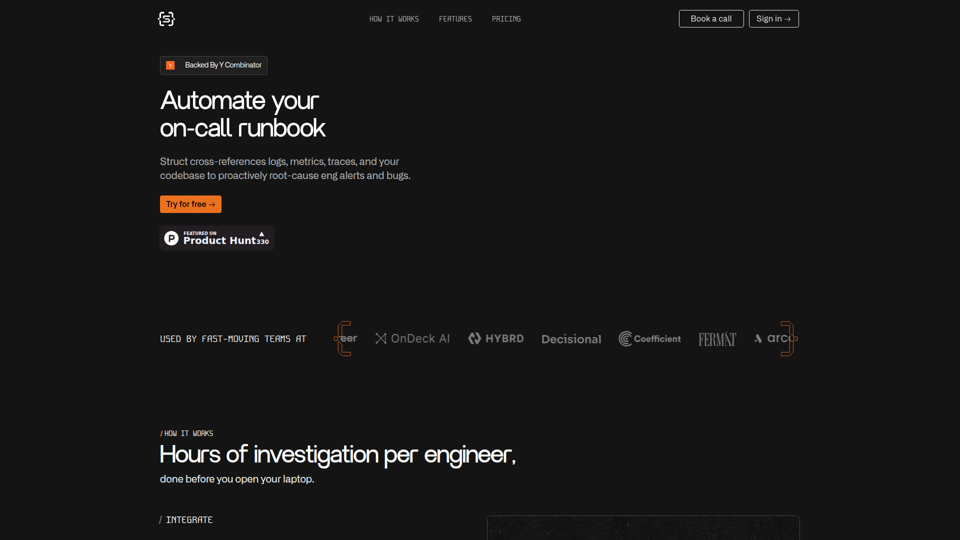
Struct is an AI on-call agent that investigates engineering alerts and bugs by analyzing logs, metrics, traces, and codebases, mainly for software engineers and SRE teams. In the AI era, it helps incident responders shorten triage time by delivering root-cause findings and suggested fixes directly in workflows.
Handit.ai — The Open Source Engine that Auto-Improves Your AI Agents
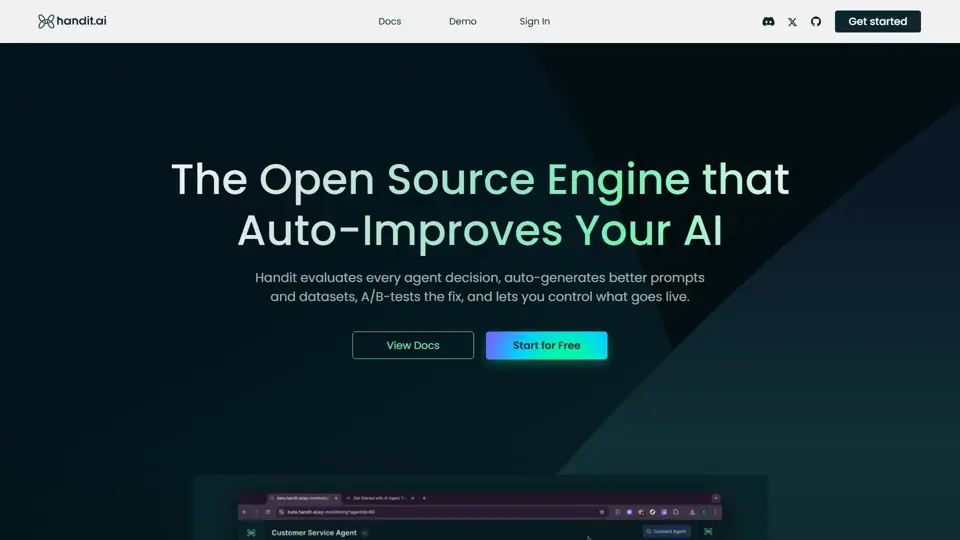
Handit.ai is an open-source optimization engine that evaluates AI agent decisions, generates improved prompts and datasets, and A/B tests changes for teams building and operating AI agents. It helps AI engineers and product teams improve agent quality faster while keeping tighter control over production behavior.
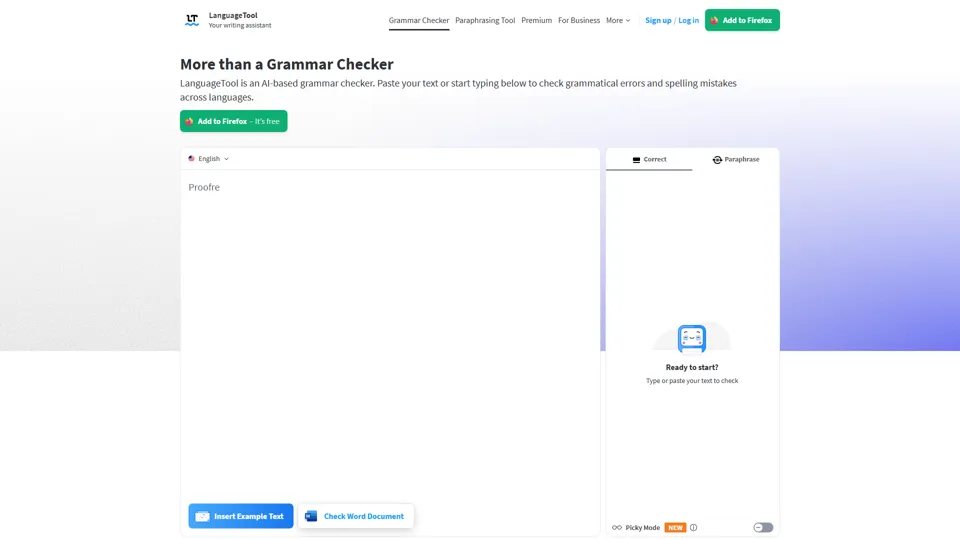
Free AI Grammar Checker - LanguageTool
LanguageTool is an AI-powered grammar and writing assistant that helps users check grammar, spelling, punctuation, and style across more than 30 languages, mainly for students, professionals, and multilingual teams. It helps writing-heavy roles communicate more clearly and edit faster at scale.

Trace
Trace is a software tool designed to support digital workflows, likely focused on helping teams organize, monitor, or analyze work more effectively. In the AI era, tools that centralize operational visibility help technical and business roles make faster decisions with less manual follow-up.
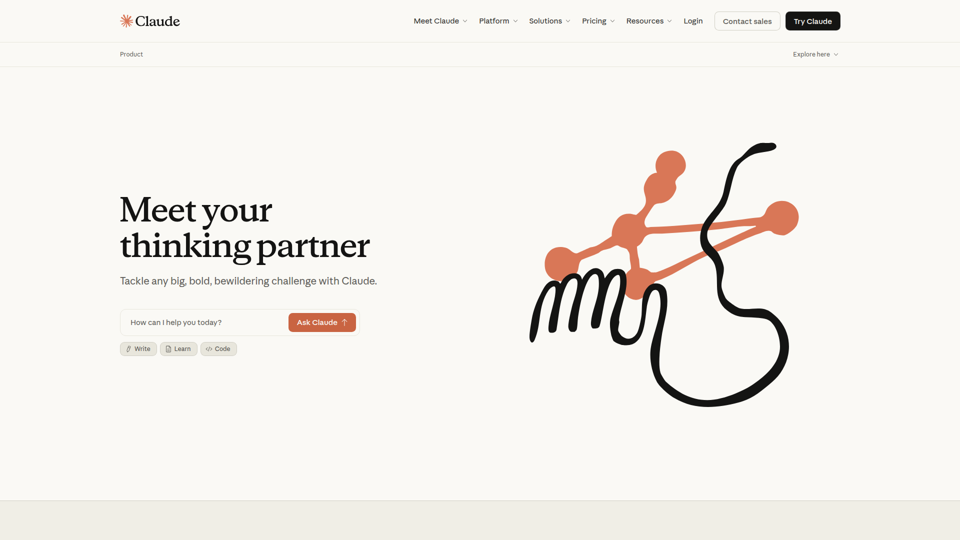
The AI for Problem Solvers | Claude by Anthropic
Claude by Anthropic is an AI assistant for problem solvers that helps users tackle complex work such as writing, coding, data analysis, research, and organizing tasks, mainly for professionals, developers, and teams handling difficult projects. In AI-enabled workflows, it can help knowledge workers and software teams move faster from analysis to execution while keeping people in control of approvals and file access.