
Pivot Robotics
Rate this Tool
Average Score
Total Votes
Select your score (1-10):
Detail Information
What
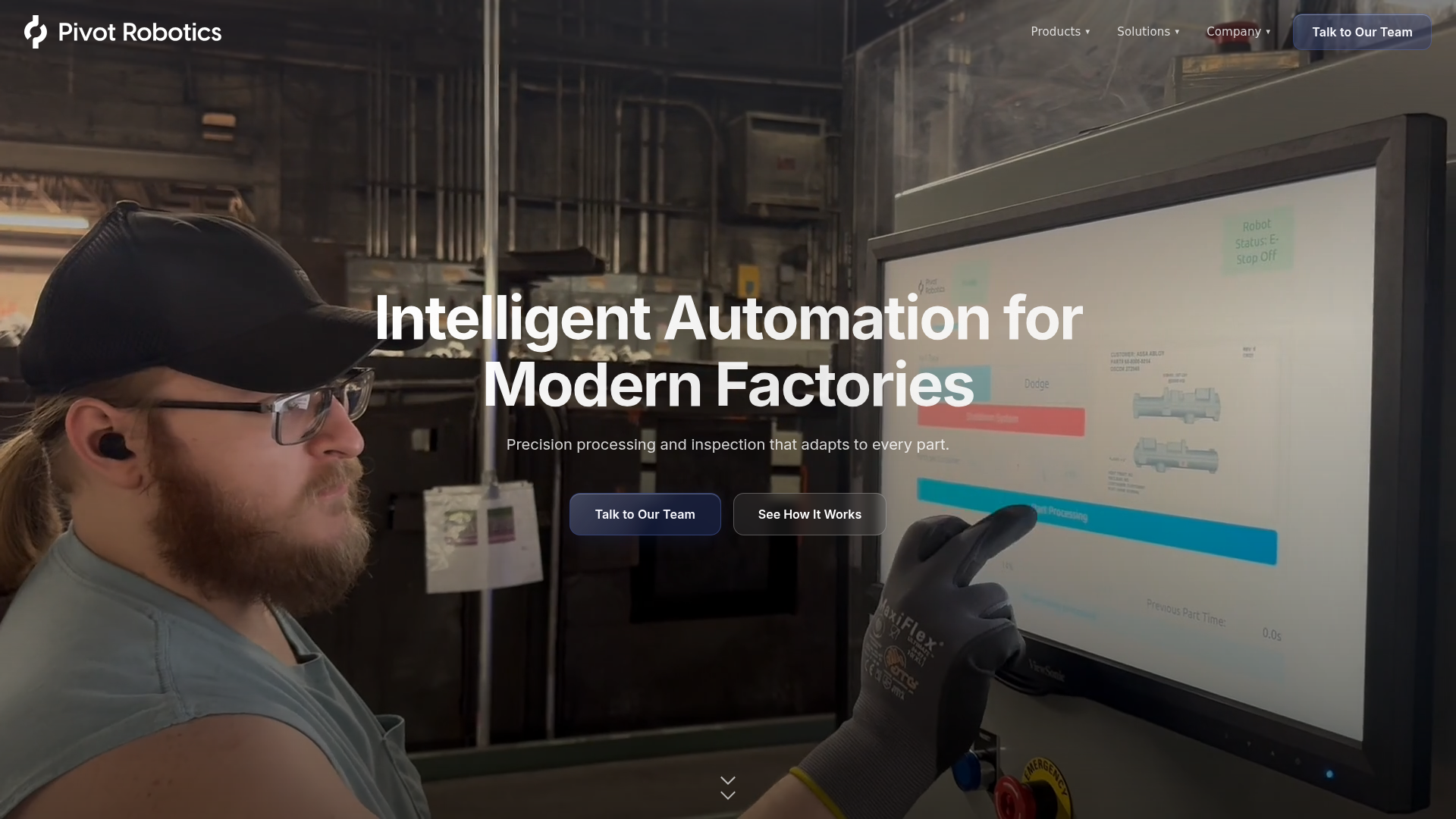
Pivot Robotics provides autonomous manufacturing automation focused on part processing and part inspection. Its positioning is centered on modern factories that need flexible finishing and quality workflows for variable parts, especially where manual grinding and finishing create labor, throughput, and consistency constraints.
The product appears aimed at manufacturers such as foundries and aerospace or defense suppliers that process complex components under tight tolerances. Its core workflow combines a camera-driven perception stack with robotic processing and inspection so the same vision system can support measurement, defect detection, gauging, and adaptive finishing tasks across changing part geometries.
Features
- Adaptive part processing: Supports grinding, cutting, sanding, machining, and spraying with a camera-driven system that adjusts to part variation instead of relying only on fixed automation.
- Computer vision inspection: Uses vision to quantify parts for defect detection and gauging, helping manufacturers verify quality on the same perception foundation used for processing.
- Shared vision stack for processing and inspection: A common perception system powers both automation and measurement, which may simplify how factories connect finishing and quality control workflows.
- Rapid new-part setup: The site claims new parts can be added without extensive programming or fixed toolpaths, which is valuable for high-mix environments where setup time can outweigh production time.
- Production-proven deployment: Pivot states its systems are already running at major foundries in North America and processing more than 5,000 parts per week, indicating real-world manufacturing use.
- Tolerance-focused finishing: The company highlights repeatable 1 mm precision on cast iron components in demanding foundry conditions, showing a focus on consistency despite part-to-part variation.
Helpful Tips
- Validate variation handling on your actual parts: For this category of automation, success depends on real geometry variation, surface conditions, fixturing, and defect profiles, so pilot testing should use representative production parts.
- Assess both processing and inspection together: A shared perception stack can be strategically useful if your goal is to connect finishing decisions with quality data rather than treating them as separate automation projects.
- Examine setup and changeover workflows closely: Since Pivot emphasizes faster onboarding of new parts, buyers should review how new part introduction, operator oversight, and exception handling work in practice.
- Check tolerance needs against the stated evidence: The page provides a specific precision example for cast iron foundry applications, but requirements in aerospace, composites, or tighter-tolerance programs should be verified directly.
- Model ROI with labor and throughput assumptions: The site mentions a sub-two-year ROI based on labor savings and throughput gains, but each plant should test this against its own staffing constraints, cycle times, and scrap or rework costs.
OpenClaw Skills
Pivot Robotics could likely fit well into the OpenClaw ecosystem as a manufacturing autonomy and quality-execution data source. Likely OpenClaw skills could include an agent that monitors processing cell performance, summarizes inspection results by part family, flags recurring defect patterns, and routes exceptions to production, quality, or maintenance teams. If the underlying system exposes operational and quality data, OpenClaw workflows could turn that into shift reports, deviation alerts, and traceable job summaries for plant leadership.
A broader likely use case is an OpenClaw agent layer that helps manufacturers operationalize adaptive finishing across multiple programs. For example, agents could compare throughput and quality trends by material type, recommend where autonomous cells should be assigned, or coordinate engineering reviews when a new part is introduced. This is an inference rather than a confirmed native integration, but the combination could be especially useful in foundries and precision manufacturing environments where labor shortages, variable part geometry, and quality traceability all affect output.
Embed Code
Share this AI tool on your website or blog by copying and pasting the code below. The embedded widget will automatically update with the latest information.
<iframe src="https://www.aimyflow.com/ai/pivotrobotics-com/embed" width="100%" height="400" frameborder="0"></iframe>
Explore Similar Tools
Korso – The Intelligence Layer for Manufacturing
Korso is an AI-powered manufacturing operations platform that helps manufacturers automate quoting, purchase orders, supplier communication, and intake from email, WhatsApp, WeChat, and ERP systems. For sales, procurement, and operations teams in manufacturing, it can reduce manual document handling and speed responses by turning RFQs, POs, and messages into structured, actionable workflows.
Arzana - Office Execution System (OES) for US Manufacturers & Distributors
Arzana is an Office Execution System that automates front-office administrative work such as quoting, order entry, purchasing, customer service, and ERP-connected workflows for US manufacturers and distributors. For sales, operations, and customer service teams in industrial companies, this kind of AI automation can reduce repetitive office work and free staff to focus on faster response times and higher-value customer-facing tasks.
Allus AI - Vision Foundation Model for Manufacturing
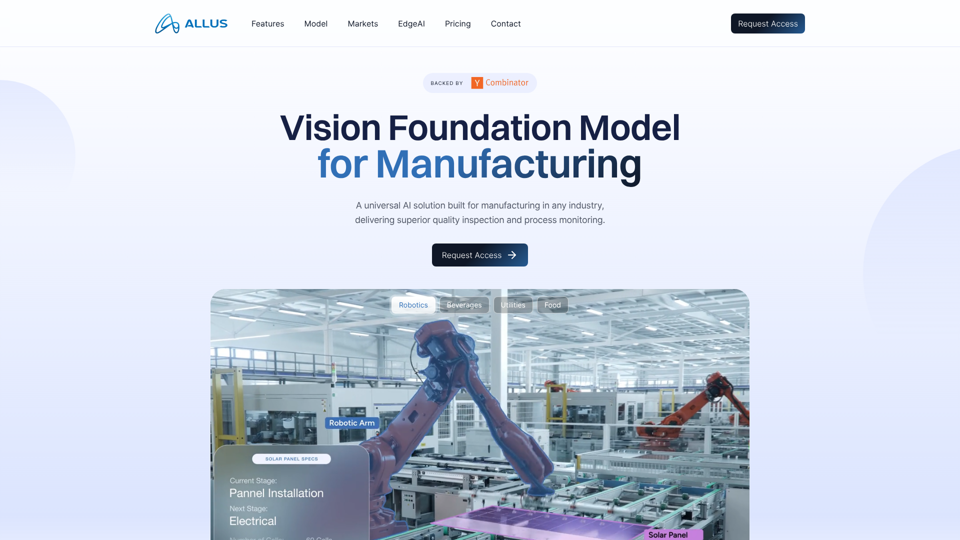
Allus AI is a vision foundation model and AI platform for manufacturing that helps teams build and deploy industrial inspection, quality assurance, anomaly detection, and process monitoring solutions, mainly for manufacturers and production operations teams. In AI-enabled factories, it can help quality engineers and manufacturing leaders reduce manual inspection work and act on real-time analytics from edge and cloud deployments.

Nexa® | Streamline Cattle Health Monitoring
Nexa is a cattle health monitoring system that uses implantable microchips, a centralized beacon, and herd management software to help farmers and ranchers detect disease early, manage breeding, and track cattle behavior and location. For livestock managers and herd health teams, its AI-driven alerts can support faster intervention decisions and more targeted daily monitoring across beef and dairy operations.
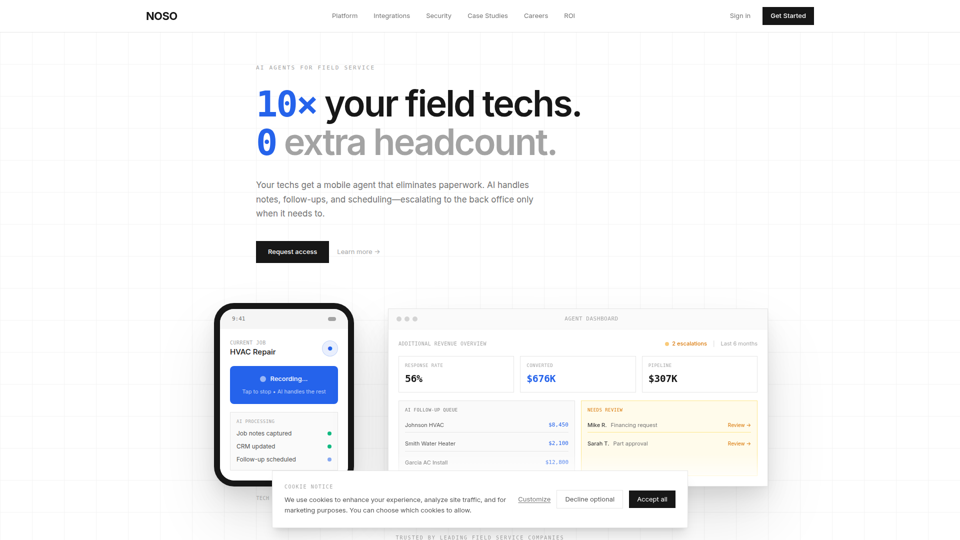
Noso - The Source of Intelligence for Field Technicians
Noso is an AI field service platform that gives field technicians a mobile agent to automate notes, follow-ups, scheduling, and CRM updates, mainly for trades and home service teams. For field service operations and back-office staff, this can reduce admin work, surface only complex exceptions, and help technicians spend more time on jobs instead of paperwork.
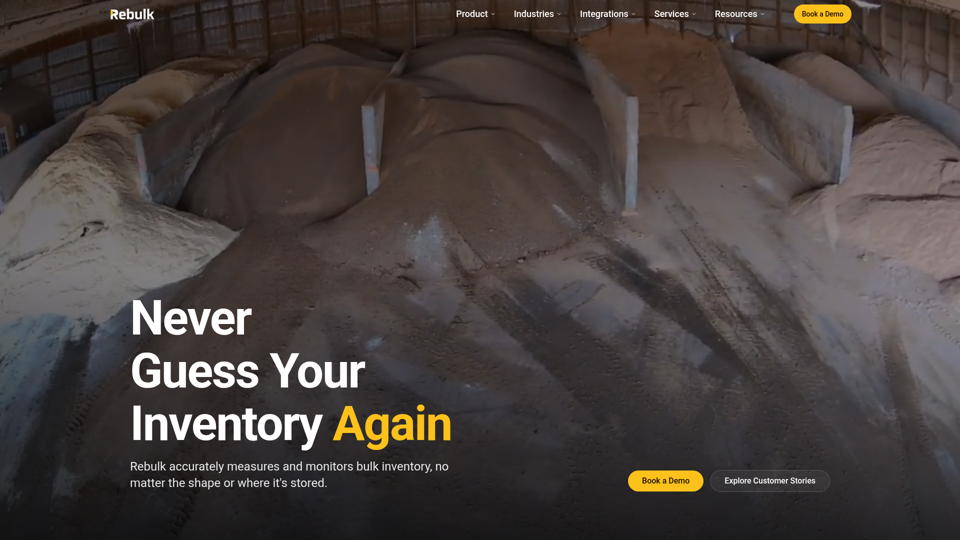
Rebulk - Automated Bulk Inventory Measurement
Rebulk is an automated bulk inventory measurement system that uses cameras, 3D sensors, software, and mobile app capture to help operations teams measure, monitor, and manage bulk materials across sites in industries like agriculture, aggregates, biomass, energy, and recycling. For operations, logistics, and field teams, AI-driven inventory visibility can reduce manual checks, improve tracking of changes over time, and help surface issues earlier for faster action.
Dartboard Energy - Ask your fleet anything
Dartboard Energy is an AI agent for solar and storage fleet teams that analyzes site data to answer operational questions, explain contract treatment, and estimate financial impact through email, Slack, or Teams without a dashboard. For operations and asset management professionals, it can speed root-cause analysis, prioritize meaningful alarms, and surface downtime or warranty exposure earlier.

Saldor
Saldor is a field training tool that helps HVAC, solar, and other trade service teams turn new hires into productive technicians faster through hands-free, in-field support. In an AI-enabled workflow, it can help trainers, operations leaders, and field managers standardize onboarding and reinforce guidance directly on the job.