
AI Architectural Documentation & BIM Automation | SWAPP | Swapp
Rate this Tool
Average Score
Total Votes
Select your score (1-10):
Detail Information
What
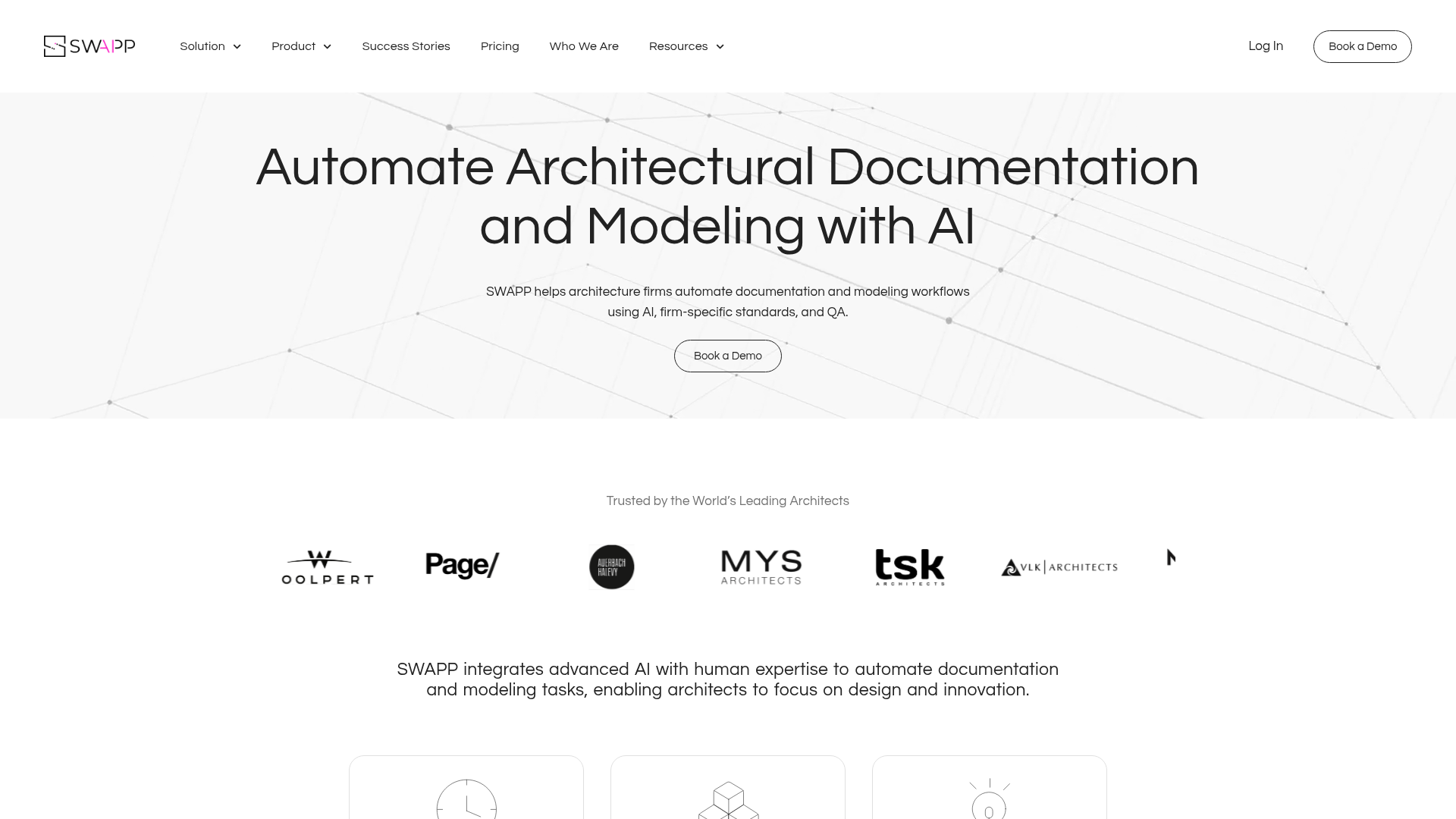
SWAPP is an AI-based product for architecture firms that automates architectural documentation and modeling workflows. The site positions it around construction documentation, BIM-related production work, and firm-specific standards, with an added emphasis on QA and human expertise.
It appears to serve architects and operations leaders who need to reduce repetitive production work, improve consistency, and maintain accuracy across projects. Based on the page, SWAPP is positioned as a workflow automation layer for architectural delivery teams rather than a general-purpose design tool.
Features
- AI-driven documentation automation: Automates repetitive documentation tasks to shorten construction documentation timelines and reduce manual production work.
- Modeling workflow automation: Supports modeling-related tasks so teams can complete BIM production work faster, although the page does not detail exact modeling functions.
- Firm-specific standards application: Uses machine learning and LLMs to make a firm's standards and guidelines actionable in real time across projects.
- Quality assurance support: Combines AI, QA, and human expertise to improve output consistency and reduce errors in documentation and modeling.
- Iterative learning over time: Continuously improves through tagging, data collection, and implementation, helping the system adapt as firm standards evolve.
- Professional-grade output focus: Aims to deliver high-detail documentation across architectural verticals, with the site claiming accuracy that exceeds industry standards.
Helpful Tips
- Validate task coverage carefully: Since the page highlights documentation and modeling broadly but gives limited workflow detail, firms should confirm which deliverables and project stages are currently supported.
- Assess standards readiness first: Products like this are most useful when a firm already has clear documentation standards, templates, and QA expectations that can be encoded consistently.
- Pilot on repetitive sheet-production work: Early adoption is typically most effective in high-volume, rules-based tasks where speed and consistency matter more than custom design judgment.
- Keep human review in the loop: The product itself emphasizes human expertise, which suggests firms should treat it as an accelerator for production teams rather than a full replacement for architectural review.
- Measure change beyond time savings: In addition to claimed speed gains, evaluate rework rates, annotation consistency, standards compliance, and team capacity improvements during rollout.
OpenClaw Skills
Within the OpenClaw ecosystem, SWAPP would likely fit well as a specialized architecture-production system that feeds structured documentation and modeling outputs into broader operational workflows. A likely use case would be OpenClaw agents that route project setup, standards selection, QA checks, drawing-package reviews, and internal coordination tasks around SWAPP-generated deliverables, even though the page does not describe any native OpenClaw integration.
This combination could be especially useful for architecture firms, design technology teams, and operations leaders building more automated delivery pipelines. Likely OpenClaw skills could include a BIM documentation QA agent, a standards-governance assistant, a project handoff coordinator, or an AI chat workflow that helps teams query firm rules and production status. In practice, that could shift architectural operations from manual sheet-by-sheet oversight toward orchestrated, standards-aware delivery systems with architects spending more time on design decisions and exception handling.
Embed Code
Share this AI tool on your website or blog by copying and pasting the code below. The embedded widget will automatically update with the latest information.
<iframe src="https://www.aimyflow.com/ai/swapp-ai/embed" width="100%" height="400" frameborder="0"></iframe>
Explore Similar Tools
Vaethat | Archviz AI Render Enhancer | Architectural Rendering
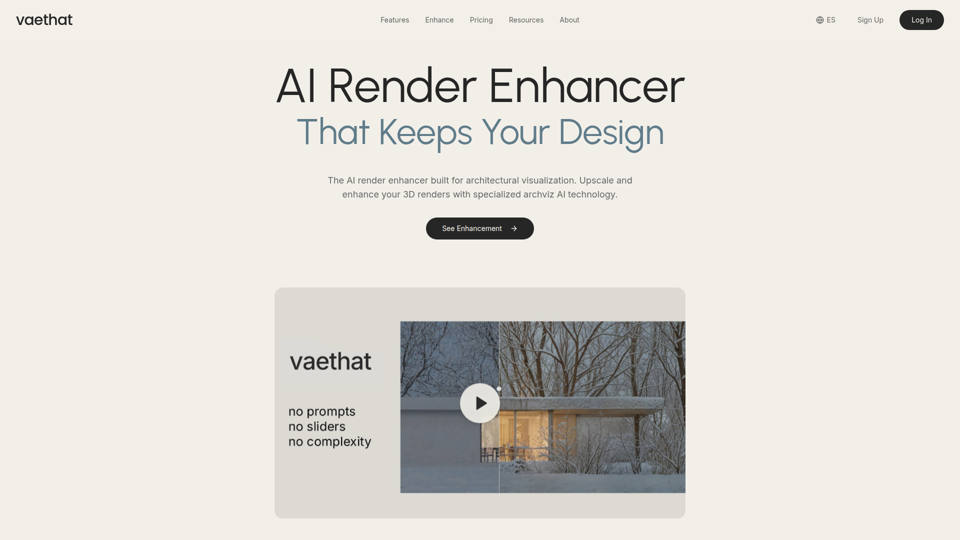
Vaethat is an AI render enhancer for architectural visualization professionals that helps them upscale and improve 3D renders using presets, batch project handling, and AI trained specifically on archviz workflows. For architectural visualizers and 3D artists, this kind of specialized enhancement can speed post-production while preserving consistency across images in a project.

Chaos 公司的 3D 可视化工具
Chaos is a 3D visualization tool ecosystem from Chaos that helps users render, simulate, and visualize projects across architecture, architectural visualization, media and entertainment, and product design, mainly for architects, AEC professionals, designers, and VFX artists. With AI-assisted ideation and connected rendering tools, it can help architects and visualization teams speed design decisions and produce more consistent photoreal outputs within existing 3D workflows.
Articulate - AI-Powered Construction Drawing Analysis
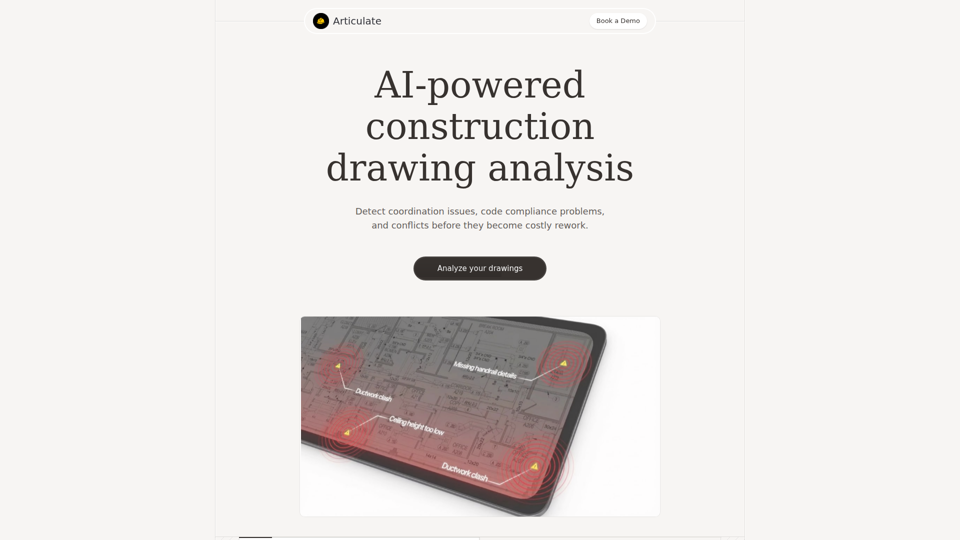
Articulate is an AI-powered construction drawing analysis platform that reviews 2D PDF plans to identify coordination conflicts, code compliance issues, and design errors for architects, engineers, general contractors, and other construction professionals. In AI-assisted preconstruction workflows, it can help design and project teams review drawings faster, prioritize issues by location and severity, and reduce RFIs and rework before work reaches the field.
Build with Brickanta
Brickanta is an agentic AI platform for construction and society-building teams that helps users work with project documentation and decision-making, with a focus on European enterprise requirements. For construction professionals and project stakeholders, this can reduce manual handling of complex documents and support more consistent, security-conscious decisions as AI becomes part of core project workflows.
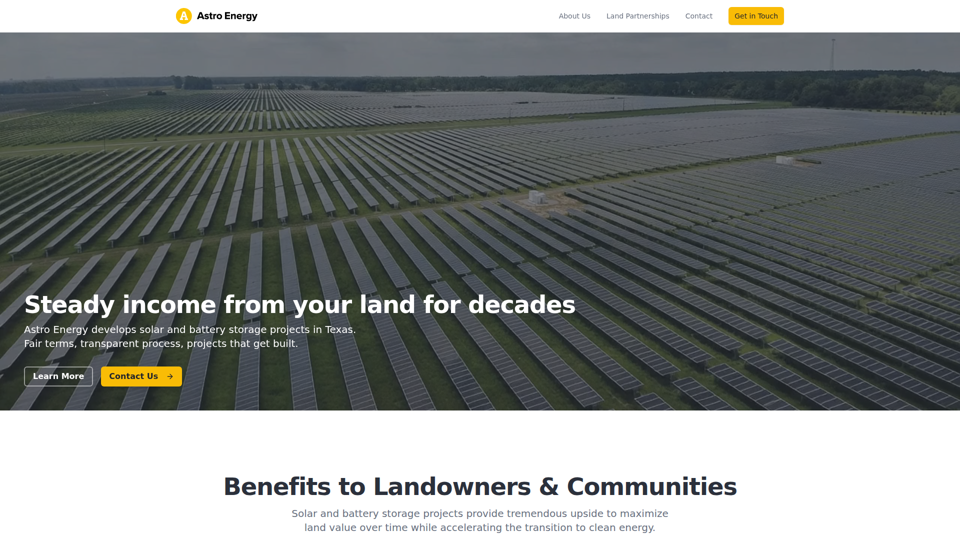
Astro Energy
Astro Energy is a utility-scale solar and battery storage developer that helps Texas landowners evaluate and lease land for long-term energy projects through a transparent development process. For landowners and rural property stakeholders, this can turn underused acreage into predictable energy income while supporting project planning in the ERCOT market.