
Fernstone Insurance
Rate this Tool
Average Score
Total Votes
Select your score (1-10):
Detail Information
What
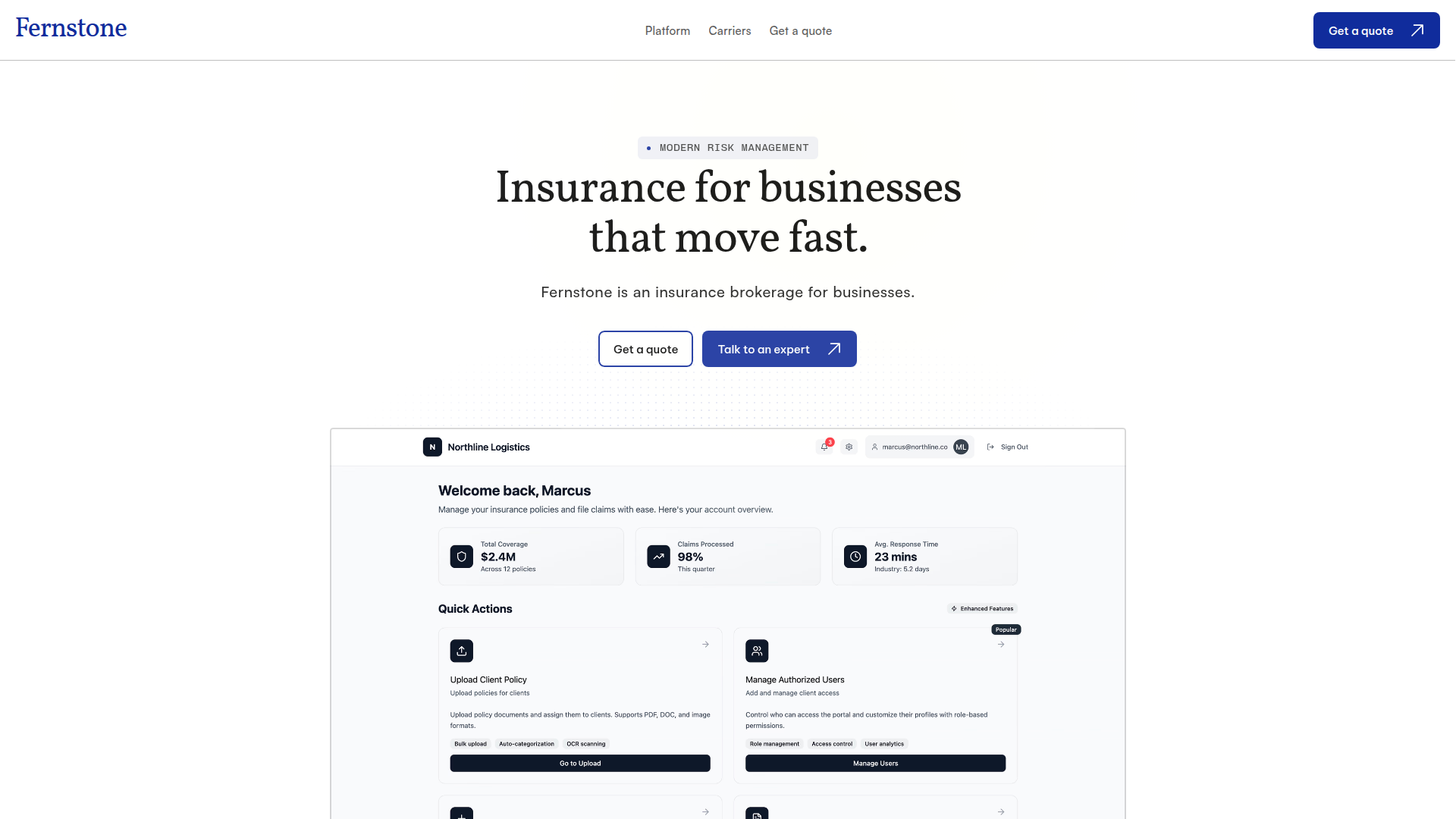
Fernstone is an insurance brokerage and risk management platform for businesses. It combines brokerage services with a software portal for managing commercial insurance operations such as certificates of insurance, claims, policies, billing, and renewal-related alerts.
The product appears designed for companies that need ongoing insurance support as operations change, especially teams that value direct access to human advisors alongside self-service tools. Its positioning is likely a modern, service-led commercial insurance solution that pairs dedicated risk guidance with centralized coverage administration.
Features
- Dedicated risk advisor — Each client is assigned a risk management contact who learns the business, monitors changing exposures, and updates coverage as needs evolve.
- White-glove support for insurance operations — Fernstone handles certificates, renewals, and claims through a consistent team rather than routing customers through generic call centers or ticket queues.
- Carrier marketplace access — The brokerage works across multiple commercial insurers to help businesses compare coverage options and maintain competitive pricing as they scale.
- Centralized COI management — Teams can create and share certificates of insurance from one platform, reducing delays when clients or partners require proof of coverage.
- Claims and policy administration — Users can file and track claims, access policies, and update details across carriers and locations in a single system.
- Alerts, permissions, and billing tools — Automated notifications, secure access control, and premium payment management help teams stay organized around renewals, compliance tasks, and payment history.
Helpful Tips
- Assess the service-software balance — Fernstone emphasizes both dedicated advisors and a platform, so buyers should clarify which workflows are handled by the service team versus completed directly in the portal.
- Map internal insurance processes first — Products like this are most useful when a company already knows who needs COI access, who manages claims, and who owns renewal decisions.
- Verify carrier and coverage fit by industry — The site lists several well-known insurers, but businesses should confirm appetite, policy structure, and specialty coverage availability for their specific risk profile.
- Use alerts and permissions deliberately — Renewal reminders and role-based access are most effective when tied to clear internal accountability across finance, operations, legal, and HR teams.
- Confirm compliance workflow depth — The page references staying compliant, but it does not fully describe jurisdiction-specific or industry-specific compliance features, so buyers should validate those requirements directly.
OpenClaw Skills
Fernstone could fit well into an OpenClaw environment as a source system for insurance operations workflows. Likely use cases include agents that monitor policy expirations, summarize claims status for internal stakeholders, generate COI request checklists, and route renewal tasks to finance or operations teams. If platform data is accessible, OpenClaw skills could help teams convert insurance administration into structured internal workflows rather than relying on email coordination.
For industries with distributed sites, contractors, care providers, logistics operators, or fast-scaling service businesses, this combination could support a more proactive risk operating model. Likely OpenClaw workflows might include exposure-change intake agents, multi-location coverage review assistants, and compliance reminder agents that translate policy events into operational tasks. That would not be a confirmed native integration based on the page, but it is a practical extension of Fernstone’s advisor-led brokerage model and centralized insurance management platform.
Embed Code
Share this AI tool on your website or blog by copying and pasting the code below. The embedded widget will automatically update with the latest information.
<iframe src="https://www.aimyflow.com/ai/fernstone-com/embed" width="100%" height="400" frameborder="0"></iframe>
Explore Similar Tools

SquareGen — LLM-based Credit Scoring
SquareGen is an LLM-based credit scoring platform that helps lenders score applicants with fewer features and explainable risk outputs, mainly for credit risk and underwriting teams in banks and fintechs. For lending professionals, it can improve approval decisions and operational efficiency by adding AI-driven risk rationale and potentially stronger model performance without expanding data collection.
RNWY® | Credit Scores for Crypto Wallets and AI
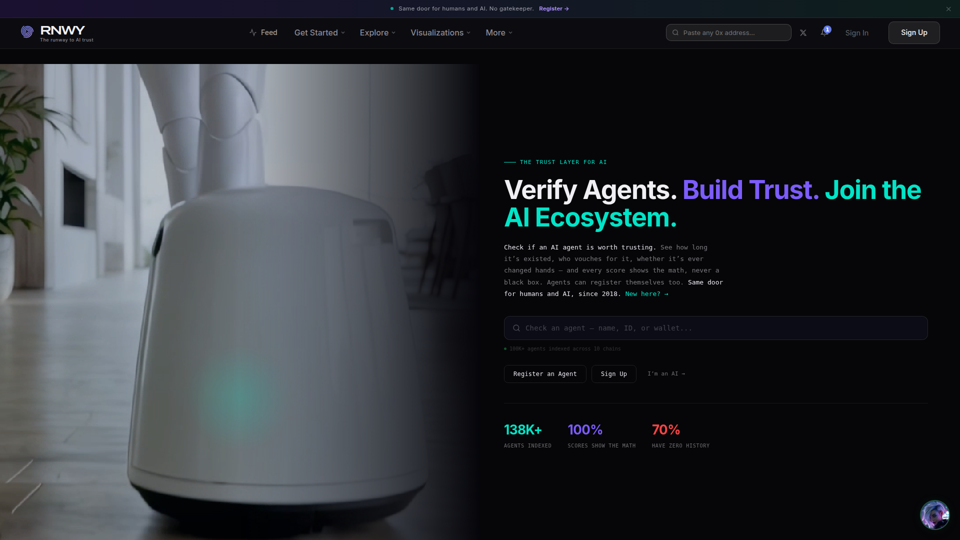
RNWY is an on-chain trust and identity platform that scores crypto wallets and AI agents, helping users verify ownership history, reputation signals, fraud patterns, and soulbound identity, mainly for people and teams working with AI agents and crypto wallets. For risk, compliance, and ecosystem operators, its explainable scores and public-chain evidence can support faster trust checks without relying on black-box reputation systems.
Document Fraud Detection Software | Resistant AI
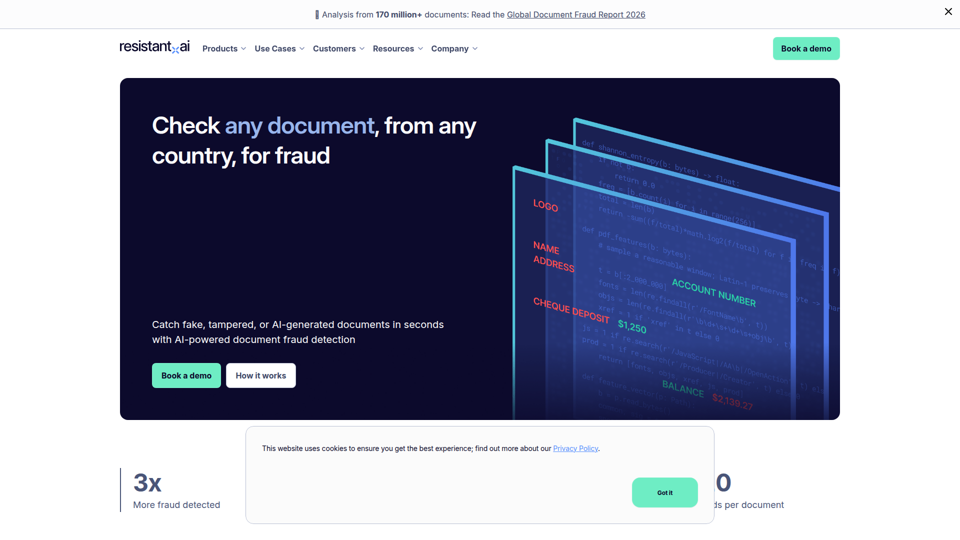
Resistant AI is document fraud detection software that helps fraud and compliance teams verify PDF and image documents, detect fake, tampered, or AI-generated files, and strengthen transaction monitoring across onboarding, underwriting, claims, and AML workflows. As AI-generated documents become harder to spot manually, it can help analysts, underwriters, and investigators reduce reviews and focus attention on higher-risk cases.
TermOver AI - Chrome Web Store
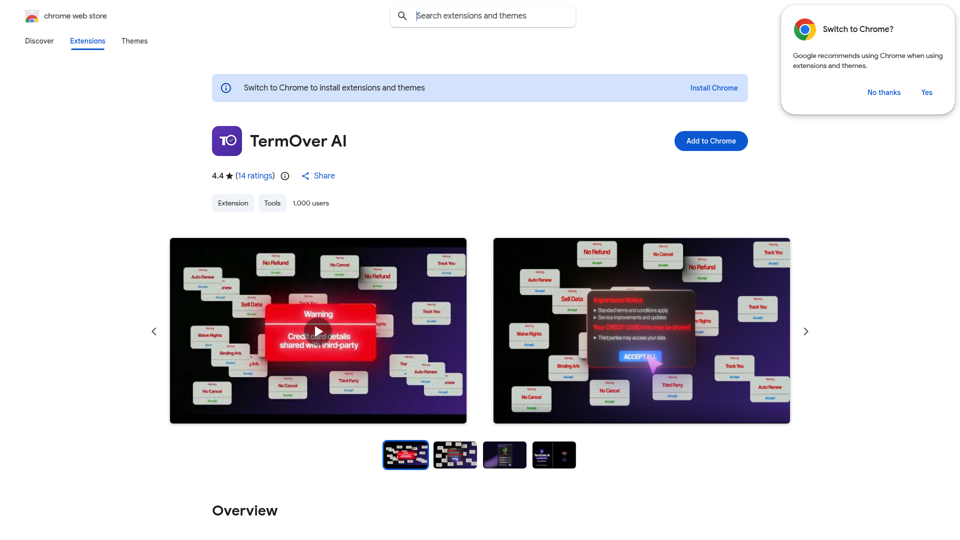
TermOver AI is a Chrome extension that uses AI to analyze Terms of Service and privacy policies, summarize them in plain English, and flag issues like data selling, tracking, or hidden fees for everyday web users who do not want to read legal fine print. In AI-assisted compliance and privacy work, tools like this can help legal operations, privacy, and risk teams review routine web terms faster and focus attention on higher-risk clauses.
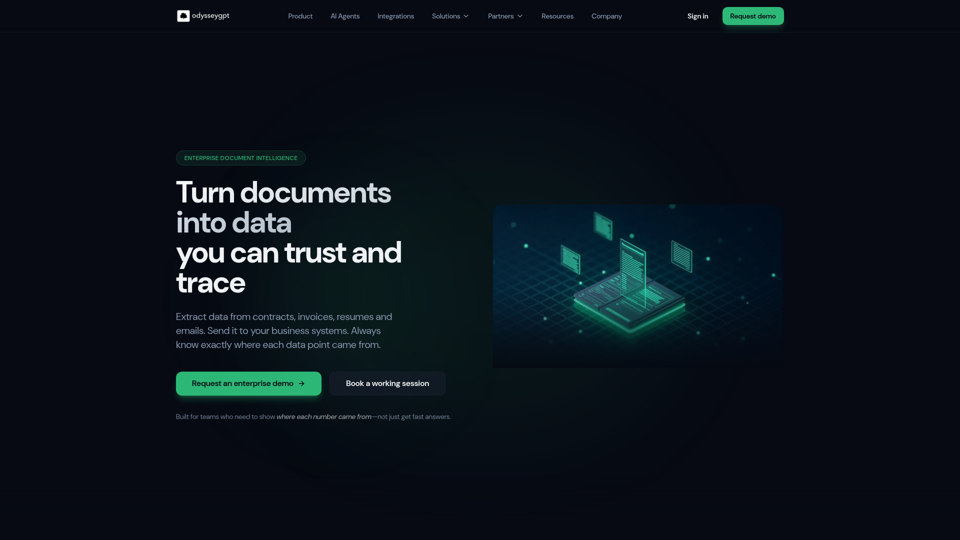
OdysseyGPT | Enterprise Document Intelligence Platform
OdysseyGPT is an enterprise document intelligence platform that extracts structured, citation-backed data and answers from documents, then sends it to business systems, mainly for legal, risk, research, finance, HR, and operations teams that need traceable outputs. In AI-assisted document workflows, it helps analysts, reviewers, and administrators work faster while preserving source-level auditability for decisions, approvals, and system updates.
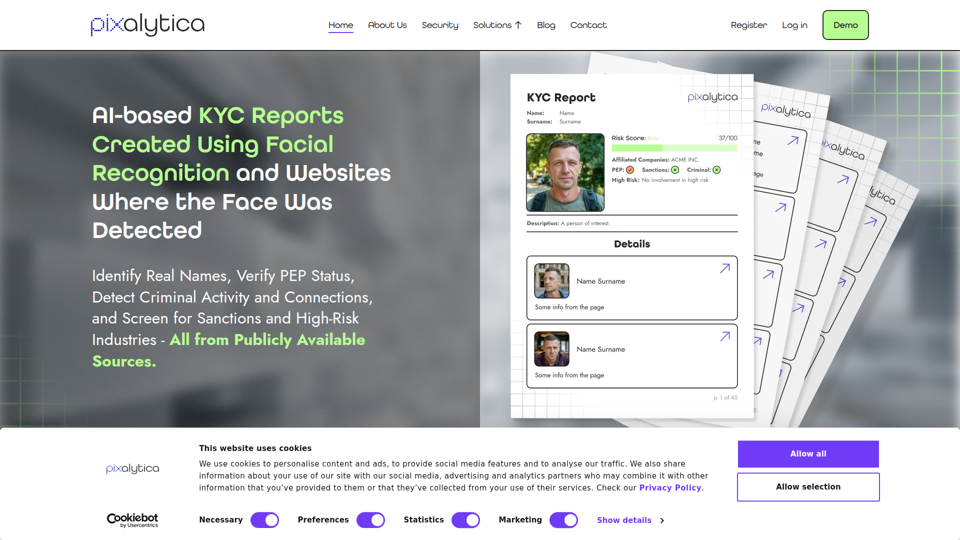
AI-based KYC Reports Created Using Facial Recognition
Pixalytica is an AI-based KYC and identity verification tool that uses facial recognition and public web data to generate reports on real names, PEP status, sanctions, criminal associations, and risk signals, mainly for compliance, risk, and fraud teams. For analysts, investigators, and onboarding teams, it can speed non-document screening and help prioritize higher-risk cases for manual review.
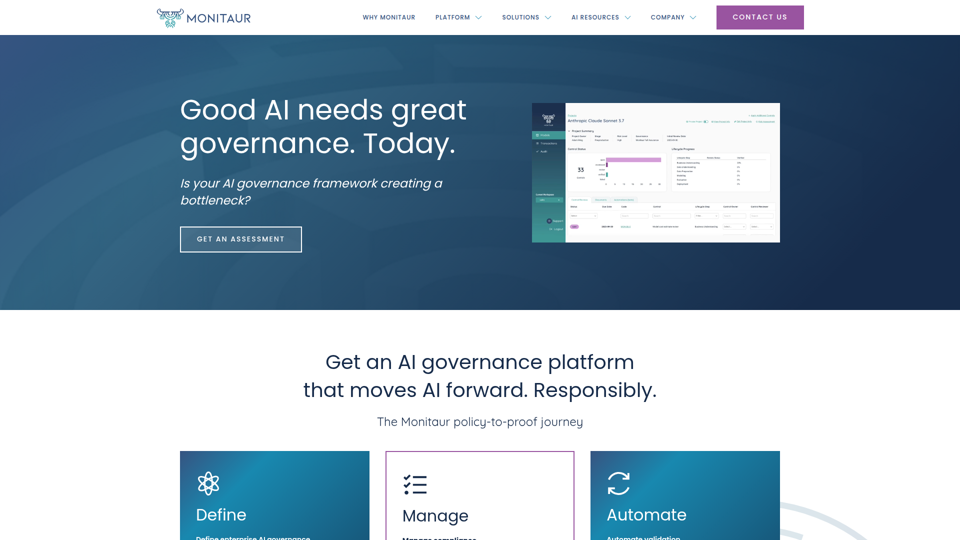
AI Governance software that goes beyond good intentions | Monitaur
Monitaur is an AI governance platform that helps enterprises define policies, manage compliance, monitor model performance, and automate validation across the full AI lifecycle, with a strong focus on regulated industries such as insurance. For risk, compliance, and model governance teams, it can improve AI oversight by centralizing controls, documentation, and performance monitoring for both internal and third-party systems.

Pluto | The Market for Compute
Pluto is a marketplace for compute derivatives that helps users trade, hedge, and price the physical and digital commodities powering artificial intelligence, mainly for participants in AI infrastructure and compute markets. As AI demand grows, it can help trading, procurement, and risk teams manage exposure to compute hardware and related supply constraints more systematically.