
AI-based KYC Reports Created Using Facial Recognition

Rate this Tool
Average Score
Total Votes
Select your score (1-10):
Detail Information
What
Pixalytica is an AI-based identity verification and KYC reporting tool that starts with a person’s photo rather than identity documents. It uses facial recognition to find matching images on publicly available websites, then applies AI analysis to assemble a report with identity signals, risk indicators, and related findings.
The product appears aimed at teams that need fast screening and background checks, including fintech, crypto, insurance, legal, accounting, real estate, casinos, cybersecurity, and corporate service providers. Its positioning is likely as a non-document verification and risk-assessment platform for onboarding, fraud prevention, sanctions and PEP screening, and general due diligence.
Features
- Photo-based identity search — Users can upload an image in the dashboard or send it through the API to start verification without requiring identification documents.
- Facial recognition across public web sources — The system searches for matching faces online to surface image sources and identity-related evidence connected to the person.
- AI-generated KYC report — Pixalytica compiles findings such as profile summary, real names, known associations, and risk scoring into a readable report.
- PEP, sanctions, and criminal-risk screening — Reports may include PEP status, sanction records, suspected criminal activity, white-collar crime records, and fraud-related indicators based on public information.
- Similarity scoring and source visibility — The report includes similarity scores and image sources, which can help reviewers judge match confidence and investigate supporting evidence.
- Developer API for embedded workflows — A REST API supports integration of identity risk scoring, facial analysis, and KYC checks into onboarding systems, dashboards, and internal tools.
Helpful Tips
- Validate legal basis and consent workflows — Because the product uses facial images and public-source intelligence, teams should confirm they have consent or another valid legal basis before operational use.
- Use it as a screening layer, not a sole decision engine — Public web data and AI summaries can accelerate review, but higher-risk decisions should still include human verification and documented escalation steps.
- Test match quality on your real user population — Similarity scores and facial search performance should be evaluated against your own edge cases, such as low-quality images, aliases, and limited online presence.
- Define review policies for adverse findings — Before rollout, decide how your team will handle sanctions hits, criminal mentions, and association-based signals to reduce inconsistent analyst decisions.
- Check API fit with current onboarding architecture — Buyers should verify latency, data handling, hosting preferences, and workflow compatibility, especially if they need region-specific processing or internal case management.
OpenClaw Skills
Within the OpenClaw ecosystem, Pixalytica could likely support skills for identity-risk triage, onboarding review, and investigative workflow orchestration. An OpenClaw agent could take a new applicant photo, request a Pixalytica report, extract key fields such as PEP status, sanctions, similarity score, and associations, then route the case to the right reviewer based on predefined risk rules. The page confirms API availability, but any deeper OpenClaw integration would be a likely use case rather than a confirmed native connection.
This combination could be especially useful in fintech, crypto, gambling, real estate, and corporate services, where analysts often need to convert fragmented public-source signals into structured case decisions. Likely OpenClaw workflows include enhanced due-diligence agents, adverse-media summarizers, false-positive review assistants, and audit-trail generators that turn Pixalytica outputs into consistent internal reasoning steps. In practice, that could reduce manual searching and help compliance or fraud teams focus on exception handling rather than first-pass data gathering.
Embed Code
Share this AI tool on your website or blog by copying and pasting the code below. The embedded widget will automatically update with the latest information.
<iframe src="https://www.aimyflow.com/ai/pixalytica-com/embed" width="100%" height="400" frameborder="0"></iframe>
Explore Similar Tools

SquareGen — LLM-based Credit Scoring
SquareGen is an LLM-based credit scoring platform that helps lenders score applicants with fewer features and explainable risk outputs, mainly for credit risk and underwriting teams in banks and fintechs. For lending professionals, it can improve approval decisions and operational efficiency by adding AI-driven risk rationale and potentially stronger model performance without expanding data collection.

RNWY® | Credit Scores for Crypto Wallets and AI
RNWY is an on-chain trust and identity platform that scores crypto wallets and AI agents, helping users verify ownership history, reputation signals, fraud patterns, and soulbound identity, mainly for people and teams working with AI agents and crypto wallets. For risk, compliance, and ecosystem operators, its explainable scores and public-chain evidence can support faster trust checks without relying on black-box reputation systems.
Document Fraud Detection Software | Resistant AI
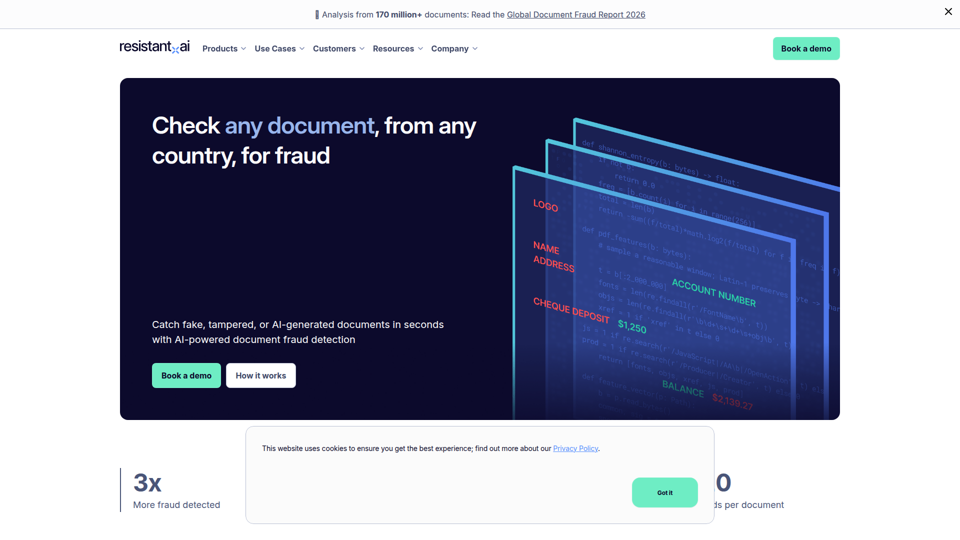
Resistant AI is document fraud detection software that helps fraud and compliance teams verify PDF and image documents, detect fake, tampered, or AI-generated files, and strengthen transaction monitoring across onboarding, underwriting, claims, and AML workflows. As AI-generated documents become harder to spot manually, it can help analysts, underwriters, and investigators reduce reviews and focus attention on higher-risk cases.
TermOver AI - Chrome Web Store
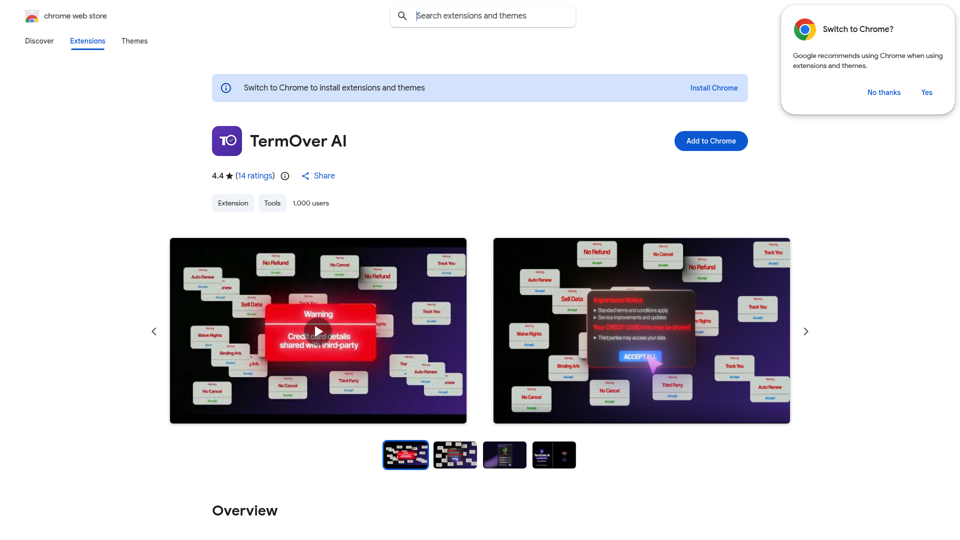
TermOver AI is a Chrome extension that uses AI to analyze Terms of Service and privacy policies, summarize them in plain English, and flag issues like data selling, tracking, or hidden fees for everyday web users who do not want to read legal fine print. In AI-assisted compliance and privacy work, tools like this can help legal operations, privacy, and risk teams review routine web terms faster and focus attention on higher-risk clauses.

OdysseyGPT | Enterprise Document Intelligence Platform
OdysseyGPT is an enterprise document intelligence platform that extracts structured, citation-backed data and answers from documents, then sends it to business systems, mainly for legal, risk, research, finance, HR, and operations teams that need traceable outputs. In AI-assisted document workflows, it helps analysts, reviewers, and administrators work faster while preserving source-level auditability for decisions, approvals, and system updates.
AI Governance software that goes beyond good intentions | Monitaur
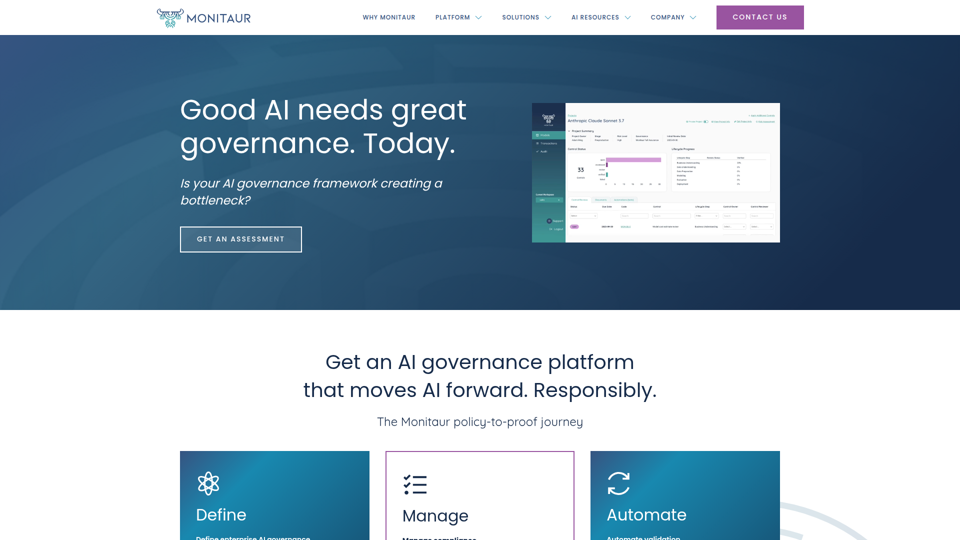
Monitaur is an AI governance platform that helps enterprises define policies, manage compliance, monitor model performance, and automate validation across the full AI lifecycle, with a strong focus on regulated industries such as insurance. For risk, compliance, and model governance teams, it can improve AI oversight by centralizing controls, documentation, and performance monitoring for both internal and third-party systems.

Fernstone Insurance
Fernstone Insurance is an AI-powered insurance brokerage and risk management platform that helps businesses manage coverage, claims, certificates, renewals, and compliance, mainly for fast-moving companies that need commercial insurance support. For operations, finance, and risk teams, its centralized policy data and automated alerts can reduce manual follow-up and help them respond faster to coverage gaps and renewal deadlines.

Pluto | The Market for Compute
Pluto is a marketplace for compute derivatives that helps users trade, hedge, and price the physical and digital commodities powering artificial intelligence, mainly for participants in AI infrastructure and compute markets. As AI demand grows, it can help trading, procurement, and risk teams manage exposure to compute hardware and related supply constraints more systematically.