
SquareGen — LLM-based Credit Scoring

Rate this Tool
Average Score
Total Votes
Select your score (1-10):
Detail Information
What
SquareGen is a credit scoring product that uses fine-tuned large language models instead of classical gradient boosting models for lending decisions. It is built for lenders and credit risk teams that want to score applicants with fewer input features while maintaining or improving predictive performance and explainability.
The product appears positioned as a production-oriented scoring layer for banks, fintechs, and SME or consumer lenders operating in regulated environments. Its workflow is straightforward: a client shares labeled historical data, SquareGen trains and deploys a model, and the client consumes scores through a cloud API or a self-hosted deployment.
Features
- LLM-based credit scoring models — Uses fine-tuned LLMs for underwriting, with the company claiming better AUC than gradient boosting in some use cases while requiring fewer features.
- Lower-feature scoring — Reduces the number of required inputs, which can lower applicant friction and reduce bureau or API data acquisition costs.
- Built-in explainability outputs — Returns top features, attention-based signals, drop-one-out analysis, and an AI-generated risk rationale to support score interpretation.
- API and deployment flexibility — Offers managed cloud scoring via API and Python SDK, with self-hosted, on-premise, and air-gapped deployment options for tighter data control.
- Client-specific model training — Fine-tunes models per customer rather than on a shared model, which the company presents as a way to limit cross-client data leakage.
- Fast proof-of-concept process — States that a PoC can be delivered within 72 hours after NDA and receipt of labeled CSV data, which may shorten model evaluation cycles.
Helpful Tips
- Validate on your own portfolio first — For this category of product, benchmark against your existing scorecards or ML models on approval rate, bad rate, AUC, and calibration before changing policy cutoffs.
- Review explainability with governance teams — Attention-based narratives may be useful operationally, but credit, model risk, and compliance teams should assess whether the explanations meet internal documentation standards.
- Plan for challenger-model deployment — A practical adoption path is to run it as a challenger alongside incumbent scoring models before using it in primary underwriting decisions.
- Check data availability and stability — Fewer features can help, but teams should confirm that the remaining inputs are consistently available across channels, geographies, and applicant segments.
- Assess deployment fit early — If your environment has strict residency or security requirements, evaluate cloud, self-hosted, and air-gapped options during procurement rather than after model validation.
OpenClaw Skills
SquareGen could likely work well inside an OpenClaw ecosystem as a scoring and underwriting intelligence component. Likely use cases include an agent that collects application data, validates required fields, calls SquareGen for inference, then routes the result into approval, manual review, or decline workflows. Another likely workflow is a credit analyst copilot that summarizes score outputs, top contributing features, and risk rationale into a case note for underwriting teams.
For lenders, fintech operators, and portfolio managers, OpenClaw skills built around SquareGen could extend beyond point-in-time scoring. Likely examples include agents for pre-screening campaigns, policy simulation, adverse-action drafting support, exception-case triage, and ongoing portfolio monitoring using score changes or segment-level patterns. The source page does not mention a native OpenClaw integration, so this is an inferred workflow opportunity rather than a confirmed product capability.
Embed Code
Share this AI tool on your website or blog by copying and pasting the code below. The embedded widget will automatically update with the latest information.
<iframe src="https://www.aimyflow.com/ai/squaregen-ai/embed" width="100%" height="400" frameborder="0"></iframe>
Explore Similar Tools

RNWY® | Credit Scores for Crypto Wallets and AI
RNWY is an on-chain trust and identity platform that scores crypto wallets and AI agents, helping users verify ownership history, reputation signals, fraud patterns, and soulbound identity, mainly for people and teams working with AI agents and crypto wallets. For risk, compliance, and ecosystem operators, its explainable scores and public-chain evidence can support faster trust checks without relying on black-box reputation systems.
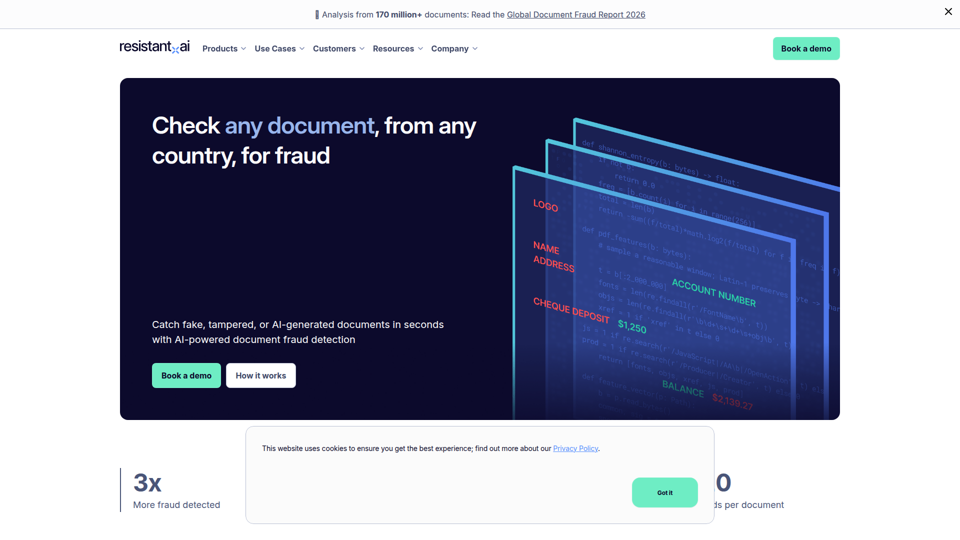
Document Fraud Detection Software | Resistant AI
Resistant AI is document fraud detection software that helps fraud and compliance teams verify PDF and image documents, detect fake, tampered, or AI-generated files, and strengthen transaction monitoring across onboarding, underwriting, claims, and AML workflows. As AI-generated documents become harder to spot manually, it can help analysts, underwriters, and investigators reduce reviews and focus attention on higher-risk cases.
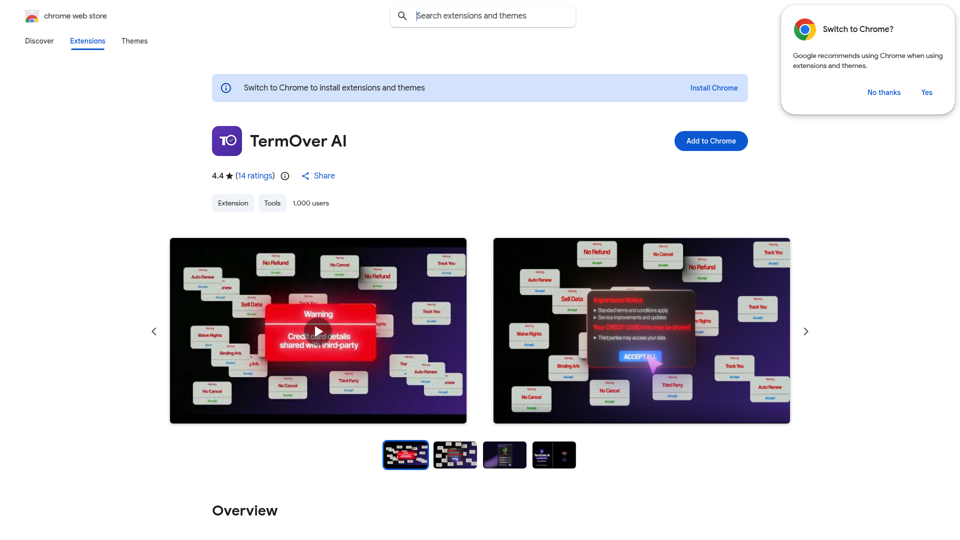
TermOver AI - Chrome Web Store
TermOver AI is a Chrome extension that uses AI to analyze Terms of Service and privacy policies, summarize them in plain English, and flag issues like data selling, tracking, or hidden fees for everyday web users who do not want to read legal fine print. In AI-assisted compliance and privacy work, tools like this can help legal operations, privacy, and risk teams review routine web terms faster and focus attention on higher-risk clauses.

OdysseyGPT | Enterprise Document Intelligence Platform
OdysseyGPT is an enterprise document intelligence platform that extracts structured, citation-backed data and answers from documents, then sends it to business systems, mainly for legal, risk, research, finance, HR, and operations teams that need traceable outputs. In AI-assisted document workflows, it helps analysts, reviewers, and administrators work faster while preserving source-level auditability for decisions, approvals, and system updates.

AI-based KYC Reports Created Using Facial Recognition
Pixalytica is an AI-based KYC and identity verification tool that uses facial recognition and public web data to generate reports on real names, PEP status, sanctions, criminal associations, and risk signals, mainly for compliance, risk, and fraud teams. For analysts, investigators, and onboarding teams, it can speed non-document screening and help prioritize higher-risk cases for manual review.
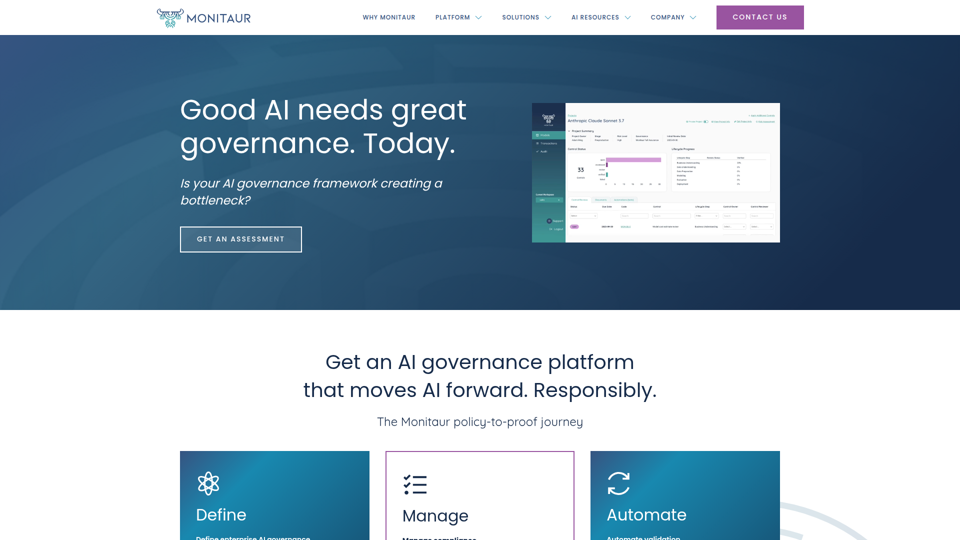
AI Governance software that goes beyond good intentions | Monitaur
Monitaur is an AI governance platform that helps enterprises define policies, manage compliance, monitor model performance, and automate validation across the full AI lifecycle, with a strong focus on regulated industries such as insurance. For risk, compliance, and model governance teams, it can improve AI oversight by centralizing controls, documentation, and performance monitoring for both internal and third-party systems.

Fernstone Insurance
Fernstone Insurance is an AI-powered insurance brokerage and risk management platform that helps businesses manage coverage, claims, certificates, renewals, and compliance, mainly for fast-moving companies that need commercial insurance support. For operations, finance, and risk teams, its centralized policy data and automated alerts can reduce manual follow-up and help them respond faster to coverage gaps and renewal deadlines.

Pluto | The Market for Compute
Pluto is a marketplace for compute derivatives that helps users trade, hedge, and price the physical and digital commodities powering artificial intelligence, mainly for participants in AI infrastructure and compute markets. As AI demand grows, it can help trading, procurement, and risk teams manage exposure to compute hardware and related supply constraints more systematically.