
DeepSim
Rate this Tool
Average Score
Total Votes
Select your score (1-10):
Detail Information
What
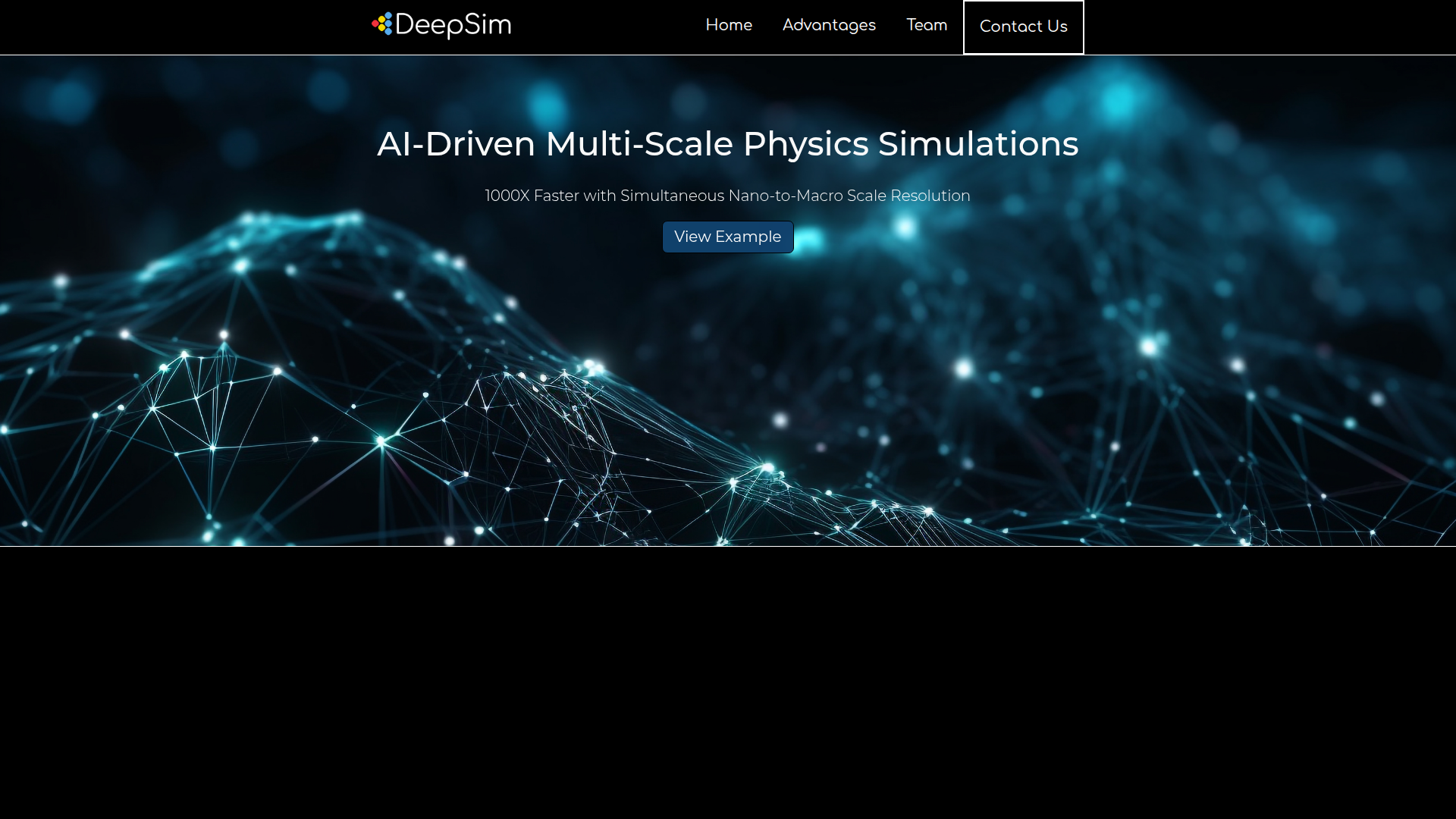
DeepSim is an AI-driven physics simulation platform focused on multi-scale modeling, with an emphasis on resolving behavior from nano to macro scales in the same workflow. The product appears designed for engineers who need faster design insight without spending as much time on complex simulation setup.
Based on the page, DeepSim’s positioning is likely an advanced engineering simulation tool that combines automation and GPU acceleration to improve productivity and scale. Its stated value is helping engineering teams evaluate detailed product designs more quickly while maintaining simulation fidelity across much larger problem sizes than conventional tools.
Features
- AI-driven multi-scale simulation — Supports simultaneous nano-to-macro scale resolution, which is useful for products where performance depends on interactions across very different physical scales.
- Automated simulation setup — Reduces labor-intensive preparation work so engineers can spend more time on analysis and design decisions rather than model configuration.
- GPU-accelerated simulation pipeline — Uses a custom GPU-based approach to improve simulation speed and make larger, more detailed studies more practical.
- Large-scale model handling — The company states it can handle simulations 1000X larger than current tools, indicating a focus on unusually demanding engineering workloads.
- Rapid design insight workflow — The platform is presented as easy to use, with the goal of speeding up iteration and shortening the path from concept to engineering feedback.
Helpful Tips
- Validate the target physics domain early — The page describes multi-scale physics broadly, so buyers should confirm which specific simulation types and material or product classes are supported in production use.
- Test setup automation on a real internal use case — Since workflow simplification is a key claim, a pilot should measure how much expert time is actually saved during model preparation and iteration.
- Assess GPU infrastructure requirements — The product emphasizes a custom GPU-accelerated pipeline, so implementation planning should include hardware availability, deployment model, and performance expectations.
- Compare scale claims with decision quality — A larger simulation is only valuable if it improves design decisions, so evaluation should focus on whether higher-resolution models change engineering outcomes in meaningful ways.
- Clarify integration with existing CAE processes — The source page does not describe interoperability, so teams should verify how results, data inputs, and review steps fit into their established engineering toolchain.
OpenClaw Skills
DeepSim could likely fit well into an OpenClaw environment through skills that orchestrate simulation requests, summarize output, and route findings into engineering workflows. A likely use case would be an OpenClaw agent that takes design parameters from product teams, prepares standardized simulation runs, compares scenario outputs, and generates structured decision briefs for mechanical, materials, or device engineers. The page does not mention a native integration, so this should be treated as a workflow inference rather than a confirmed capability.
In practice, this combination could be especially useful in R&D-heavy industries where engineers need to move from design changes to simulation-backed recommendations quickly. OpenClaw skills could likely help by automating experiment tracking, extracting recurring failure patterns, and coordinating handoffs between simulation specialists and broader engineering teams. That would make DeepSim not just a solver in the loop, but part of a larger agent-driven design review system that improves how organizations use simulation insight at scale.
Embed Code
Share this AI tool on your website or blog by copying and pasting the code below. The embedded widget will automatically update with the latest information.
<iframe src="https://www.aimyflow.com/ai/deepsim-io/embed" width="100%" height="400" frameborder="0"></iframe>
Explore Similar Tools
MOVE. | Agents for Hardware Engineering
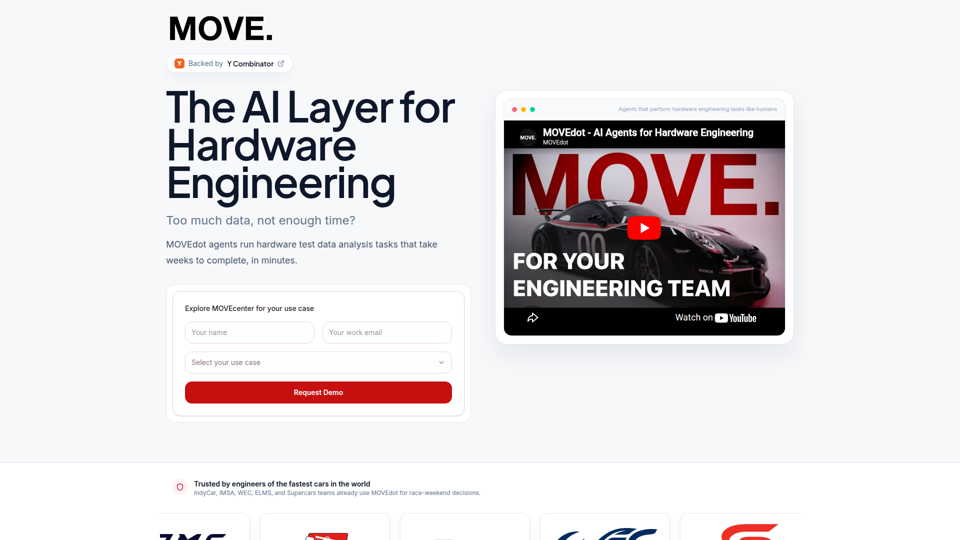
MOVE. is an AI agent platform for hardware engineering teams that analyzes hardware test data, surfaces anomalies and correlations, and turns raw telemetry, sensor logs, and related inputs into reports and answers faster. For hardware engineers, race engineers, and R&D teams, it can reduce manual data review so they can focus more on diagnosing issues, improving performance, and making engineering decisions.
Topological
Topological is a physics-based AI platform for CAD optimization that helps hardware and mechanical engineering teams generate and refine designs for complex physical problems while accounting for geometry, manufacturability, and physical constraints. For mechanical engineers and computational design teams, this can shorten design iteration cycles and support faster, more informed optimization in AI-assisted engineering workflows.
Adam - AI Powered CAD
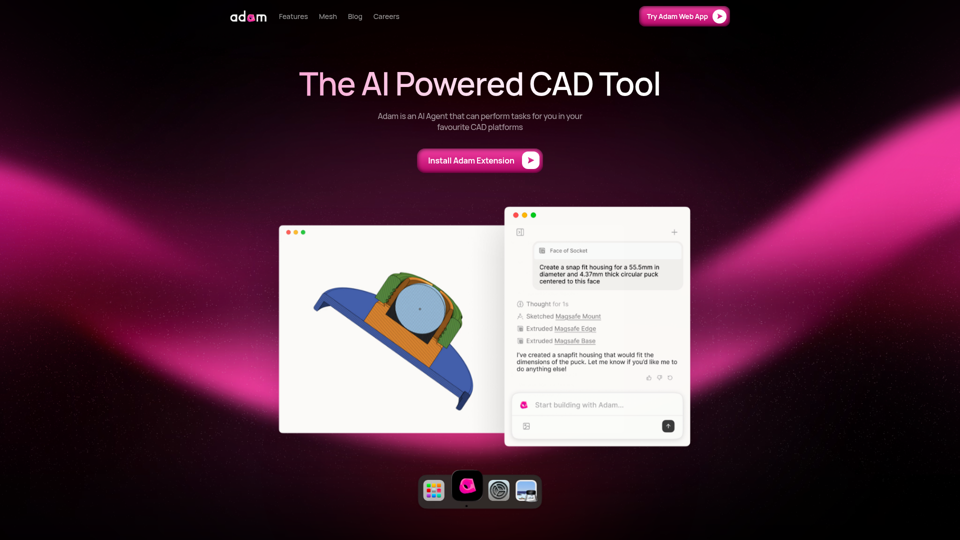
Adam is an AI-powered CAD agent that helps mechanical engineers build and edit hardware faster in their preferred CAD platforms using prompts for part editing, selection-based feature creation, feature tree optimization, and parametrization. For engineering and CAD workflows, it can reduce repetitive clicks and help turn ad hoc models into more structured, reusable designs.
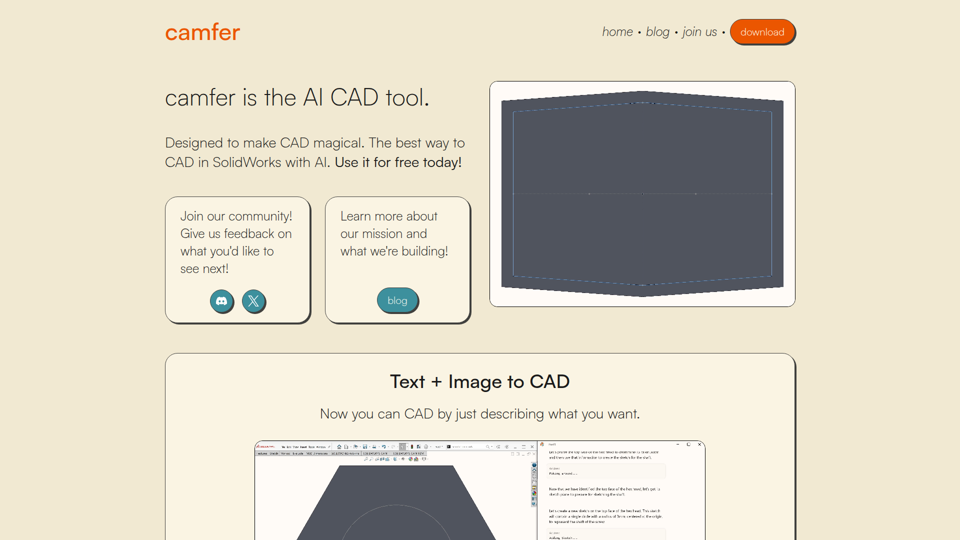
camfer - the AI CAD tool
Camfer is an AI CAD tool for SolidWorks that helps users create and understand CAD designs from text or images and retrieve feature-tree information, mainly for mechanical engineers. For engineering and CAD teams, this can reduce manual navigation in design software and speed up routine design tasks through natural-language interaction.
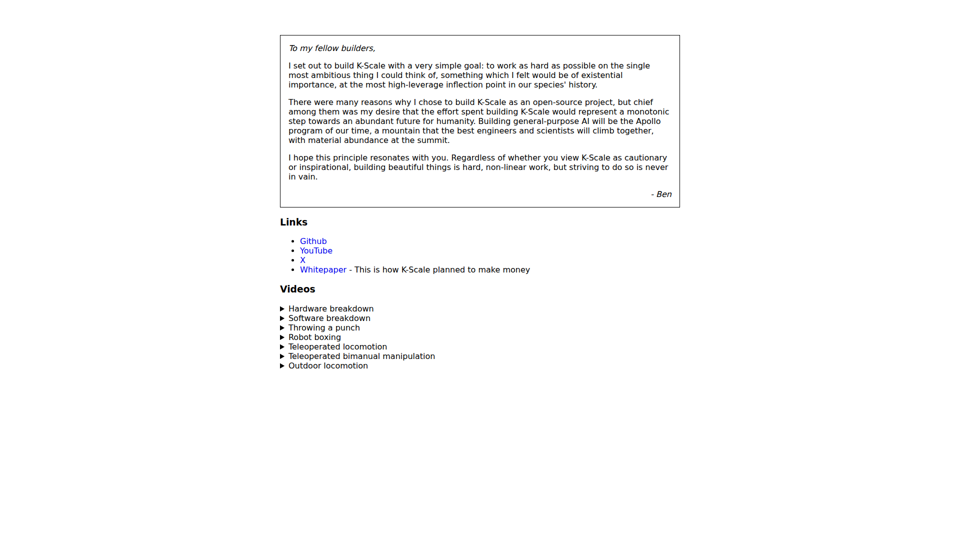
K-Scale Labs
K-Scale Labs is an open-source AI and robotics project focused on building general-purpose AI and related hardware and software, mainly for engineers, scientists, and technical builders. For AI and robotics teams, its open development model and public hardware and software breakdowns can support faster research, prototyping, and collaboration on embodied systems.
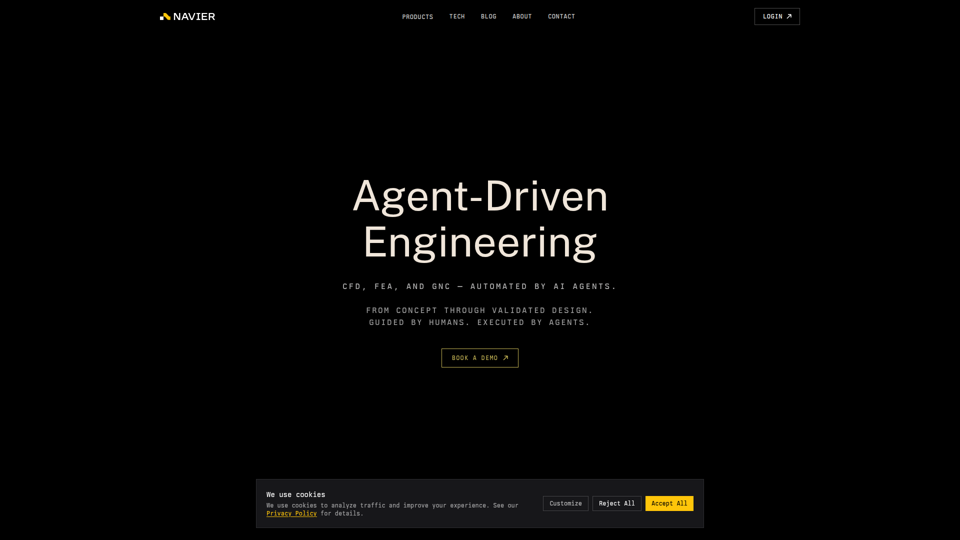
Navier AI
Navier AI is an agent-driven engineering platform that automates CAD, CFD, FEA, meshing, simulation, and GNC workflows from concept through validated design, mainly for engineers and technical teams running simulation-heavy design processes. In AI-enabled engineering work, it can help simulation, aerospace, and mechanical professionals spend less time on setup and execution loops so they can focus on evaluating results and making final design decisions.
Tuesday Lab
Tuesday Lab is an engineering studio focused on building “delightful robots,” aimed mainly at teams and organizations seeking custom robotics engineering expertise. In an AI-driven workflow, this kind of robotics engineering support can help robotics and product engineering professionals move from model and software concepts to reliable physical systems faster.