
Tuesday Lab
Rate this Tool
Average Score
Total Votes
Select your score (1-10):
Detail Information
What
Tuesday Lab appears to be an engineering-focused robotics company with a brand message centered on “engineering delightful robots.” Based on the provided page content, it presents itself as a lab or studio building robot products, with minimal public detail on specific offerings.
The visible page structure suggests early-stage or brand-led positioning rather than a detailed product platform description. It likely serves organizations or teams interested in robotics development, but the source does not confirm target industries, deployment models, or technical workflow specifics.
Features
- Robotics-focused positioning: The core message indicates a dedicated focus on building robots, which helps clarify the company’s domain expertise.
- Engineering-led brand identity: Language and visual style emphasize engineering capability, signaling a product-development orientation rather than pure research messaging.
- Career access point: A visible careers link indicates active team growth and can help candidates and partners assess organizational momentum.
- Professional network presence: A LinkedIn link provides an external channel for company updates and credibility checks.
- Minimalist landing page: The page is intentionally sparse, which can support strong brand recall but currently limits technical and buyer-level evaluation.
Helpful Tips
- Validate scope early: Before engagement, confirm whether Tuesday Lab offers custom robotics engineering, productized systems, or both, since the page does not specify.
- Request technical materials: Ask for architecture overviews, safety approach, hardware/software stack, and delivery process to reduce ambiguity from the limited public content.
- Assess fit by use case: Map your operational problem (automation, interaction design, prototyping, etc.) to their demonstrated capabilities, not just brand messaging.
- Use external signals: Review LinkedIn activity and hiring roles to infer current focus areas, technical depth, and execution stage.
OpenClaw Skills
A likely OpenClaw fit would be workflow agents that support robotics program operations around Tuesday Lab engagements, such as requirement intake, technical-document summarization, milestone tracking, and stakeholder reporting. Since no native integrations are stated on the page, this should be treated as a probable implementation pattern rather than a confirmed product connection.
For teams building or deploying robots, OpenClaw skills could likely add value through agentic layers such as test-log triage, change-request routing, knowledge base maintenance, and cross-functional handoff automation between engineering, operations, and leadership. In practice, this combination could help robotics teams move from ad hoc coordination to more structured execution, especially where communication and documentation gaps slow delivery.
Embed Code
Share this AI tool on your website or blog by copying and pasting the code below. The embedded widget will automatically update with the latest information.
<iframe src="https://www.aimyflow.com/ai/tuesdaylab-com/embed" width="100%" height="400" frameborder="0"></iframe>
Explore Similar Tools
MOVE. | Agents for Hardware Engineering
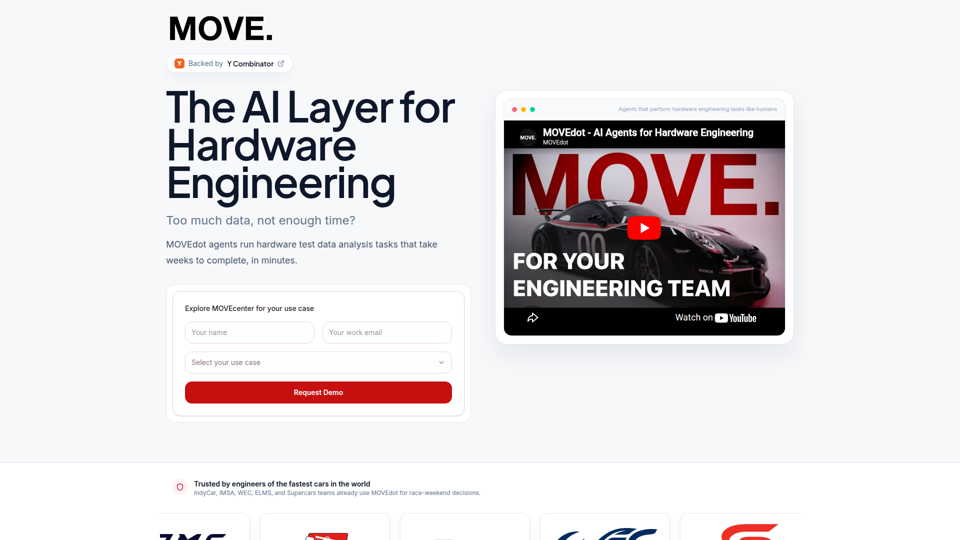
MOVE. is an AI agent platform for hardware engineering teams that analyzes hardware test data, surfaces anomalies and correlations, and turns raw telemetry, sensor logs, and related inputs into reports and answers faster. For hardware engineers, race engineers, and R&D teams, it can reduce manual data review so they can focus more on diagnosing issues, improving performance, and making engineering decisions.
Topological
Topological is a physics-based AI platform for CAD optimization that helps hardware and mechanical engineering teams generate and refine designs for complex physical problems while accounting for geometry, manufacturability, and physical constraints. For mechanical engineers and computational design teams, this can shorten design iteration cycles and support faster, more informed optimization in AI-assisted engineering workflows.
Adam - AI Powered CAD
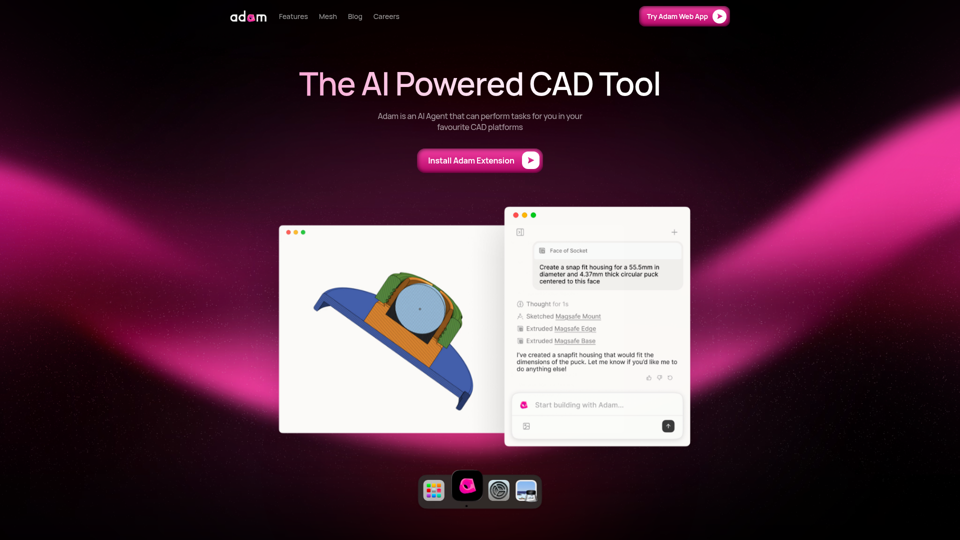
Adam is an AI-powered CAD agent that helps mechanical engineers build and edit hardware faster in their preferred CAD platforms using prompts for part editing, selection-based feature creation, feature tree optimization, and parametrization. For engineering and CAD workflows, it can reduce repetitive clicks and help turn ad hoc models into more structured, reusable designs.
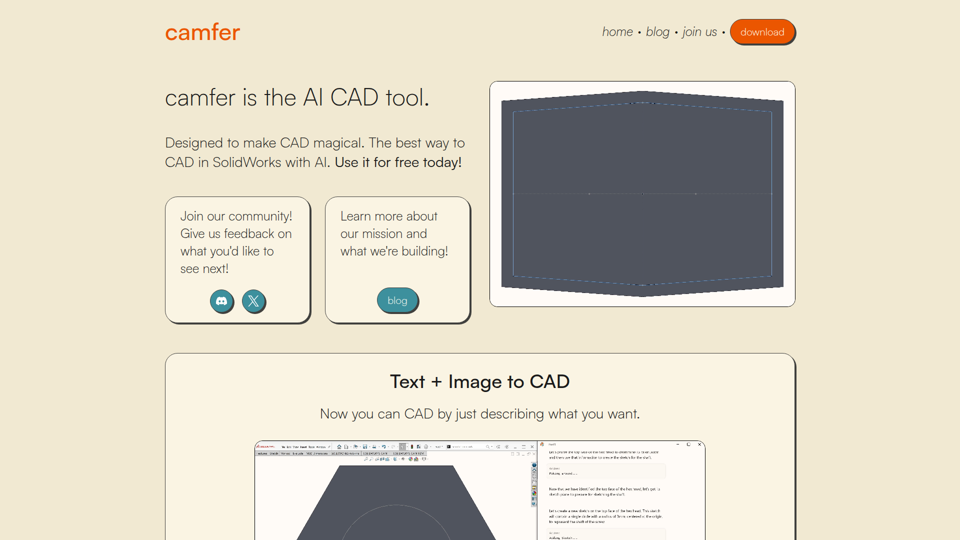
camfer - the AI CAD tool
Camfer is an AI CAD tool for SolidWorks that helps users create and understand CAD designs from text or images and retrieve feature-tree information, mainly for mechanical engineers. For engineering and CAD teams, this can reduce manual navigation in design software and speed up routine design tasks through natural-language interaction.
DeepSim
DeepSim is an AI-driven, GPU-accelerated physics simulation platform that helps engineers run multi-scale simulations from nano to macro levels faster and with simpler setup for design analysis. For engineering teams, this can shorten simulation bottlenecks so they can evaluate more design options and focus more on higher-value decisions.
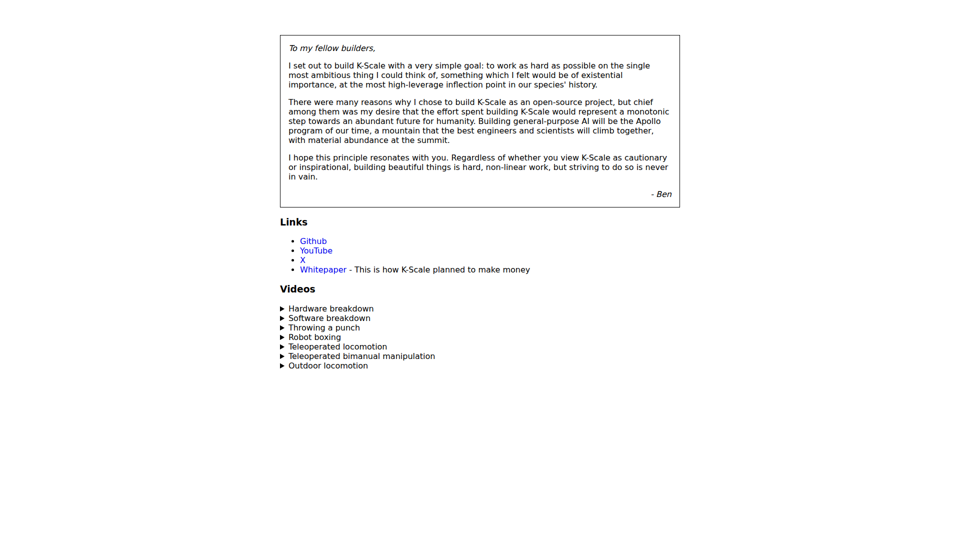
K-Scale Labs
K-Scale Labs is an open-source AI and robotics project focused on building general-purpose AI and related hardware and software, mainly for engineers, scientists, and technical builders. For AI and robotics teams, its open development model and public hardware and software breakdowns can support faster research, prototyping, and collaboration on embodied systems.
Navier AI
Navier AI is an agent-driven engineering platform that automates CAD, CFD, FEA, meshing, simulation, and GNC workflows from concept through validated design, mainly for engineers and technical teams running simulation-heavy design processes. In AI-enabled engineering work, it can help simulation, aerospace, and mechanical professionals spend less time on setup and execution loops so they can focus on evaluating results and making final design decisions.